
PED 2014/68/EU
UPDATES
EU
17 Nov 2026
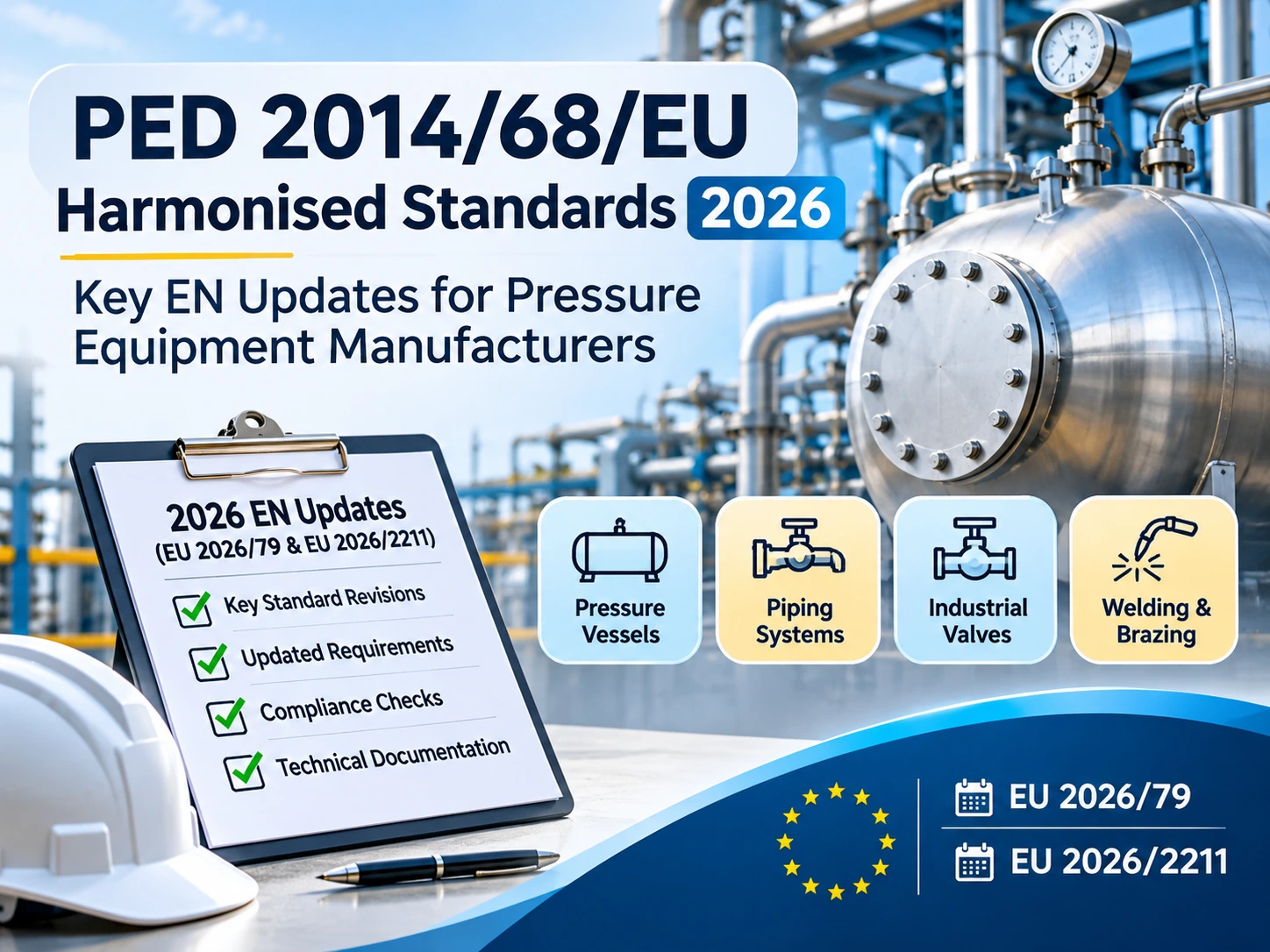
PED 2014/68/EU Harmonised Standards 2026: Key EN Updates for Pressure Equipment Manufacturers
By Editorial Team
Table Of Contents
- What Are Harmonised Standards Under PED 2014/68/EU?
- Overview of the 2026 PED Harmonised Standards Updates
- Key EN Standard Updates Introduced in 2026
- What Manufacturers Should Know About the Transition Period
- How the 2026 Updates Affect Pressure Equipment Manufacturers
- PED 2014/68/EU Manufacturer Compliance Checklist
- Practical Steps for Reviewing PED Standard Updates
- PED Standards Update Review Flow
- Where to Verify the Latest PED Harmonised Standards List
- Conclusion
Related Blogs
NOV
07
PED Piping Compliance: Design, Classification and Inspection Requirements for Industrial Piping
OCT
17
PED 2014/68/EU Harmonised Standards 2026: Key EN Updates for Pressure Equipment Manufacturers
SEP
11
What Are the Latest PED 2014/68/EU Pressure Vessel Regulations, Design Standards, Safety Factors and Certification Requirements in 2026 for Indian and Global Manufacturers?
SEP
10
ASME Section VIII vs EN 13445 for PED 2014/68/EU: CE Marking Requirements for Indian Manufacturers in 2026
Adherence to harmonised European standards constitutes a fundamental prerequisite for establishing conformity with the Pressure Equipment Directive (PED) 2014/68/EU. Producers of pressure vessels, piping systems, and associated apparatus are mandated to employ the specific, applicable edition of these standards to ensure regulatory compliance. In 2026, the European Commission amended the official list of harmonised standards through two distinct legislative instruments: EU 2026/79 and EU 2026/2211, which collectively address diverse sectors of manufacturing. This analysis delineates the pivotal revisions introduced to the PED 2014/68/EU framework via these 2026 updates and underscores the critical verification steps manufacturers must undertake when auditing their technical documentation.
What Are Harmonised Standards Under PED 2014/68/EU?
Harmonised standards, formulated by accredited standardisation bodies on behalf of the European Commission and disseminated via the Official Journal of the European Union (OJEU), serve a pivotal role in regulatory compliance. Pursuant to Article 12 of Directive 2014/68/EU (PED), pressure equipment that adheres to these standards benefits from a presumption of conformity with the Directive’s essential safety requirements. Nevertheless, adherence to such standards does not automatically ensure compliance with the entirety of the PED’s stipulations; manufacturers remain obligated to conduct a comprehensive evaluation of their equipment against all relevant Directive requirements. Consequently, it is imperative to distinguish between the most recent edition of a standard and the specific version cited in the OJEU, meticulously verifying associated references and limitations prior to any conformity assessment.
Overview of the 2026 PED Harmonised Standards Updates
The 2026 amendments update the consolidated list established by Commission Implementing Decision (EU) 2025/165.
| Implementing Decision | Publication Date | Main Areas Covered |
|---|---|---|
| (EU) 2026/79 | 13 January 2026 | Steel tubes, pipe fittings, copper alloys, unfired pressure vessels, flanges, industrial valves and safety devices |
| (EU) 2026/2211 | 2 October 2026 | Pipe fittings, aluminium products, shell boilers, refrigeration systems, LPG equipment, cryogenic vessels, welding and brazing |
These resolutions update the current inventory of harmonized standards without supplanting Directive 2014/68/EU (PED).
Key EN Standard Updates Introduced in 2026
3.1 Updates under Commission Implementing Decision (EU) 2026/79
The January 2026 amendment incorporated revised stipulations alongside new provisions specifically addressing components and materials utilized in pressure equipment.
Some important entries include:
| Standard Reference | Subject | Manufacturer Review Area |
|---|---|---|
| EN 1591-1:2024 | Design rules for gasketed circular flange connections | Flange connection calculations |
| EN 10216-2:2024 | Seamless steel tubes for pressure purposes | Material specifications and elevated-temperature properties |
| EN 10253-4:2025 | Butt-welding pipe fittings in stainless and duplex steels | Fitting specifications and inspection requirements |
| EN 12420:2024 | Copper and copper alloy forgings | Material procurement and verification |
| EN 12735-2:2024 | Copper tubes for air-conditioning and refrigeration equipment | Tubing specifications |
| EN 13445-5:2021+A1:2024 | Unfired pressure vessels: inspection and testing | Inspection and test documentation |
| EN 16668:2025 | Metallic industrial valves used as pressure accessories | Valve requirements and testing |
The proposed amendment encompasses copper-based products, titanium vessels, and safety apparatus, thereby mandating that manufacturers meticulously scrutinize technical specifications, perform requisite calculations, adhere to rigorous inspection protocols, and maintain comprehensive records of all components.
3.2 Updates under Commission Implementing Decision (EU) 2026/2211
Amended in October 2026, the revised standards govern pressure equipment encompassing shell boilers, refrigeration systems, LPG and cryogenic vessels, as well as welding specifications.
| Standard Reference | Subject | Manufacturer Review Area |
|---|---|---|
| EN 10253-2:2021+A1:2025 | Butt-welding pipe fittings made from non-alloy and ferritic alloy steels | Piping component specifications |
| EN 12392:2025 | Aluminium products intended for pressure equipment | Material selection and product verification |
| EN 12953-2:2025 | Shell boiler materials | Boiler pressure-part materials |
| EN 12953-6:2024 | Shell boiler equipment | Boiler equipment and safety provisions |
| EN 12953-9:2024 | Shell boiler limiting devices | Limiting and protective devices |
| EN ISO 17779:2025 | Brazing procedure specification and qualification | Brazing procedure records |
| EN ISO 24664:2024 | Pressure relief devices for refrigeration systems and heat pumps | Relief device calculations |
| EN ISO 13585:2024 | Qualification testing of brazers and brazing operators | Personnel qualification |
| EN ISO 15613:2025 | Welding procedure qualification based on pre-production testing | Welding procedure records |
| EN ISO 15614-5:2024 | Welding procedure qualification for titanium and titanium alloys | Procedure qualification |
| EN ISO 15614-11:2025 | Welding procedure qualification for electron and laser beam welding | Special process qualification |
| EN ISO 14732:2025 | Qualification of welding operators and weld setters | Personnel qualification records |
EN 12953-6:2024 incorporates specific limitations, noting that certain clauses and Annex F do not presuppose conformity with the safety mandates of the Pressure Equipment Directive (PED); consequently, manufacturers must scrutinize these constraints with due diligence when implementing the standard.
What Manufacturers Should Know About the Transition Period
Following the revision of a harmonised standard, its predecessor may remain accessible during a designated transitionary phase to facilitate manufacturer adaptation. Decision (EU) 2026/2211 stipulates that the withdrawal of certain superseded standards shall be deferred until 2 April 2028; however, this provision applies exclusively to the specified standards in question and does not constitute a universal extension across all Pressure Equipment Directive (PED) standards. Consequently, manufacturers are obligated to ascertain the precise applicability and current status of each individual standard while maintaining a comprehensive register. This register must meticulously document the active reference, the most recent edition, the publication status within the Official Journal of the European Union (OJEU), any imposed restrictions, the pertinent withdrawal date, and the specific equipment or documentation impacted.
How the 2026 Updates Affect Pressure Equipment Manufacturers
These modifications may impact various phases of the manufacturing process for pressure equipment, as well as the procedures governing conformity assessment.
Design and engineering
Design teams must ascertain whether amended standards exert any impact on pressure vessel computations, piping constituents, flange assemblies, pressure relief apparatus, or boiler installations. Furthermore, all design calculations and specifications must explicitly reference the appropriate edition of the governing standard.
Material selection and traceability
Material specifications, purchase orders, and inspection records must be meticulously cross-referenced with relevant material standards to ensure compliance. Furthermore, material identification, traceability, and inspection documentation must be maintained with rigorous consistency throughout the entire production cycle.
Welding and brazing
The updated guidelines concerning welding and brazing protocols necessitate a rigorous re-examination of procedure qualification records alongside personnel credentials. Manufacturers are obligated to ascertain the continued applicability of existing welding procedure specifications (WPS), welding procedure qualification records (WPQR), and operator certifications to both the current production methodologies and the specific material configurations in use.
Inspection and testing
Inspection protocols, testing methodologies, and acceptance criteria must be rigorously cross-referenced against the pertinent editions of applicable standards. This scrutiny is of paramount importance when evaluating pressure vessels, boiler systems, and safety mechanisms.
Technical documentation
The technical documentation must explicitly align with the specific standards and editions applicable at the stages of design, manufacturing, and conformity assessment. Should a revision to a standard necessitate modifications to the equipment, the manufacturer is required to document the evaluation process and any consequent alterations.
PED 2014/68/EU Manufacturer Compliance Checklist
Use the following checklist when reviewing the impact of the 2026 amendments.
| Review Area | What to Verify |
|---|---|
| Standards Register | Confirm the current standard edition and OJEU status |
| Design Calculations | Review applicable design and calculation references |
| Material Records | Check material grades specifications and traceability |
| Welding Documentation | Review WPS WPQR and relevant qualification records |
| Brazing Documentation | Check procedure and operator qualification records |
| Inspection and Testing | Review inspection plans and test procedures |
| Safety Devices | Verify applicable requirements and standard restrictions |
| Technical File | Update references records and assessment evidence |
| Transition Dates | Record applicable withdrawal dates for superseded references |
Practical Steps for Reviewing PED Standard Updates
Manufacturers may adopt the following sequential procedure to evaluate the implications of a revised harmonised standard.
- Compile the pertinent EN standards specified within the equipment’s design and manufacturing documentation.
- Verify the Official Journal of the European Union (OJEU) by cross-referencing each citation against the most recent publication from the European Commission.
- Catalogue newly issued, modified, superseded, or restricted citations.
- Evaluate the technical implications by scrutinizing potential repercussions on design specifications, material selection, welding procedures, and inspection or testing protocols.
- Amend controlled documentation as necessary, including specifications, operational procedures, inspection protocols, and technical records.
- Maintain documentation of the evaluation to substantiate the findings, the conclusions reached, and the remedial measures implemented.
PED Standards Update Review Flow
This methodology is applicable when conducting an internal compliance audit.
Standards register → OJEU status check → Revision and restriction review → Technical impact assessment → Document updates → Final compliance record
The adoption of a revised standard solely on the basis of its more recent publication date is untenable; prior to such acceptance, a rigorous evaluation of its harmonisation status, as well as its defined scope and limitations, must be conducted.
Where to Verify the Latest PED Harmonised Standards List
The European Commission’s portal for pressure equipment functions as the definitive repository for harmonized standards mandated under Directive 2014/68/EU (PED). This resource consolidates the foundational decision, subsequent amendments, and a comprehensive inventory of standard references, the latter serving an informational capacity devoid of legal force. Prior to invoking a standard for conformity assessment, manufacturers are obligated to rigorously verify its official designation, confirm its publication in the Official Journal of the European Union, ascertain the date of applicability, identify any retracted references, evaluate newly imposed restrictions, and ensure alignment with all pertinent essential safety requirements.
Conclusion
The 2026 amendments to Directive 2014/68/EU regarding Pressure Equipment necessitate a comprehensive revision of the harmonised EN standards applicable to pressure vessels, piping systems, boiler apparatus, and related components. Manufacturers are required to meticulously validate the Official Journal of the European Union (OJEU) status, implementation deadlines, scope of application, and any associated limitations for each standard. This rigorous verification process, underpinned by a controlled standards register and scheduled periodic reviews, is essential to maintain regulatory compliance and to effectively identify all equipment subject to these modifications.
Related Searches
- How to Select a Notified Body for PED Certification Globally: 10 Things Manufacturers Should Check
- How ISO 9712-Certified NDT Personnel Support EN 15085, EN 1090 and PED Compliance
- How Bhutanese Pressure Equipment Manufacturers Can Prepare Material Traceability Records for PED Compliance
- PED Certification for Pressure Equipment Manufacturers: How to Achieve CE Marking Under EU Requirements from India?
- When Is an EN 10204 Type 3.2 Certificate Required for PED Pressure Equipment Globally?