
Related Blogs
AUG
22
ISO 9606‑1 vs ISO 14732: Welder vs Welding Operator Qualification
AUG
22
How to Read an ISO 9606-1 Welder Qualification Certificate: A Field-by-Field Guide
AUG
22
ISO 9606-1 Welder Qualification Test: What Happens During the Certification Process?
See Also.....
Certification Alerts
- EN ISO 3834-4 transition deadline: 31 Dec 2024
- NABCB accreditation renewal — Updated requirements
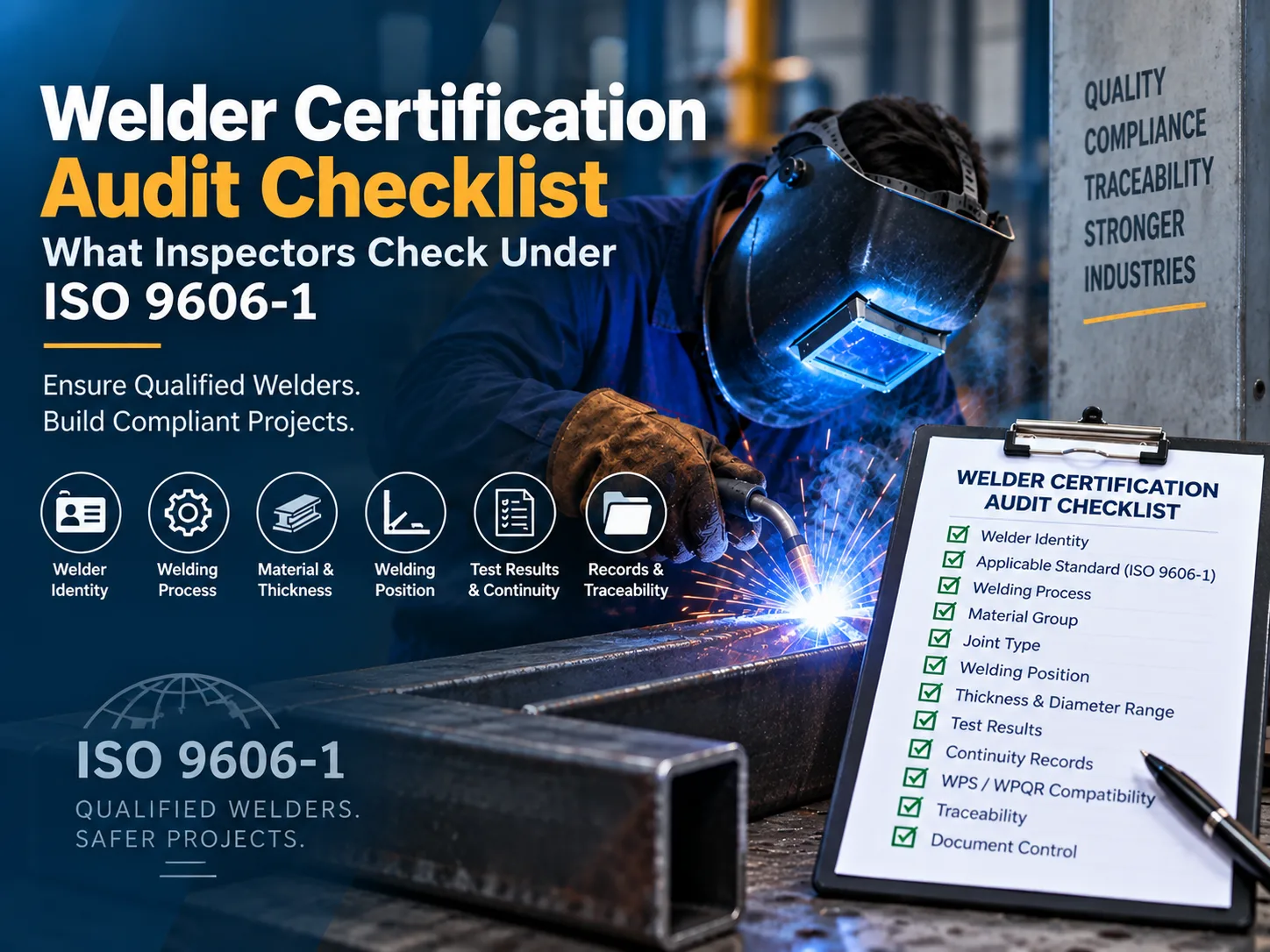
WELDER CERTIFICATION
ISO 9606-1
INSPECTORS GUIDE
19 Sep 2026
Welder Certification Audit Checklist: What Inspectors Check Under ISO 9606-1
By Editorial Team
A welder’s certificate alone does not establish that the person is qualified for every welding job. During a welder certification audit, inspectors verify the qualification record, test conditions, qualified range, continuity and supporting welding documentation.
ISO 9606-1:2012 specifies requirements for qualification testing of welders performing fusion welding of steels. The standard is intended to provide a systematic qualification framework based on the welder’s ability to manually produce an acceptable weld. It applies to manual and partly mechanized welding processes, not fully automated welding.
For manufacturers working under ISO 3834, EN 1090, pressure-equipment or other welding-quality requirements, maintaining accurate welder qualification records is therefore an important part of production quality control.
What Is a Welder Certification Audit?
A welder certification audit is a systematic review of a welder’s qualification documents and related welding records to determine whether the qualification is appropriate, current and traceable for the intended production work.
An inspector may verify:
- Welder identification
- Applicable qualification standard
- Welding process
- Test piece
- Material group
- Product type
- Welding position
- Filler material
- Shielding gas, where applicable
- Thickness and diameter ranges
- Test results
- Qualified range
- Continuity records
- Supporting WPS/WPQR documentation
The objective is not simply to confirm that a certificate exists, but to determine whether the documented qualification supports the welding work being performed.
ISO 9606-1 Welder Certification Audit Checklist
- Verify the Welder’s Identity
The first check is whether the qualification certificate clearly identifies the individual who performed the test.
Inspectors may compare:
- Full name
- Welder identification number
- Employee records
- Welder identification system
- Qualification certificate
- Production welding records
The identification should provide a reliable link between the qualified welder and production welds.
- Check the Applicable Standard
The auditor verifies that the qualification has been performed against the applicable standard.
For steel fusion welding, ISO 9606-1:2012 is the relevant ISO 9606 part. ISO currently lists the 2012 edition as the published current edition, while noting that revision work is underway.
Organizations should therefore control which edition and contractual requirements apply to their particular project.
- Verify the Welding Process
The certificate should identify the welding process used during qualification.
Examples include:
- 111 — Manual metal arc welding
- 131 — MIG welding
- 135 — MAG welding
- 136 — Flux-cored arc welding
- 141 — TIG welding
The auditor checks whether the production welding process falls within the welder’s qualified range.
A welder qualified for one process should not automatically be assumed to be qualified for another.
- Check the Test Material and Material Group
The qualification record should identify the material used for the test.
The inspector checks whether the production material falls within the applicable range of qualification.
This is particularly important when manufacturers use different steel grades or material groups in production.
The qualification range should be assessed against the applicable ISO 9606-1 requirements rather than assuming that one test automatically covers every steel grade.
- Verify Joint Type
The auditor checks whether the qualification covers the type of weld being produced.
Typical categories include:
Butt welds
Fillet welds
The qualification record and applicable ranges should correspond to the production joint.
ISO’s published interpretations also address specific questions concerning the relationship between butt- and fillet-weld qualification ranges, demonstrating why the qualification record should be reviewed against the applicable clauses rather than interpreted generically.
- Check Welding Position
Welding position is a critical qualification variable.
The inspector checks the position used during the qualification test and the resulting qualified positions.
Examples include:
- PA
- PB
- PC
- PD
- PE
- PF
- PG
The applicable qualification range depends on the test conditions and ISO 9606-1 requirements.
ISO’s official interpretations include specific questions regarding how positions such as H-L045 and J-L045 affect the qualified range.
- Verify Thickness and Diameter Range
Inspectors check whether the production weld falls within the welder’s qualified:
- Material thickness range
- Weld deposit thickness range, where applicable
- Outside diameter range for applicable pipe qualifications
This is one of the most common areas where a certificate can be incorrectly assumed to provide broader qualification than it actually does.
For example, a certificate showing a test thickness does not automatically mean that the welder is qualified for every thickness.
- Check Filler Material and Consumables
The audit should verify relevant filler-metal information and whether the production consumable falls within the qualification requirements.
Depending on the welding process, this can involve checking:
- Filler classification
- Filler designation
- Electrode type
- Consumable identification
- Applicable grouping requirements
The objective is to ensure that the production welding conditions remain within the qualified scope.
- Verify Shielding and Backing Conditions
For applicable welding processes, inspectors may verify:
- Shielding gas
- Gas mixture
- Gas backing
- Material backing
- Flux backing
- Consumable insert
These variables can affect the qualified range.
ISO’s official interpretation database specifically addresses questions concerning backing conditions and their relationship to qualification ranges.
- Review the Qualification Test Results
The auditor verifies that the welder actually passed the required qualification tests.
Depending on the qualification test and applicable requirements, examination can involve methods such as:
- Visual testing
- Radiographic testing
- Ultrasonic testing
- Bend testing
- Fracture testing
- Macro examination
The exact examination requirements depend on the test configuration and applicable ISO 9606-1 provisions.
The important point is that the certificate should be supported by valid test results demonstrating that the qualification requirements were satisfied.
- Check the Welder’s Continuity
A qualification certificate should not be treated as permanently valid without considering the applicable continuity requirements.
Auditors may examine records showing that the welder has continued to perform welding within the relevant qualification conditions.
Useful records can include:
- Welding logs
- Production weld records
- Welder continuity logs
- Job cards
- Weld maps
- Welding reports
- Project records
Maintaining continuity records helps demonstrate that the qualification remains applicable under the relevant requirements.
- Check Certificate Dates and Status
Inspectors should verify:
- Qualification/test date
- Certificate issue date
- Relevant validity/prolongation information
- Continuity status
- Requalification records
The organization should have a system that identifies qualifications approaching expiry or requiring action.
An expired or improperly maintained qualification should not simply be treated as current because the original certificate remains in the personnel file.
- Verify WPS and WPQR Compatibility
A welder’s qualification and the welding procedure are related but not interchangeable.
During an audit, inspectors may compare:
Welder Qualification → WPS → WPQR → Production Weld
The WPS establishes the welding instructions for production, while the welder qualification demonstrates the welder’s ability to produce an acceptable weld within the applicable qualification range.
Therefore, having a valid welder certificate does not automatically mean that every WPS can be used by that welder.
- Check Welder Traceability
A strong welding quality system should allow the organization to identify who performed each weld.
Auditors may compare:
- Welder ID
- Weld number
- Weld map
- WPS number
- Material/heat number
- Welding process
- Production records
- Inspection reports
This creates a traceability chain:
Welder → Qualification → WPS → Production Weld → Inspection Record
This is particularly important for manufacturers operating under structured welding-quality systems such as ISO 3834.
- Check Document Control
Finally, inspectors review whether welder qualification documents are properly controlled.
The organization should be able to quickly identify:
- Current certificates
- Expired certificates
- Continuity records
- Requalification records
- Welder identification
- Applicable welding processes
- Qualified ranges
- Supporting test reports
A centralized welder qualification matrix can make this process significantly easier.
Common Findings During Welder Certification Audits
Some common documentation and compliance problems include:
Expired or incomplete qualification records
The company has a certificate but cannot demonstrate its current status.
Incorrect qualification range
The welder is assigned work outside the thickness, diameter, position, process or other applicable qualified range.
Missing continuity records
The organization cannot demonstrate the required continuity of qualification.
Poor welder traceability
Production welds cannot be reliably linked to the person who performed them.
Certificate and WPS mismatch
The welder’s qualification does not support the welding conditions specified for the production work.
Missing test documentation
The certificate exists, but supporting examination or test records are incomplete.
Uncontrolled records
Different departments maintain conflicting or outdated versions of welder qualifications.
Welder Certification Audit Checklist
Before an ISO 9606-1 audit, verify the following:
| Audit Check | Status | |
|---|---|---|
| Welder identity verified | ☐ | |
| ISO 9606-1 qualification identified | ☐ | |
| Welding process verified | ☐ | |
| Material group checked | ☐ | |
| Joint type checked | ☐ | |
| Welding position checked | ☐ | |
| Thickness range checked | ☐ | |
| Diameter range checked | where applicable | ☐ |
| Filler material checked | ☐ | |
| Shielding/backing conditions checked | ☐ | |
| Required test results available | ☐ | |
| Certificate status verified | ☐ | |
| Continuity records available | ☐ | |
| WPS compatibility checked | ☐ | |
| WPQR relationship reviewed | ☐ | |
| Production weld traceability established | ☐ |
How to Maintain Welder Qualification Compliance
Manufacturers can simplify welder certification management by maintaining a centralized qualification matrix containing:
Welder ID | Process | Material | Joint Type | Position | Thickness | Diameter | Certificate Status | Continuity Date
The matrix should be regularly updated whenever a welder:
- Completes a new qualification test
- Changes qualification scope
- Performs relevant production welding
- Requires requalification
- Has a change in certification status
This allows welding supervisors and QA/QC personnel to verify qualification before assigning a welding job, rather than discovering a qualification issue during an audit.
Final Takeaway
A successful welder certification audit under ISO 9606-1 is about more than checking whether a welder has a certificate.
Inspectors need to establish that the qualification:
- Belongs to the correct welder
- Covers the applicable welding process
- Covers the relevant material and joint type
- Covers the required position and dimensions
- Has valid supporting test results
- Remains properly maintained through applicable continuity requirements
- Can be traced to production welding records
For manufacturers, maintaining an accurate ISO 9606-1 welder qualification matrix, continuity records and welder-to-weld traceability can make certification audits more efficient and reduce qualification-related nonconformities.
ISO 9606-1:2012 remains the current published edition listed by ISO as of 2026, although ISO states that a replacement is under development. Organizations should therefore verify the applicable edition and contractual requirements for each project.