
ISO 9606-1
WELDING JOB
QUALIFICATION
16 Sep 2026
Can a Qualified Welder Perform Any Welding Job? ISO 9606-1 Qualification Limits Explained
By Editorial Team
Table Of Contents
- Executive Summary
- Clear Answer
- ISO 9606-1 Scope and Basics
- Covered Materials and Joints
- Welding Processes and Transfer Modes
- Essential Variables and Qualification Ranges
- Certificate Validity, Continuity and Requalification
- National/Code Adoption and Annexes
- Employer/Site Qualification vs Standard Qualification
- Transferability, Requalification and FAQs
- Implications for Employers, Inspectors and Welders
- Best Practices and Recommendations
Related Blogs
AUG
22
ISO 9606‑1 vs ISO 14732: Welder vs Welding Operator Qualification
AUG
22
How to Read an ISO 9606-1 Welder Qualification Certificate: A Field-by-Field Guide
AUG
22
ISO 9606-1 Welder Qualification Test: What Happens During the Certification Process?
See Also.....
Certification Alerts
- EN ISO 3834-4 transition deadline: 31 Dec 2024
- NABCB accreditation renewal — Updated requirements
Executive Summary
No.An ISO 9606-1 welder qualification only covers the specific variables that were tested, not all types of welds.The welder’s certificate shows the conditions under which they are approved – these are based on important factors like the welding process, material type, thickness, joint type, filler metal, and welding position. Each of these factors has specific limits, such as thickness ranging from 3 to 2T or certain welding positions.If a welder is asked to work outside these limits, like using a new process, thicker material, or a different position, they need to be requalified or take another test.The certificate remains valid only if it is confirmed every six months and renewed regularly. In real situations, welders must be matched to jobs based on each variable, and employers need to keep track of these qualifications (an ISO 3834 audit requires a qualification matrix).
Clear Answer
No – a “qualified” welder is only qualified for a specific job.ISO 9606-1 certificates list important factors like welding method, materials used, type of joint, backing, thickness or size of weld, pipe diameter, and position, each with a set range.If any of these go outside that range, the welder is no longer qualified.For example, a welder who is qualified to weld a 10 mm plate in flat position (PA) can’t automatically weld a 30 mm pipe in overhead position without extra testing.So, qualification isn’t a general permission for all welding work; it’s limited by the rules in the standard.
ISO 9606-1 Scope and Basics
ISO 9606-1: Steels is an international standard used to qualify welders for fusion welding, whether done manually or with some help from machines.It covers welding different types of steel, like regular steel, alloy steel, and stainless steel. There are separate parts of the standard for other metals such as aluminum, copper, nickel, and titanium.This standard applies to welding methods that are done by hand or with partial automation, like stick welding, MIG welding, TIG welding, flux cored welding, submerged arc welding, and oxy-fuel welding. Fully automatic welding is not covered here and is instead covered by ISO 14732.The standard focuses on the welder’s skill rather than the specific welding process. The welder’s ability to control the welding torch and electrode is tested under supervision. The outcome is a personal Welder Qualification Certificate (WQC) that includes all the important factors and their allowed ranges.
Covered Materials and Joints
- Materials: ISO 9606-1 applies to steel and its alloys, and it groups materials using ISO/TR 15608. A welder who is qualified to weld one type of steel can usually weld other types within the same group, or those covered by special rules.The base metal itself is not an important factor (except when welding without adding any filler material). For example, if a welder passes a test using carbon steel with a stainless steel filler, they can also weld stainless steel using that same filler. (The standard considers the filler metal group as important, not the base metal group, which was different in the old EN 287-1.)
- Joint types: The standard includes two main types of joints – butt welds (also called groove joints) and fillet welds (also called angle joints).
Being qualified for one type of joint does not automatically mean you are qualified for the other, unless you take a combined test. Annex C allows for an extra fillet weld test to be done with a butt weld. For joints like branches or T-joints, the thickness considered is the thickness of the thicker part of the metal. - Backing/Inserts: The use of backing, like a support or insert, is also important.
ISO 9606-1 lists different types of backing, such as the material used, gas, flux, and consumable inserts, and it shows which types of backing are considered similar (see Table 11 in the standard) .For example, if a welder is tested using backing (like using a certain material or gas), they can usually weld without it, but not the other way around.The certificate will show if the test was done with backing (mb) or without it (nb), and the actual production must use the same or an approved backing condition.
Welding Processes and Transfer Modes
The process is an important factor.Changing from one process group to another needs retesting. Some related processes can qualify each other, like MMAW 111 and FCAW 131/135, but only under certain conditions. Usually, each process needs its own test. In GMAW (MIG/MAG), the transfer mode is also important. For example, a test done using short-circuit or dip transfer (process 131/135) can cover spray transfer (138), but a test done with spray transfer (138) does not cover short-circuit transfer (131). Similarly, changing the shielding gas or moving from manual to mechanized mode also needs a new test.
Essential Variables and Qualification Ranges
- Welding process: The welding method used must be the same as one that has been officially approved, like MMAW 111, GMAW 135, GTAW 141, etc.If there is any change in the welding process, such as switching from GMAW to GTAW, a new test is needed.
- Material and filler groups: The group of filler metal (FM1–FM6 according to ISO 9606) is important.
For steel, FM1 is for mild steel, FM2 for high-strength steel, FM3 for stainless steel, FM6 for certain nickel alloys, and so on.A weld made with a solid electrode usually covers the same group of cored-wire, but the opposite is not true. If there is a change in filler metal group, like FM1 to FM2, a new test is needed.However, the base material group is not a key factor (unlike EN 287-1).A test on one steel group can be used for other groups according to the ISO 15608 table, except for autogenous welds.For fillet welds, the range is based on the thickness of the base metal. - Product type (like plate or pipe) and welding position: These factors determine which welding positions are allowed.
ISO 6947 defines welding positions (PA/1G is flat, PB is fillet weld in horizontal and vertical, PC is butt weld in horizontal, PF is vertical-up, PE is overhead, and there are also positions for pipes like H-L0xx).Each test position covers a group of positions.For example, a flat (PA) plate test only covers flat positions, while an overhead (PE) plate test covers PA, PB, PC, PD, and PE. A vertical-up (PF) plate test covers PA, PB, PC, and PF.For pipes, testing in H-L045 (inclined fixed pipe) covers all positions (PA–PE plus H). This means you need to make sure that the welding positions used for testing include the positions required for production.
| Test Position | Additional Positions Covered | |
|---|---|---|
| PA (flat) | PA only | |
| PB (fillet | horiz-vert) | PA, PB |
| PC (butt | horizontal) | PA, PC |
| PF (vertical-up) | PA, PB, PC, PF | |
| PE (overhead) | PA, PB, PC, PD, PE | |
| H-L045 (pipe | 45° fixed) | PA, PB, PC, PD, PE, PF, H-L045 |
- Table: Position coverage – a qualification in a given position automatically qualifies the welder for other positions (as per ISO 9606-1).
- Thickness (plate or pipe wall): For butt welds, ISO 9606-1 bases the qualified range on the thickness of the deposited weld metal (which is similar to the thickness of the plate for planning).
- The qualification range is: below 3 mm → t to 2t; 3–12 mm → 3 mm to 2t; above 12 mm → 3 mm to 2t.Example: a 12 mm plate test gives a range of 3–24 mm. Production plates within that thickness range are covered, but larger plates need a new qualification test. For fillet welds, the thickness of the base metal is the variable, and the same 3 mm to 2t rule applies.
- Pipe outside diameter (OD): It also has its own range.
For a pipe test with an OD of ≤25 mm, the range is D to 2D; for OD between 25–150 mm, the range is 0.5D (but not less than 25 mm) to unlimited; for OD over 150 mm, the range is unlimited (for that position). Example: a test on a 168.3 mm OD pipe covers all pipes with an OD of 84 mm or more, but a test on a 21.3 mm (DN15) pipe only covers pipes with OD between 21.3–42.6 mm.A plate test does not cover small-diameter pipes.
Certificate Validity, Continuity and Requalification
ISO 9606-1 sets clear rules for keeping welding certificates valid and renewing them:
- Continuous validity (6-month rule): Every six months, the Welding Coordinator or the person in charge must check that the welder has actually done welding within the original area they were certified for.
This is not a test but a simple check. If this six-month check is not done, the certificate becomes invalid even if the main time period (2 to 3 years) hasn’t passed. In practice, many certificates are lost because people forget to do this. Treat the six-month check like a deadline and make sure to include it in your quality assurance calendar. - Requalification methods: Clause 9.3 provides three ways to renew a certificate:
- Retest every three years: The welder must do a full test again.
- Production test every two years: The welder must make two production welds (using the same method and scope) that are checked with non-destructive testing within the last six months.These need to be recorded. This extends the certificate for another two years. This is often used in well-managed fabrication work.
- Unlimited validity under ISO 3834: If a welder works for the same employer, and that employer has an ISO 3834-2 or 3 quality system that is regularly checked, and there are good records of acceptable welds, the certificate doesn’t have a set expiry. Note: For PED category II–IV projects, method (3) is not allowed—certificates must still expire or be retested.
- Traceability: Any renewal or requalification must be linked back to the original certificate.
Keep a clear and ready-to-check qualification matrix as required by ISO 3834. This matrix should show each welder’s tested values and ranges. For every job, the Welding Coordinator must match the production WPS with the welder’s WQC, check all the relevant variables (like process, position, thickness, etc.), and confirm everything is continuous before allowing the welder to work on that joint. - Metlab highlights: “Qualify ranges, not jobs.
A slightly bigger test piece can often double the production range… plan your test around the year’s work, not just this week.” Also, “Keep a diary of all confirmations. Six-month checks and two-year revalidations are quality assurance tasks—treat them like calibration dates.” In short, keeping good records is very important.
National/Code Adoption and Annexes
Although ISO 9606-1 is a global standard, how it’s used can be different in each country.
- In Europe, the standard is called EN ISO 9606-1:2017 and it aligns with EU rules, like the Pressure Equipment Directive.
An older standard, EN 287-1:2011, has been replaced, but some rules still refer to it. For example, if a vessel specification says EN 287-1:2011, it must use that standard for welding even though EN ISO 9606-1 is newer. When EN ISO 9606-1 is officially published in the EU’s official journal, it becomes the main standard for compliance. Some key differences from EN 287-1 are that qualification is based on the type of filler metal used, not the base metal, and the thickness of the weld depends on the deposited metal. Many countries have added extra guidance or national annexes, such as material group tables or instructions for welding positions and tests. For instance, in the UK, EN ISO 9606-1 is used with a normative Annex ZA/ZB and an informative national foreword, which may also require a job knowledge test.
- In Australia and New Zealand, Weld Australia has adopted ISO 9606-1 along with the AS 1554.1 standard.
They created the Australian Welder Certification Register (AWCR) to manage ISO 9606-1 certifications. Welders are registered under this standard and can be checked by asset owners. Weld Australia says that ISO 9606-1 is accepted in Europe and the US, and it doesn’t require retesting for specific jobs.
- In the United States, ASME Section IX is the main standard for pressure equipment.
It has similar ideas, like essential variables and retest rules. Recent versions of ASME IX now recognize ISO 9606-1 as equivalent. AWS D1.1 is used for structural steel and has its own system for welder qualifications, with no fixed expiry if the welder keeps working. In practice, welders in the US are tested according to ASME IX or AWS depending on the project, but big contractors who do international work might also use ISO 9606-1 to make it easier to work across borders.
- In other regions, many countries use ISO 9606-1 or a local standard that’s similar to it, like Japan’s JIS Z 3801.
The key ideas of ISO are widely followed, such as portable welding tests and managing them through national registries or certifications.Some industries, like railways (EN 15085) and nuclear (RCC-M), specifically require ISO 9606-1 certification.
Employer/Site Qualification vs Standard Qualification
Some employers use “employer qualification tests,” also called site tests or coded tests, for welders, especially in fields like construction or shipbuilding. These tests are usually specific to a project or welding procedure specification (WPS) and don’t give an ISO 9606-1 certificate. They only allow a welder to work on that particular project for that company. These certificates aren’t transferable to other jobs.On the other hand, an ISO 9606-1 certificate is personal, given by an approved organization or examiner, and can be used by a welder with any employer as long as it’s still valid. It’s important for both welders and employers to know the difference. Only the formal ISO certificate is widely accepted. Employers should include ISO qualification tracking in their quality assurance processes, following ISO 3834, instead of depending only on site tests.
Transferability, Requalification and FAQs
Certificate Portability: An ISO 9606-1 welder certificate is personal and generally accepted around the world.Weld Australia says these qualifications can be used at different worksites and employers. This means if a welder changes jobs or works at a new site, they don’t need to take a new test as long as the job is within the original scope of their certificate and it is still valid. (The buyer should check that the work continues without interruption and that the process is the same.)
Continuity: If a welder moves to a new company, the new employer is responsible for confirming the welder’s qualification every six months.
If there is a gap of more than six months without work, the certificate becomes invalid.- Requalification: If there are changes to the welding process, there are two main options: a full retest or a partial test (see requalification routes above).
Under ISO 9606-1, you can extend the certificate by testing only the new parts (like a thicker weld or a different position) and refer back to the original certificate.The results should be recorded on the certification documents.This keeps a clear record, which is important for auditors who expect the full scope of qualifications to be shown through linked records.
Examples and FAQs:
- “My welder passed on a 5 mm fillet weld in flat position; can he weld 15 mm butt welds?” – No.
Fillet and butt welds are different, and the thickness is also a separate factor. The welder would need a test for butt welds and coverage of the thicker range. - “Qualified in PA (flat); can he do PB or PF?” – Only if the flat position (PA) covers those positions.
To do PB or PF, the welder needs to be qualified in those positions. - “Tested on a pipe with an outside diameter of 100 mm; what sizes can he weld?” – According to ISO, the welder can work on pipes from 50 mm to any larger size using the same position.
A 30 mm pipe joint would be outside the range and would require a new test. - “What about preheat, interpass, or post-weld heat treatment (PWHT)?” – These are procedure variables (ISO 15614-1), not welder qualification variables.
ISO 9606-1 assumes the welder will follow the WPS (Welding Procedure Specification) used during the test.Preheat and PWHT must match the procedure from the test, but ISO 9606-1 does not consider them as limits on the welder’s qualification. (In contrast, ASME includes heat input and interpass as variables.) The welder’s ability is judged under the WPS parameters. - “What if I skip the 6-month confirmation sign-off?” – The certificate is no longer valid and requires requalification.
ISO 9606-1 is strict—lack of timely confirmation effectively ends the certificate. - “Does ISO 9606-1 cover mechanized welding or welding operators?” – No.
Mechanized welding and welding operators are covered by ISO 9606-2–5 (for other materials) and ISO 14732 (for welding operators and mechanized welding).
Implications for Employers, Inspectors and Welders
- Employers or job coordinators must keep up-to-date records of welders, including their approved welding methods, materials, and thickness ranges.Before assigning any job, they need to check if the welder’s certificate covers all the key factors like welding process, position, thickness, pipe size, filler material, and type of metal. They should also ensure that a six-month confirmation has been done. Not doing this could cause welds that don’t meet standards or are unsafe. When auditors from ISO 3834 check, they will ask how you know a welder can handle a certain joint, and they expect proof, like a table or software record, showing that the welder’s skills match the job. Training should explain the difference between a welding procedure (WPS) and a welder’s qualification (WQTC), and why it’s important to stay within the approved limits.
- Inspectors and auditors should make sure the welder’s certificate covers the work they are doing.
Just having a certificate isn’t enough — you must check that all key factors match the job.Important areas to check during audits include six-month confirmations, proof that revalidation was done, and that any extra tests are properly recorded. - Welders should know the limits of their certificate.
They need to keep track of the welding methods they are allowed to use and report if their work goes beyond that. They should also keep personal records of their confirmations and ask for retesting well before their certificate expires. They must remember that changing to a new process or material without first testing is not allowed.
Best Practices and Recommendations
Plan tests by scope: When checking if a welder is qualified, choose the broadest possible range so the certificate covers the work they’ll do.For example, testing a slightly thicker weld or a PE position can save the need for re-testing later.
Document everything: Treat 6-month confirmations and 2-year revalidations like other quality assurance deadlines.
Use a calendar or tracking tool to remind when these are due.
Keep a welder list or matrix: To meet ISO 3834 standards, maintain a list of qualified welders and the ranges they are approved for.
Many companies use welding management software to connect certificates to jobs in real-time (see industry solutions).
Use third-party certification: Where possible, use certified bodies that are accredited (ISO/IEC 17024) to ensure impartiality.
Many large construction projects and PED-related work require approval from an independent third party.Internal tests may not be enough for strict audits.
Provide ongoing training: Besides the test, make sure welders are trained on the WPS they’ll use, since welding procedure qualification and welder skill are separate.
Help them understand the rules like ISO 3834 and PED so they follow them as part of their everyday work.
Flowchart: How to Check if a Welder is Qualified for a Job.
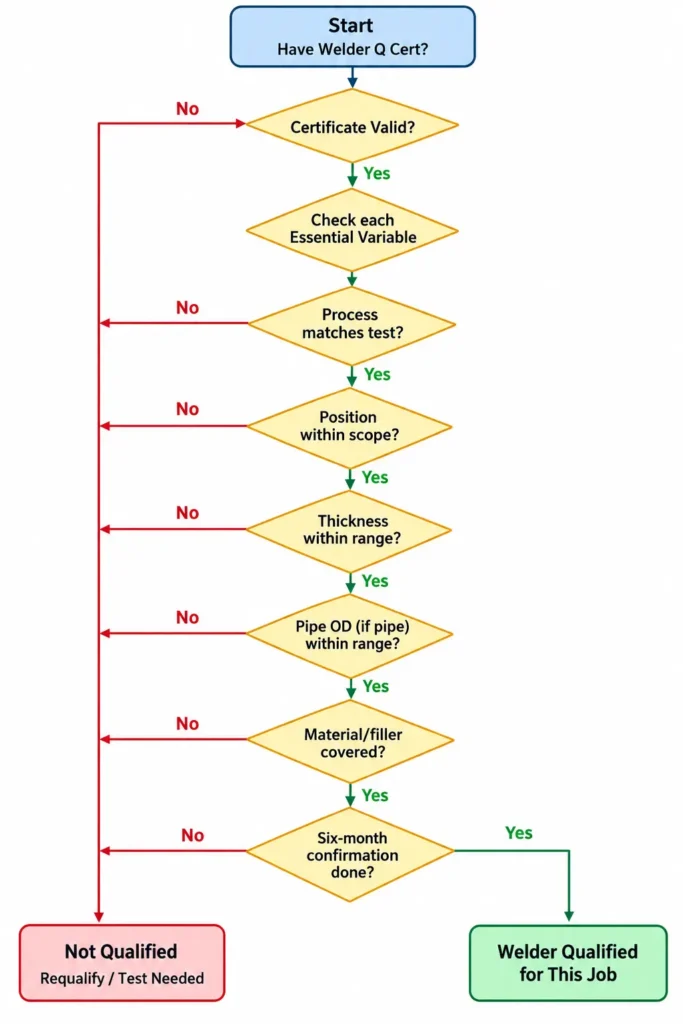
This flowchart shows that a welder can only be approved with a valid ISO 9606-1 certificate if all tested factors match the real weld joint, and the certificate is still active.If any part of the check is not met, the welder can’t be assigned unless more testing or proof is provided.