
SPVD Certification
PED Certification
India
SPVD vs PED Certification: 8 Critical Checks for Pressure Vessel Manufacturers in India
By First Welding Certification Technical Editorial Team
8 Min Read Time
16 Oct 2026
Table Of Content
- Introduction
- Understand the difference between SPVD and PED
- Verify the product scope and design conditions
- Calculate the pressure-volume product
- Determine the applicable PED classification
- Review materials and construction requirements
- Confirm welding and inspection requirements
- Select the correct conformity assessment procedure
- Verify CE marking and technical documentation
- Common mistakes to avoid
- Frequently asked questions
- Related Searches
- Conclusion
SPVD vs PED Certification
Product Scope
Identify which directive may apply.
Pressure-Volume Limits
Understand the SPVD thresholds.
Compliance Requirements
Review materials, welding, assessment and CE marking.
Introduction
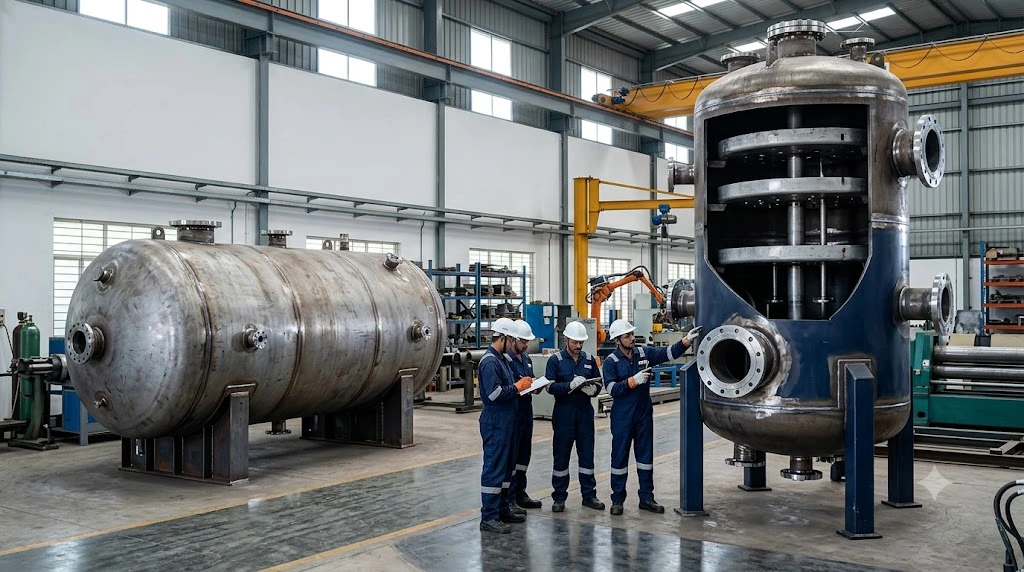
Choosing the correct European directive is an important step for Indian manufacturers exporting air receivers, compressor tanks and other pressure vessels to the European market. Two key regulations are the Simple Pressure Vessels Directive (SPVD) 2014/29/EU and the Pressure Equipment Directive (PED) 2014/68/EU.
Although both address pressure-related safety, they apply to different categories of equipment. A series-manufactured welded air receiver may qualify under SPVD if it satisfies the directive’s specific scope conditions. Another pressure vessel may fall under PED depending on its design, intended contents, operating parameters and construction.
SPVD vs PED certification is not simply a choice between two certificates. Manufacturers must first identify the applicable legislation, establish the product’s classification and determine the correct conformity assessment route.
This guide explains eight critical checks manufacturers should complete before planning pressure vessel conformity assessment and CE marking.
What Is the Difference Between SPVD and PED Certification for Pressure Vessels?
SPVD 2014/29/EU covers a defined category of simple pressure vessels manufactured in series. PED 2014/68/EU covers a broader range of stationary pressure equipment within its scope.
Manufacturers should understand the distinction before selecting a compliance route.
| Comparison | SPVD 2014/29/EU | PED 2014/68/EU |
|---|---|---|
| Main scope | Qualifying simple pressure vessels | Pressure equipment within PED scope |
| Typical equipment | Eligible series-manufactured welded air or nitrogen vessels | Vessels, piping, pressure accessories, safety accessories and assemblies within scope |
| Material conditions | Specific permitted non-alloy steel and aluminium materials | Applicable PED material requirements |
| Classification | Defined product conditions and pressure-volume thresholds | Equipment-specific rules involving PS, V or DN, fluid state and fluid group |
| Conformity assessment | SPVD procedures, where applicable | PED procedures based on the applicable classification |
| CE marking | Depends on the applicable SPVD provisions | Depends on the applicable PED provisions |
The two directives have separate legal requirements. Manufacturers should not select a directive solely because the equipment resembles a previously assessed product.
The European Commission publishes separate guidance for both directives. Manufacturers should consult the current consolidated legislation before finalising a compliance decision.
Does Your Product Qualify for SPVD Compliance in India?
The directive covers series-manufactured welded vessels that meet specified conditions, including:
- The vessel is intended to contain air or nitrogen and is not intended to be fired.
- Its internal gauge pressure exceeds 0.5 bar.
- Pressure-retaining parts are made from the specified non-alloy quality steel or permitted aluminium materials.
- Its construction matches one of the configurations defined in the directive.
- Its maximum working pressure does not exceed 30 bar.
- Its pressure-volume product does not exceed 10,000 bar·litres.
- Its minimum and maximum working temperatures remain within the applicable limits: at least −50°C, no more than 300°C for steel vessels, and no more than 100°C for aluminium or aluminium-alloy vessels.
These conditions must be assessed together. Satisfying the pressure limit alone does not establish SPVD applicability.
For example, a vessel intended for a different gas, made from a material outside the permitted scope, or built in a different configuration cannot automatically qualify as a simple pressure vessel.
Important: A vessel that falls outside SPVD does not automatically qualify under PED. The manufacturer must separately establish whether PED or another applicable legal framework governs the product.
How Do You Calculate PS × V for SPVD Pressure Vessel Certification?
The pressure-volume product is an important part of the SPVD scope assessment and determines which provisions apply to a qualifying vessel.
The formula is:
PS × V = Maximum allowable pressure × Vessel capacity
Where:
- PS represents maximum allowable pressure, expressed in bar.
- V represents vessel capacity, expressed in litres.
- PS × V is expressed in bar·litres.
Example calculation
Consider an air receiver with:
- Maximum allowable pressure: 12 bar
- Vessel capacity: 250 litres
Calculation:
12 × 250 = 3,000 bar·litres.
The result is below the SPVD maximum of 10,000 bar·litres. However, this calculation alone does not establish that the vessel qualifies under SPVD. The manufacturer must also verify the material, design, temperature, contents and other scope conditions.
Understanding the 50 bar·litre threshold
SPVD distinguishes between vessels with a pressure-volume product not exceeding 50 bar·litres and those above that threshold.
- PS × V ≤ 50 bar·litres: Qualifying vessels fall under the applicable sound-engineering-practice provisions.
- PS × V > 50 bar·litres: Qualifying vessels are subject to the applicable essential safety requirements and conformity assessment procedures under SPVD.
The sound-engineering-practice route must not be confused with the route for vessels subject to SPVD’s essential safety requirements. In particular, CE marking must not be applied under SPVD solely on the basis of the sound-engineering-practice provision.
When Does PED 2014/68/EU Apply to Pressure Equipment?
If a product does not meet SPVD’s scope conditions, manufacturers must assess whether it falls within PED 2014/68/EU.
PED covers a wider range of stationary pressure equipment, subject to its scope and exclusions. Its classification rules depend on the equipment type and relevant operating characteristics.
The assessment may involve:
- Maximum allowable pressure (PS).
- Volume (V) or nominal size (DN), where applicable.
- Whether the fluid is a gas or liquid.
- Fluid group classification.
- Equipment type and intended use.
- Applicable exclusions and special provisions.
PED equipment within scope may fall under Sound Engineering Practice or Categories I, II, III and IV, depending on the applicable classification rules.
Manufacturers should therefore avoid using SPVD’s pressure-volume thresholds to determine a PED category. The two directives have different scope conditions and classification systems.
Which Material and Construction Checks Matter for SPVD and PED Compliance?
Material selection affects pressure vessel safety, design verification and conformity assessment.
For SPVD, the manufacturer must verify that the pressure-retaining materials and vessel configuration meet the directive’s specific requirements. A vessel does not qualify simply because its material is commonly used for compressed-air equipment.
For PED equipment, the manufacturer must demonstrate material suitability under the applicable requirements and assessment route.
Review the following items before production:
- Material grade and mechanical properties.
- Design temperature and pressure suitability.
- Material compatibility with the intended contents.
- Pressure-retaining component specifications.
- Material identification and traceability.
- Applicable inspection certificates and records.
- Compliance with the relevant design and manufacturing specifications.
Material documentation must match the actual components used in the vessel.
For example, EN 10204 Type 3.2 inspection documentation should not be assumed mandatory for every pressure vessel without checking the applicable legislation, material specifications, harmonised standards and conformity assessment requirements.
What Welding and Inspection Requirements Apply to Pressure Vessel Manufacturers?
Welding quality is important for pressure vessel integrity, but the required controls depend on the applicable directive and conformity assessment route.
For qualifying SPVD vessels, the directive establishes requirements concerning the approval and qualification of pressure-retaining welds and the competence of personnel performing them.
For PED equipment, requirements for permanent joining and non-destructive testing depend on the applicable category and conformity assessment provisions.
Manufacturers should review:
- Welding procedure specifications and their applicable qualification records.
- Welder and welding-operator qualifications.
- Qualified ranges for materials, thicknesses, joints and welding processes.
- Production welding controls and inspection arrangements.
- Material identification and traceability.
- Required non-destructive examinations and pressure tests.
- Records demonstrating that the vessel meets the applicable requirements.
A previously qualified welding procedure does not automatically cover every material, thickness or production condition. The manufacturer must verify its qualified range against the actual application.
Likewise, passing a pressure test does not independently establish conformity with SPVD or PED. The applicable requirements extend beyond the final test result.
How Should Manufacturers Select the Correct Conformity Assessment Route?
After determining the applicable legislation, manufacturers must identify the permitted conformity assessment procedure.
Under SPVD, vessels subject to the essential safety requirements follow the applicable procedures specified by the directive. The relevant procedure depends on the pressure-volume product and other applicable provisions.
Under PED, the permitted conformity assessment modules depend on the equipment classification and relevant legal provisions.
Before beginning production, confirm:
- The applicable directive and its scope.
- The product classification or relevant pressure-volume threshold.
- The applicable design and manufacturing requirements.
- Whether a notified body must participate.
- The required inspection, testing and technical documentation.
- The applicable declaration and marking obligations.
Not every product requires the same level of third-party involvement. Manufacturers should confirm the permitted route before engaging a conformity assessment body.
This review can reduce avoidable delays caused by selecting an unsuitable assessment procedure or preparing incomplete technical records.
What CE Marking and Documentation Must Be Checked Before Export?
CE marking must follow the applicable legislation and conformity assessment procedure. A successful pressure test or an existing certificate for a similar vessel is not sufficient by itself.
For SPVD vessels subject to its essential safety requirements, manufacturers must complete the applicable conformity assessment, prepare the required EU declaration of conformity and meet the applicable CE-marking and inscription requirements.
Vessels following the SPVD sound-engineering-practice provisions do not receive CE marking under SPVD solely on that basis.
For PED equipment subject to Article 4(1) or Article 4(2), manufacturers must satisfy the applicable essential safety requirements, complete the relevant conformity assessment, prepare the EU declaration of conformity and apply CE marking as required.
A product subject to PED Article 4(3) follows a different route and must not carry the PED CE marking solely on the basis of that provision.
Before placing a vessel on the market, check the applicable requirements for:
- Product identification and traceability.
- Maximum allowable pressure and other required inscriptions.
- Operating instructions and safety information.
- Technical drawings and design calculations.
- Material and manufacturing records.
- Welding and inspection documentation.
- Test reports.
- The required declaration of conformity and marking.
The exact documentation depends on the product and applicable legal route. Manufacturers should verify the current consolidated directives and relevant standards rather than applying a generic checklist to every vessel.
Common Mistakes When Choosing Between SPVD and PED
Pressure vessel manufacturers should avoid these frequent errors:
- Assuming every compressed-air receiver falls under SPVD.
- Using an incorrect SPVD pressure-volume limit.
- Selecting a directive based only on pressure or capacity.
- Ignoring material, construction and temperature restrictions.
- Using SPVD thresholds to determine PED categories.
- Assuming identical welding and inspection requirements under both directives.
- Starting production before confirming the conformity assessment procedure.
- Applying CE marking without completing the applicable legal requirements.
- Treating an assessment of one vessel design as automatic approval for every subsequent design.
A documented product-scope review helps manufacturers identify regulatory issues before they affect production planning or export schedules.
Frequently Asked Questions
Is SPVD the same as PED?
No. SPVD 2014/29/EU covers a defined class of simple pressure vessels manufactured in series, while PED 2014/68/EU covers a broader range of stationary pressure equipment within its scope.
Does every air receiver require SPVD certification?
No. An air receiver must meet all applicable SPVD scope conditions. If it does not qualify, the manufacturer must determine whether PED or another legal framework applies
What is the maximum PS × V value under SPVD?
The SPVD scope limit is 10,000 bar·litres, together with the other conditions in Article 1. A vessel must satisfy all relevant scope requirements to qualify.
Does a vessel below 50 bar·litres need CE marking under SPVD?
A vessel within SPVD’s scope whose PS × V does not exceed 50 bar·litres follows the applicable sound-engineering-practice provisions. CE marking must not be applied under SPVD solely on that basis.
Can an Indian manufacturer export pressure vessels to Europe?
Yes, provided the manufacturer meets the applicable European product legislation and market-access requirements. The correct conformity assessment route depends on the product’s characteristics and intended market.
Related Searches
- PED 2014/68/EU Material Requirements: Material Traceability, PMA & European Approval Explained
- Top 10 PED Documentation & Welding Compliance Gaps That Can Delay Pressure Equipment Conformity Assessment: WPS, WPQR, Welder & NDT Records Explained
- PED Certification Cost in India 2026: Fees, Factors, Process & Documents
- What Are the Latest PED 2014/68/EU Pressure Vessel Regulations, Design Standards, Safety Factors and Certification Requirements in 2026 for Indian and Global Manufacturers?
- How Do Indian and Global Manufacturers Choose the Right SPVD Conformity Assessment Module? B, C, C1 & C2
Conclusion
Selecting between SPVD and PED is a critical early decision for pressure vessel manufacturers targeting the European market.
SPVD 2014/29/EU applies to a defined class of simple pressure vessels, while PED 2014/68/EU covers a broader range of pressure equipment. The correct route depends on product scope, pressure-volume characteristics, materials, construction, intended use and the relevant conformity assessment requirements.
By completing these checks before production, manufacturers can plan the appropriate assessment route, organise welding and inspection records, and prepare the technical documentation required for their product.
Planning SPVD or PED conformity assessment for your pressure vessel?
First Welding Certification Pvt. Ltd. (PRVÁ ZVÁRAČSKÁ, a.s.) undertakes conformity assessment and certification activities within its applicable designation and scope.
Manufacturers can enquire about the appropriate regulatory route for their air receivers, compressor tanks and other pressure equipment intended for the European market.