
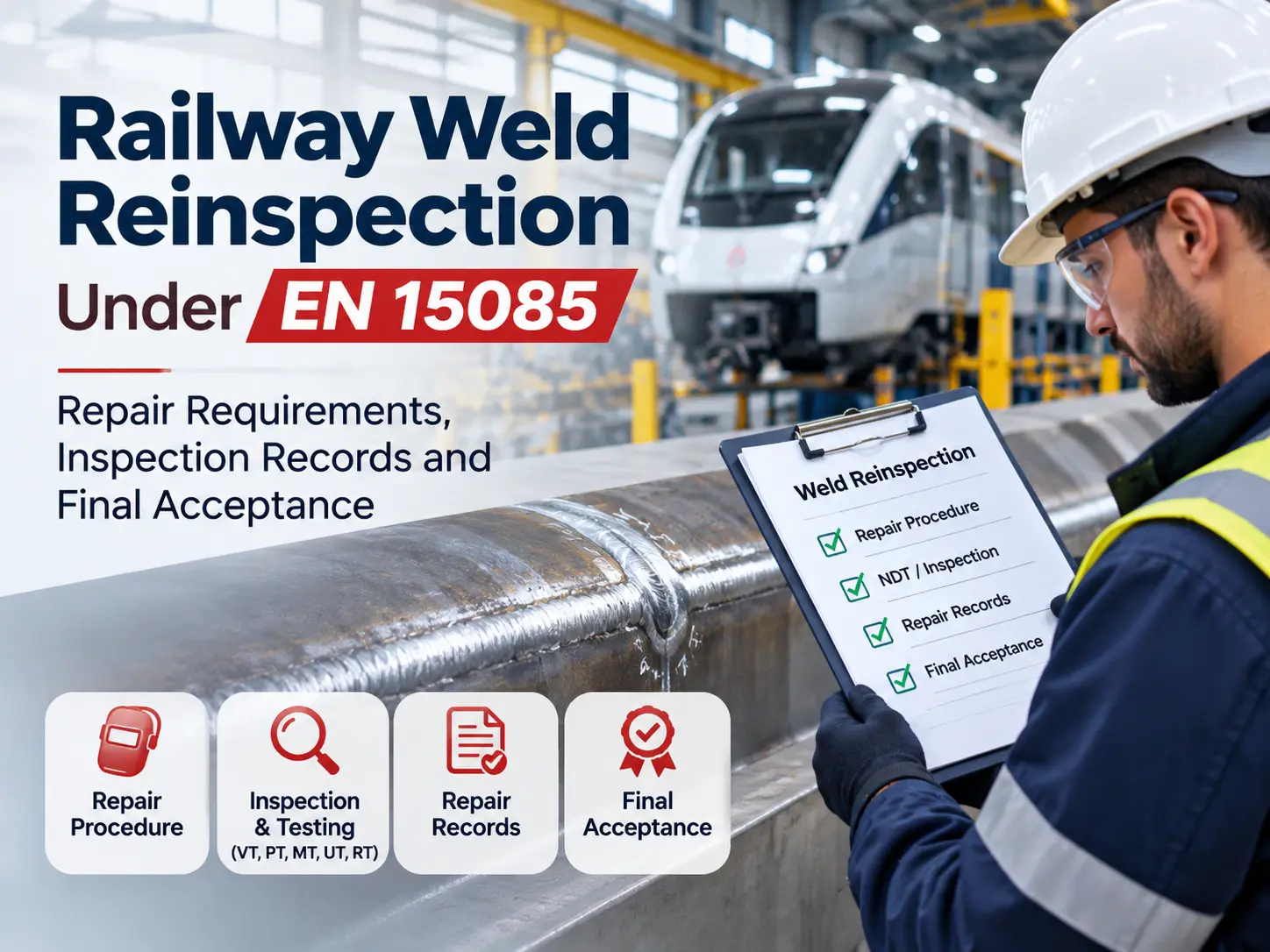
EN 15085
REINSPECTION
PROCEDURE
03 Nov 2026
Railway Weld Reinspection and Repair: Inspection Requirements, Repair Records and Final Acceptance Under EN 15085
By Editorial Team
Table Of Contents
- Why Railway Weld Reinspection Matters
- Railway Weld Repair: What Should the Procedure Include?
- EN 15085-5 Inspection and Testing Requirements
- Railway Weld Reinspection and Final Acceptance
- Essential Railway Welding Inspection Records
- Material Traceability and Welding Personnel Qualification
- A Practical Workflow for Controlling Railway Weld Defects
- Common Railway Weld Repair Mistakes to Avoid
- How to Prepare for an EN 15085 Assessment
- Frequently Asked Questions
- Conclusion
- Related Searches
Related Blogs
SEP
09
EN 15085 Latest Edition 2026: EN 15085-2:2025 Update for Indian & International Manufacturers
AUG
31
CL1 vs CL2 vs CL3: Understanding EN 15085 Classification Levels Correctly
AUG
21
EN 15085 Certification in Chennai: 10 Common Audit Problems Railway Manufacturers Face
AUG
19
EN 15085 Certification Cost in India: What Determines the Price?
JLY
29
EN 15085 Certification Requirements: What Railway Manufacturers Should Check Before Certification
The presence of even a single unresolved weld defect can severely impede railway manufacturing operations, driving up rework expenditures and rendering quality evaluations increasingly complex. Manufacturers are therefore compelled not merely to detect such imperfections, but also to manage repair protocols, validate corrective outcomes, and preserve comprehensive inspection documentation. In accordance with EN 15085-5:2023, adherence to documented repair procedures, implementation of suitable inspection regimes, and maintenance of pertinent quality records are mandatory prerequisites to guarantee that repaired welds conform to established standards. Consequently, a profound comprehension of reinspection mandates is indispensable for welding coordinators and quality managers tasked with safeguarding both product integrity and traceability.
Why Railway Weld Reinspection Matters
Ensuring strict adherence to design and manufacturing specifications in railway welding demands a rigorous, systematic approach to quality control. Any anomalies detected through visual examination or Non-Destructive Testing (NDT) must be meticulously assessed against established technical benchmarks, a process that may necessitate supplementary inspections, remedial interventions, or outright rejection of the weld. Frequent defects observed in this sector encompass cracks, porosity, insufficient fusion, dimensional variances, missing inspection documentation, and lapses in traceability. When inadequately managed, such imperfections can precipitate protracted delays, costly rework, and additional scrutiny. Consequently, the adoption of a codified inspection and testing protocol aligned with EN 15085-5 empowers manufacturers to promptly identify non-conformities, formulate appropriate corrective measures, and confirm that rectified welds satisfy all acceptance criteria. Maintaining precise control over these critical variables is indispensable for achieving peak production quality.
Railway Weld Repair: What Should the Procedure Include?
A comprehensive railway weld repair procedure must comprehensively address defect assessment, the execution of removal and repair operations, subsequent inspection protocols, clearly delineated responsibilities, and stipulated requirements for both welding practices and testing methodologies.
| Repair Stage | Required Activity | Purpose |
|---|---|---|
| 1. Defect identification | Record the component, weld location and inspection findings. | Establish a traceable defect record. |
| 2. Technical assessment | Evaluate the defect and determine the appropriate disposition. | Ensure the repair approach is suitable. |
| 3. Defect removal | Remove the defect using the specified method. | Eliminate the identified non-conformity. |
| 4. Verification | Inspect the prepared area to confirm defect removal. | Prevent the repair from proceeding with an unresolved defect. |
| 5. Welding repair | Apply the applicable WPS or specific repair WPS, as required. | Maintain control over the welding activity. |
| 6. Reinspection and retesting | Perform the required inspection and testing. | Verify that the repaired weld meets applicable requirements. |
| 7. Final disposition | Review results and document the acceptance decision. | Provide evidence for controlled component release. |
In accordance with EN 15085-5:2023, documented protocols must be established to govern the rectification of welding defects, encompassing the systematic removal of imperfections, verification of repairs, adherence to pertinent welding procedures, and the execution of requisite non-destructive testing, all derived from the governing technical documentation and specifications.
EN 15085-5 Inspection and Testing Requirements
Verification that a weld satisfies stipulated criteria hinges fundamentally on rigorous inspection and testing. The selection of appropriate methodologies is contingent upon the specific component, the nature of the weld, the established inspection plan, and applicable regulatory specifications. The standard repertoire of techniques encompasses visual testing (VT), penetrant testing (PT), magnetic particle testing (MT), ultrasonic testing (UT), and radiographic testing (RT), alongside dimensional assessments to evaluate weld geometry and size. It is imperative to recognize that no single weld necessitates the application of every available method; rather, the requisite approaches are defined exclusively by the inspection plan. Furthermore, regarding repaired welds, post-repair examinations must adhere to the identical methods employed in prior assessments, as mandated by EN 15085-5:2023. Ultimately, the provision of unambiguous inspection instructions is critical to guaranteeing that inspectors possess a comprehensive understanding of the specific requirements. what must be examined, which method to use and how results should be recorded.
Railway Weld Reinspection and Final Acceptance
The mere execution of a repair is insufficient to validate the acceptability of a weld; rather, it mandates rigorous inspection and testing conducted in strict conformity with technical documentation and established repair protocols.Acceptance criteria, as delineated by EN 15085-5, are variable, shaped by design specifications, quality standards, inspection mandates, and contractual obligations.Manufacturers are obligated to ensure that defects are meticulously documented, repairs adhere strictly to prescribed procedures, and inspections satisfy the requisite acceptance benchmarks.Furthermore, corrective actions must be implemented, records must unequivocally identify the specific components and welds involved, and final dispositions must be formally recorded.In instances where repairs prove inadequate, manufacturers must comply with non-conformity management processes to preclude the premature release of components.This systematic approach guarantees consistent quality assurance while mitigating risks associated with undocumented repairs.
Essential Railway Welding Inspection Records
To guarantee comprehensive documentation and uphold rigorous quality standards, a railway welding inspection record template must encompass specific fields for defect identification, repair specifications, reinspection outcomes, and final acceptance.
| Record Field | Information to Capture |
|---|---|
| Component identification | Part number, serial number or production order |
| Weld identification | Weld number, location and drawing reference |
| Initial inspection | Inspection method, date and findings |
| Defect details | Defect description and non-conformity reference |
| Repair details | Repair method and applicable WPS reference |
| Personnel details | Relevant welding and inspection personnel |
| Reinspection | Test method, date and results |
| Acceptance status | Accepted, further action required or rejected |
| Authorisation | Relevant inspector or responsible personnel |
| Traceability references | Links to material, welding and inspection records |
The record architecture is inherently flexible, accommodating diverse standards, inspection protocols, and specific client requirements. In accordance with EN 15085, welding traceability records must establish a definitive linkage among inspections, defect evaluations, repair activities, and final testing, all directly associated with specific components. Furthermore, the implementation of controlled records guarantees that personnel retrieve the precise version necessary for conducting quality audits, investigating defects, or performing formal assessments.
Material Traceability and Welding Personnel Qualification
Rigorous documentation serves as the cornerstone of control within welding operations, essential for substantiating regulatory adherence. The requisite archival portfolio encompasses material identification, welding procedure specifications, welder certifications, inspection findings, repair directives, non-conformity registers, and final acceptance documentation. Furthermore, maintaining traceability in railway welding materials guarantees an unbroken chain of custody linking specific components to their constituent materials. Strict observance of EN 15085 standards mandates that only qualified personnel execute welding tasks, thereby safeguarding operational integrity. An efficacious production traceability framework integrates disparate records, effectively mitigating fragmentation.Although digital archiving enhances data administration, the fundamental tenets of compliance remain rooted in precision, comprehensiveness, oversight, and unambiguous traceability.
A Practical Workflow for Controlling Railway Weld Defects
Implement a structured workflow for defect management in manufacturing.
- Identify imperfections by employing suitable inspection techniques.
- Record findings, noting weld locations and defect details.
- Evaluate the available options and select the most appropriate remediation strategy.
- Eliminate the defect and confirm its eradication.
- The welding repair must be carried out in strict accordance with established protocols by duly qualified personnel.
- Conduct post-repair inspections and document outcomes.
- Assess the non-conformity comprehensively and proceed with its formal closure, verifying that every stipulated acceptance criterion has been fully satisfied.
- The component shall be released solely upon the successful completion of all requisite conformity assessments and the submission of the corresponding documentation.
Furthermore, the welding coordinator is tasked with overseeing corrective measures and dissecting recurring defects to ascertain their root causes, thereby mitigating the probability of future anomalies within the production workflow.
Common Railway Weld Repair Mistakes to Avoid
Manufacturers should review their repair processes for the following weaknesses:
- The absence of documented protocols for repairing defects fosters operational inconsistency.
- Confirm the elimination of defects prior to executing repairs to ensure that latent issues do not persist.
- Adopt welding procedures that are fully compliant with the specified technical mandates.
- Execute the mandatory post-repair assessments on all inspected components.
- Ensure complete inspection records for traceability (e.g., dates, identification).
- Never finalize the closure of non-conformities unless the acceptance of the requisite requirements has been explicitly verified.
- A systematic inquiry into recurring welding anomalies is essential to formulate and execute effective corrective measures.
Tackling these deficiencies fortifies the uniformity of repair operations, bolsters documentation standards, and elevates readiness for subsequent assessments.
How to Prepare for an EN 15085 Assessment
Entities pursuing EN 15085 certification must rigorously evaluate their quality management systems across the spectrum of welding operations, including inspection protocols, repair methodologies, and comprehensive documentation procedures.
Internal review questions include:
- Is there a systematic framework in place for documenting and evaluating welding defects?
- Do established repair protocols exist and are they consistently adhered to?
- Are defect removal procedures confirmed prior to the execution of welding repairs?
- Are applicable WPS documents controlled?
- Have the requisite post-repair inspections and testing protocols been fully executed?
- Can final inspection results link to the correct weld?
- Are material and personnel qualification records maintained?
- Are recurring defects reviewed for corrective action?
Is the retrieval of pertinent documentation executed with efficiency during the course of evaluations?
While the checklist serves as a valuable instrument for pinpointing documentation deficiencies prior to an external assessment, it cannot supplant a thorough EN 15085 evaluation. Manufacturers should also review their certification scope, production activities and applicable quality documentation to ensure that their preparation reflects their actual welding operations.
Frequently Asked Questions
Does EN 15085 require documented welding repair procedures?
Conformity with EN 15085-5:2023 necessitates the establishment of documented protocols for the rectification of welding defects. Such protocols must comprehensively govern the excision of defects, the subsequent verification of their complete removal, the specific welding procedures to be employed, and the scope of non-destructive testing required post-repair.
Can a repaired railway weld be accepted without retesting?
Compliance with the mandated inspection and repair protocols is obligatory. As stipulated by EN 15085-5:2023, retesting must employ the identical methodology utilized in prior assessments, though the welding coordinator retains the authority to incorporate supplementary testing techniques as deemed appropriate.
Which records should be maintained after a weld repair?
Relevant documentation typically encompasses defect reports, repair specifications, references to applicable welding procedures, inspection and test outcomes, component identification, and final disposition records. The precise scope of these requirements is contingent upon the governing technical and contractual stipulations.
What is the role of EN 15085-5 in railway welding inspection?
EN 15085-5 delineates the protocols for inspection, testing, and documentation pertaining to the welding of railway vehicles and their constituent components. This standard establishes specific mandates concerning the strategic planning of inspections, the maintenance of comprehensive records, and the systematic management of welding defects.
How does EN 15085-3 relate to weld acceptance?
EN 15085-3 delineates design mandates, encompassing pertinent standards for weld integrity. Applicable acceptance criteria must be ascertained through a review of the associated design documentation, technical specifications, and contractual stipulations.
Why is material-to-weld traceability important?
Material-to-weld traceability enables manufacturers to establish a definitive link between raw materials and components with their corresponding welding, inspection, and repair documentation, thereby facilitating rigorous quality investigations, validating conformity, and ensuring the efficient retrieval of critical production data.
Conclusion
Successful remediation of railway welds transcends mere defect elimination; it necessitates a meticulously controlled protocol, complemented by rigorous inspection and testing, the involvement of certified personnel where mandated, and the maintenance of robust documentation.
By fortifying EN 15085-5 inspection and testing protocols, ensuring the maintenance of traceable repair documentation, and rigorously investigating recurrent defects, railway manufacturers can substantially enhance their quality control mechanisms and more convincingly demonstrate regulatory conformity.
Adhering to a consistent methodology further empowers quality teams to expedite evidence retrieval, facilitate non-conformity investigations, and underpin production release determinations.
Are you advancing your organization toward EN 15085 certification?