
Related Blogs
SEP
08
EN 1090 Standard: Which Companies Need It in India & International Markets in 2026?
AUG
14
EN 1090 CE Marking Audit: Complete Checklist, Common Non-Conformities & Preparation Guide
AUG
12
EN 1090 Execution Classes: Complete Guide to EXC1, EXC2, EXC3 & EXC4
AUG
10
Mastering EN 1090 Factory Production Control (FPC): Comprehensive Audit Checklist & Compliance Guide
JLY
31
EN 1090 Certification Requirements: 15-Point Checklist for Structural Steel & Aluminium Manufacturers
JLY
20
CE Marking vs EN 1090: Key Differences Every Manufacturer and Exporter Should Know (2026 Guide)
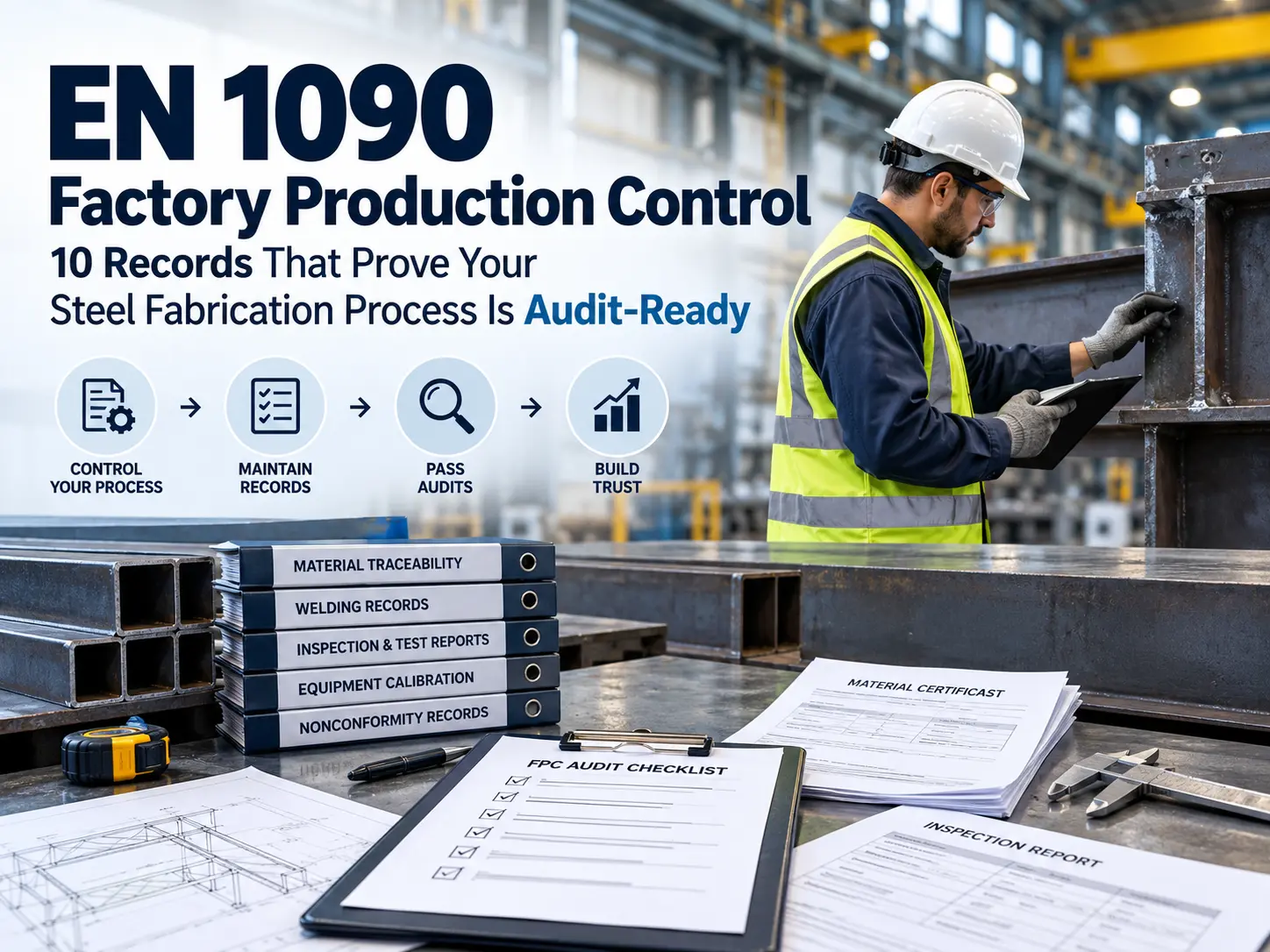
EN 1090
FPC CHECKLIST
STEEL FABRICATION
22 Oct 2026
EN 1090 Factory Production Control: 10 Records That Prove Your Steel Fabrication Process Is Audit-Ready
By Editorial Team
Table Of Contents
- What Is Factory Production Control Under EN 1090?
- 10 Records to Prepare for an EN 1090 FPC Audit
- Quick Reference: EN 1090 FPC Audit Records
- EN 1090 FPC Audit Preparation Flowchart
- Common EN 1090 Audit Documentation Gaps
- EN 1090 FPC Pre-Audit Checklist
- Frequently Asked Questions
- Make Your EN 1090 Audit Easier to Manage
Getting ready for an EN 1090 certification audit means more than just having a quality manual. Steel fabricators need to show that their manufacturing processes are controlled, written down, and able to consistently make parts that match the required standards.
This is where Factory Production Control (FPC) plays a key role.
According to EN 1090-1, FPC is a documented system that a manufacturer uses to manage production and check the performance of structural steel and aluminium parts within their area of responsibility.
The certification process includes checking the factory and its FPC system, and then ongoing reviews to make sure everything stays in line.
No matter what you make—like structural beams, steel frames, welded parts, or other load-bearing components—keeping clear and traceable records is important for being ready for an EN 1090 audit.
In this guide, we go through 10 key FPC records, common issues with documentation, and a useful checklist to help you prepare for your next audit.
What Is Factory Production Control Under EN 1090?
Factory Production Control is the system a manufacturer uses to watch over and manage the whole production process, starting from when materials arrive until the final check and delivery.
A good FPC system shows that the manufacturing process follows set rules and that the finished parts meet the stated performance standards.
Common FPC controls are:
- Who is responsible and their skills
- How materials are labelled and tracked
- How welding and other production methods are done
- How inspections, tests, and equipment are handled
- How to deal with products that don’t meet requirements
- How to manage documents and production records
The exact needs depend on the standard being followed, what the production goals are, the manufacturing steps used, and the certification area.
10 Records to Prepare for an EN 1090 FPC Audit
The following records make up a useful list of steps to prepare. Not all records apply exactly to every manufacturer; check the specific requirements for your products and execution class.
- Factory Production Control Manual and Procedures
Your FPC manual explains how your manufacturing processes are controlled. It should show what actually happens in your workshop, not just what should happen in an ideal situation.
Keep the following available:
- FPC manual and related procedures
- Organisation chart with assigned responsibilities
- Production and inspection instructions
- Records of document revisions and approvals
Audit tip: Make sure workers are following the most recent approved procedures and that old documents are not being used anymore.
- Material Certificates and Traceability Records
Material traceability connects the steel used in a part to its supporting documents. For example, when steel comes in, it might have an inspection certificate.
Your process should show how the material is identified, checked, stored, and tracked during cutting and making.
Keep these records available:
- Inspection certificates for the material, if they exist
- Purchase orders and delivery logs
- Records of material type and identification
- Traceability using heat or batch numbers
- Records of cutting and moving the material, if needed
Audit tip: Choose a finished part and show how its material can be traced back to the original incoming documents.
- Welding Procedure Specifications and Qualification Records
For welded structural parts, the welding documents need to match the work being done and the rules that apply. Keep these documents ready when needed:
– Welding Procedure Specifications (WPS)
– Welding Procedure Qualification Records (WPQR/PQR)
– Records showing the procedure was properly tested and approved
– Information about the welding method and the materials used
– Any other papers that support the welding work
Audit tip: Look at some examples of welds made recently and check them against the correct WPS and the qualification records.
Make sure the materials, thickness, type of joint, and other important factors are within the approved limits.
- Welder and Welding Operator Qualification Records
People who do welding need to have the right qualifications for the jobs they are doing.
Make sure these documents are kept on hand when needed:
- Welders’ qualification certificates
- Records showing that welding operators are qualified
- Records showing when qualifications are valid and up to date
- Records that connect each person to the welding tasks they are doing
Audit tip: Check that the people currently doing welding have the correct qualifications for the processes and tasks they are working on.
- Welding Coordination and Personnel Competence Records
Manufacturers should have clear roles for tasks related to quality. The way welding is managed should match the needs of the manufacturing process.
Keep the following available:
- The name and job description of the welding coordinator
- Proof that the person has the right skills and qualifications
- Records of training and competence
- Who is responsible for checking and approving production
Audit tip: Make sure the people in charge know their duties and can explain how welding work is controlled.
- Equipment Maintenance and Calibration Records
Manufacturing and inspection tools need to stay in good condition so they work properly for their intended purpose.
If measurement or testing equipment needs to be checked or calibrated, there should be records showing that it is properly managed.
Keep the following documents available:
- A list of all equipment
- Records of regular maintenance
- Calibration or verification documents, if needed
- Records of equipment checks
- Records of steps taken when equipment is not suitable for use
Audit tip: Make sure that equipment used for checking size, testing, or other important quality tasks is clearly labelled and its current status is known.
- Inspection and Testing Reports
Inspection records show that the necessary checks were done and that the results were reviewed.
Depending on the product and the rules that apply, these checks might include things like size, weld quality, how parts are connected, how surfaces were prepared, or other specific features.
Keep these documents ready:
- Inspection and test plans, if needed
- Records from checking materials that came in
- Reports from inspections done during the process
- Results from checking dimensions
- Reports from non-destructive testing, if required
- Records from the final inspection and approval
Audit tip: Make sure the records show which part or group of parts were checked, what was checked, the result, and the standards used to decide if it was acceptable.
- Production and Process Control Records
Production records show that manufacturing follows the right requirements and that any changes are properly controlled.
Keep the following available when applicable:
- Job or production orders
- Approved drawings and specifications
- Records of cutting, drilling, forming, and assembly
- Records of welding or bolting processes
- Process checks and inspection sign-offs
- Records of approved production changes
Audit tip: Follow a sample job from the approved order and drawings through the manufacturing and inspection stages to the finished component.
- Nonconformity and Corrective Action Records
A good FPC system doesn’t just find problems. It also keeps track of how faulty items are handled and what steps are taken to fix the issues.
Keep the following records available:
- Reports about nonconformities
- Information on the parts or groups that were affected
- Approvals for handling and fixing the items, if needed
- Analysis of the main causes, when appropriate
- Records of the actions taken to fix the problems
- Checks to make sure the actions worked, when needed
Audit tip: Look at past nonconformities and check if the products were properly managed and if the actions were carried out.
- Final Product Identification and Delivery Records
Before sending out products, manufacturers need to show how they track and connect finished parts to their production and inspection records. Keep these documents ready when needed:
- Records of final product inspection and approval
- Records showing how components are identified and marked
- Delivery notes and order details
- Traceability information related to the component
- Any required Declaration of Performance (DoP) and CE marking documents
Audit tip: Pick a delivered part and check if you can find its identification, inspection status, and supporting paperwork.
Quick Reference: EN 1090 FPC Audit Records
| Record category | What it demonstrates |
|---|---|
| FPC manual and procedures | Controlled manufacturing processes |
| Material certificates and traceability | Material identity and supporting documentation |
| WPS and procedure qualification | Appropriate control of welding procedures |
| Welder qualifications | Competence for assigned welding activities |
| Welding coordination records | Defined technical responsibilities |
| Equipment maintenance and calibration | Equipment suitability and control |
| Inspection and testing reports | Evidence of required checks and results |
| Production records | Control of manufacturing activities |
| Nonconformity and corrective actions | Control of defects and follow-up |
| Final inspection and delivery records | Product release and supporting traceability |
EN 1090 FPC Audit Preparation Flowchart
Use this workflow to organise your pre-audit review.
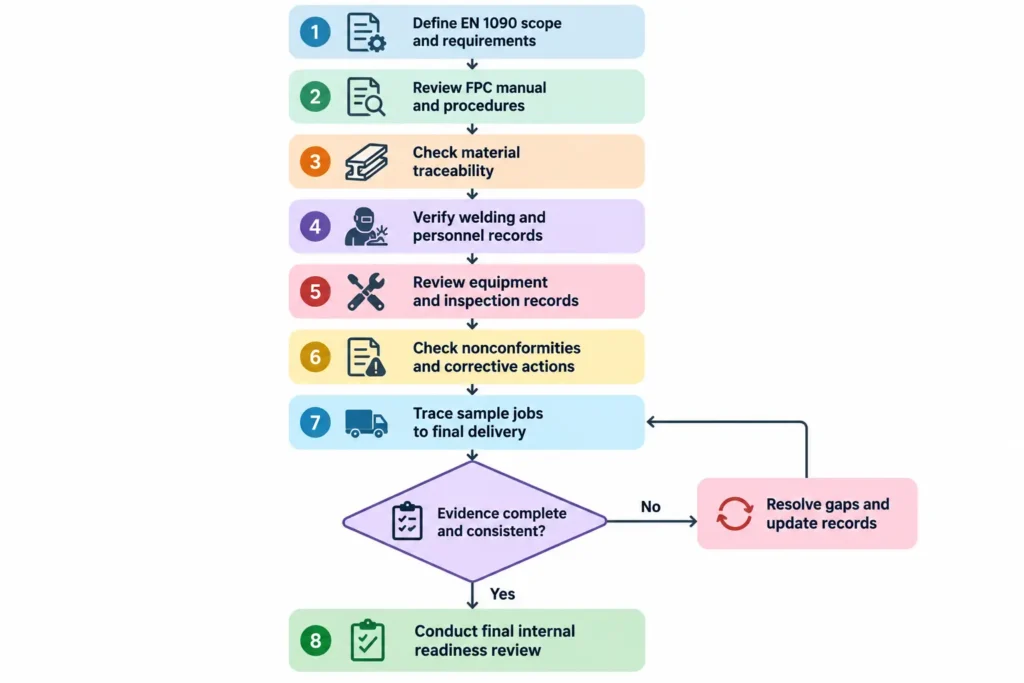
This is a practical preparation workflow, not an official EN 1090 conformity-assessment procedure.
Common EN 1090 Audit Documentation Gaps
Even manufacturers with established quality systems can overlook details that affect audit readiness.
| Common gap | Recommended action |
|---|---|
| Material certificates cannot be linked to components | Strengthen material identification and traceability |
| WPS does not cover the work performed | Verify procedure qualification and applicable scope |
| Qualification records are outdated or incomplete | Review personnel qualifications and continuity requirements |
| Inspection records lack acceptance results | Record results and applicable acceptance criteria |
| Equipment status is unclear | Maintain equipment identification and calibration or verification records |
| Corrective actions remain open | Assign responsibility deadlines and follow-up |
| Procedures do not match actual practice | Review processes with workshop personnel |
| Final records cannot be retrieved promptly | Organise records by job component batch or another traceable identifier |
EN 1090 FPC Pre-Audit Checklist
Before you start your assessment, check these things:
- Make sure the FPC manual and procedures are up to date.
- Check that responsibilities are clearly given to the right people.
- Have material certificates and records showing where the materials came from.
- Look at welding procedures and qualification records to make sure they cover the work done.
- Ensure that all relevant staff have current and proper qualifications.
- Keep records of equipment maintenance, calibration, or verification when needed.
- Check inspection and testing records to confirm they meet the required standards.
- Make sure nonconforming products are found and properly controlled.
- Check that corrective actions are written down and followed through.
- Verify that final inspection, product identification, and delivery records can be traced.
Use this checklist as a starting point and adjust it according to your specific manufacturing process and certification needs.
Frequently Asked Questions
What is Factory Production Control in EN 1090?
Factory Production Control is the manufacturer’s written method for managing production and ensuring that structural steel or aluminium parts meet the required standards consistently.
Which documents are checked during an EN 1090 audit?
The assessment might include things like how FPC procedures are followed, whether personnel are qualified, how materials are handled, welding methods, equipment used, how inspections and tests are done, how to handle issues or problems, and how to track the product. The specific evidence needed depends on the rules that apply and the range of what is being certified.
Is material traceability important for EN 1090 certification?
Yes. Properly identifying and tracking materials helps show that the materials used in production meet the required standards and are supported by the necessary documents.
Are welding records required for every EN 1090 manufacturer?
Welding controls and records depend on the manufacturing processes and the rules that apply. Companies that do welding work need to make sure their methods, the skills of the workers, how they plan and work together, and the checks they do are all right for what they’re making.
How can a manufacturer prepare for an EN 1090 surveillance audit?
Look back at what was found before, check the current steps being followed, take samples from actual production, make sure you can track everything back, check the records of the people and tools used, and ensure that any fixes have been properly done. Make sure all the requirements match the correct certification rules.
Make Your EN 1090 Audit Easier to Manage
A Factory Production Control system that is ready for audit is created by having consistent production methods, clear roles, dependable inspections, and records that can be traced—not by making up documents at the last minute.
By looking at these 10 record types, steel fabricators can find missing documentation, improve their production control, and get better prepared for EN 1090 assessment and surveillance.
Need support with EN 1090 certification?
Discover PZVAR’s EN 1090 certification services to find out more about getting certified for structural steel and aluminium components.