
WPS QUALIFICATION
COMPLIANCE
GUIDE
15 Sep 2026
WPS Qualification Range: Key Variables Explained
By Editorial Team
Related Blogs
AUG
28
From WPS to Digital Weld Records: Building a Connected Welding Quality System
AUG
11
How Long Is WPQR Valid? WPQR Validity Explained
AUG
10
How to Prepare a WPQR: Step-by-Step Welding Procedure Qualification Guide
AUG
04
WPS & WPQR Explained: The Complete Manufacturer's Guide to Welding Procedure Qualification, Requirements, Standards and Industrial Applications (2026)
See Also.....
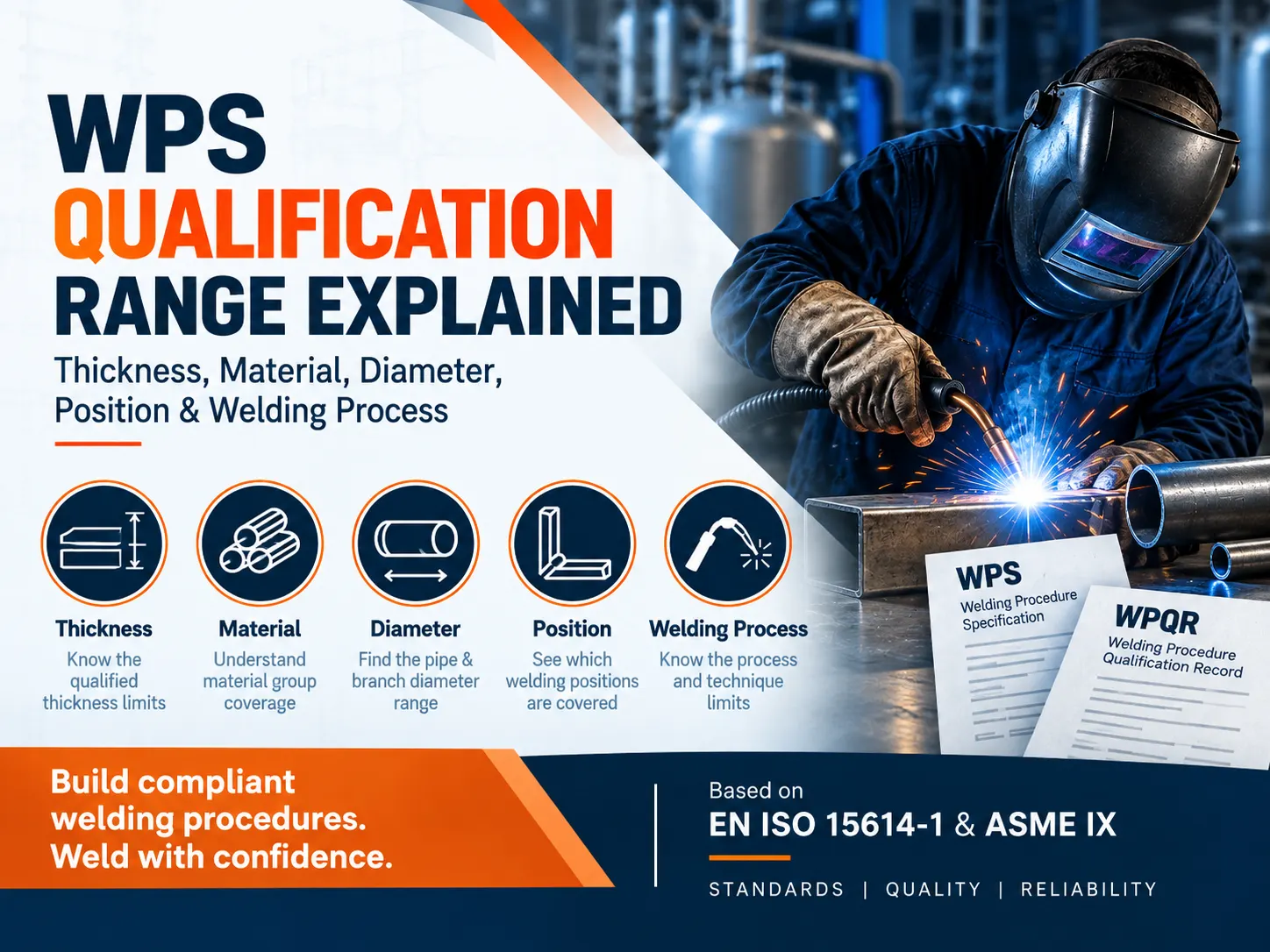
A Welding Procedure Specification (WPS) is a controlled document that tells welders exactly how to weld. A Welding Procedure Qualification Record (WPQR) (also called WPAR) documents the test weld and results that prove the procedure works. The WPQR also defines the qualified ranges of parameters (thickness, materials, joint, etc.) for that WPS. In other words, the WPS may only be used for production welds within the ranges approved by its WPQR. As PZVAR explains, one must always “look at the actual thickness range that was approved in the WPQR” before changing a WPS. Below we summarize how the main variables are limited by common standards (especially EN ISO 15614‑1 and ASME IX).
Thickness Range
- General rule (ISO 15614‑1): A butt-weld test at thickness t typically qualifies production welds from about 5⋅t up to 2⋅t. (Therness notes that the exact multipliers vary by material group.) In practice, this means if you qualify a 10 mm test coupon, the WPS can cover welds roughly 5–20 mm thick. Tests on thin coupons give narrower ranges; for example, ISO 15614‑1:2017 lowered the minimum from 0.7⋅t to 0.5⋅t when the test coupon is ≤3 mm.
- Dissimilar thickness rule: For butt joints with very unequal plates, ISO 15614‑1:2017 introduced special rules. If the PQR test piece is ≥32 mm thick, one base metal thickness may be essentially unlimited (e.g. an extremely thick plate), provided the deposited weld thickness on the other side stays within the qualified range. Example: a PQR welded thickness of 16–64 mm on one side can accept the other side being 200 mm thick. If the test piece is <30 mm, then both base materials must lie in the qualified thickness range.
- Fillet welds: Fillet welds are qualified by their throat size. ISO 15614‑1’s Table 8 (fillet welds) sets throat-thickness ranges (unchanged in 2017). A note says if plates of different thickness are fillet-welded, calculate each thickness range separately.
- ASME Section IX: ASME IX has similar concepts. For example, if a PQR is done at thickness t, a WPS can cover up to 2⋅t (with some caps). If t≥3 mm, the maximum qualified thickness is 2⋅t (up to an upper limit); if t<3 mm, the range is fixed (e.g. 1.6–6.4 mm). (PZVAR notes that any change outside the approved thickness range needs requalification.)
Base-Material (Group) Range
- ISO/TR 15608 (P–Groups): ISO categorizes steels (and alloys) into P-groups (see ISO/TR 15608). Generally, a WPQR qualified for one P-group covers adjacent groups. As Therness explains, “Qualifying one sub-group typically also qualifies welds to/from adjacent groups within a defined matrix”. For example, a test on a carbon steel P1 or P11 may also cover lower-strength steels in the same group. However, switching to a different family (e.g. steel to stainless) usually requires a new qualification.
- Composition limits: Some standards impose limits on chemistry or strength. For example, a high-strength steel PQR might cover any weld with strength ≤ that steel, but not higher. Always check the product standard (EN or AWS) for specific elemental or impact criteria that might restrict the material range.
Pipe & Branch Diameter Range
- ISO 15614‑1 (Table 9): For pipe and branch welds, ISO 15614‑1 defines how a test coupon’s diameter D covers other diameters. In older versions: if D≤25 mm, qualified range was 0.5⋅D to 2⋅D; if D>25 mm, qualified range was ≥0.5⋅D (minimum 25 mm). Update (2017): the committee adopted a simpler rule: any pipe (or branch) qualified on diameter D covers all larger diameters ≥0.5⋅D. In practice, a 50 mm test weld covers pipes of 25 mm and above. (PZVAR and TWI note that the old cap was deemed “too restrictive”, so now the range is “≥0.5D for all diameters”.)
- Example: A branch connection welded on a 40 mm-diameter pipe (outside) would qualify production welds on any pipe ≥20 mm OD. If your weldment has smaller pipes, a smaller-diameter test may be needed.
Welding Position Range
- ISO 15614‑1 Annex B: Position is an essential variable. ISO 15614‑1 uses an annex table to map position coverage. Broadly, a test in a vertical position (PF = vertical up) is considered “highest heat input” and covers many others. For instance, a PF test usually qualifies the flat (PA) and horizontal (PC) positions as well, though not the worst-case overhead. Conversely, a test in flat (PA) is a “low heat input” position and generally does not qualify the vertical or overhead positions. (ISO 15614‑1 clarifies which exact positions are covered; Therness warns that a PF test “covers a defined set of other positions… it does not cover all positions by default”.)
- Fixed pipe welds: If the test coupon is a fixed pipe (welded 360° around), some relaxations apply. For example, two coupons might not be needed, since overhead and vertical hardness/impact can both be taken from a single fixed test. In all cases, vertical down (PG) positions often require their own test – ISO now explicitly notes that vertical-down welds must be qualified by a specific test.
- Fillet positions: Similar logic applies to fillet weld positions (e.g. 4F, 2F, etc.). Typically, welding fillet in the horizontal (2F) is “low heat input” and might not qualify the vertical or overhead fillet positions; welding in vertical (3F/4F) is “high heat input” and covers flat. Always check your code’s position table.
Welding Process Range
- Process is essential: Changing the welding process (e.g. SMAW → GMAW, or GMAW to FCAW) is generally an essential variable, requiring a new PQR. ISO 15614‑1 explicitly notes that a qualification on one process does not extend to a different process. For example, qualification on GMAW (ISO 135) does not cover FCAW (ISO 136) – even though both use wire feed, their metallurgy differs. Similarly, in ASME IX each welding process (e.g. 135 vs. 131 vs. 136) has its own essential-variables tables.
- Multi-process welds: If the test coupon itself uses more than one process (e.g. a TIG root with SMAW fill), then ISO 15614‑1 requires that the WPS is only valid for that same process sequence and that the test included all processes. In practice, if you plan to switch processes (e.g. manual to mechanized), be prepared to re-qualify unless your code explicitly allows the change.
- Other variables: Several other parameters (e.g. heat input, preheat, filler metal) have their own qualified ranges, but they tie back to the above categories. For example, an ISO WPQR will list the actual heat input used and allow ±25% (or a set range) around it. Essential-variable tables in ISO 15614‑1 and ASME IX detail these. But the core range is usually defined by thickness, material, joint geometry, position and process – as summarized above.
Putting It All Together
In summary, every dimension of a WPS is limited to what its WPQR proved. Therness notes that “the range [of a WPQR] is defined in Annex B” of the standard and constrained by thickness, material group, process, and position. If any production welding falls outside those approved ranges, the WPS is not valid without additional testing. Key tips:
- Check the WPQR/WPAR: The WPQR document must list the qualified ranges (thickness span, material group, positions, etc.). Always refer to it.
- Update WPS carefully: If a change stays “within the approved range” (per PZVAR’s advice), you can modify the WPS without a new test. If not, you need to re-qualify.
- Link WPS–WPQR: In your quality system (e.g. per EN ISO 3834), ensure every production WPS is explicitly tied to a WPQR and its qualified ranges. Auditors will expect to see that each weld’s actual thickness, material, joint, etc. falls under a WPQR’s limits.
By understanding and respecting the WPS qualification ranges from your governing code (ISO 15614-1, ASME IX, etc.), you ensure that all production welding remains compliant and certified. No matter how skilled your welders are, they can only weld what has been proved by test!
Sources: Welding codes and expert guides (ISO 15614‑1, ASME IX, etc.) and PZVAR technical articles.