
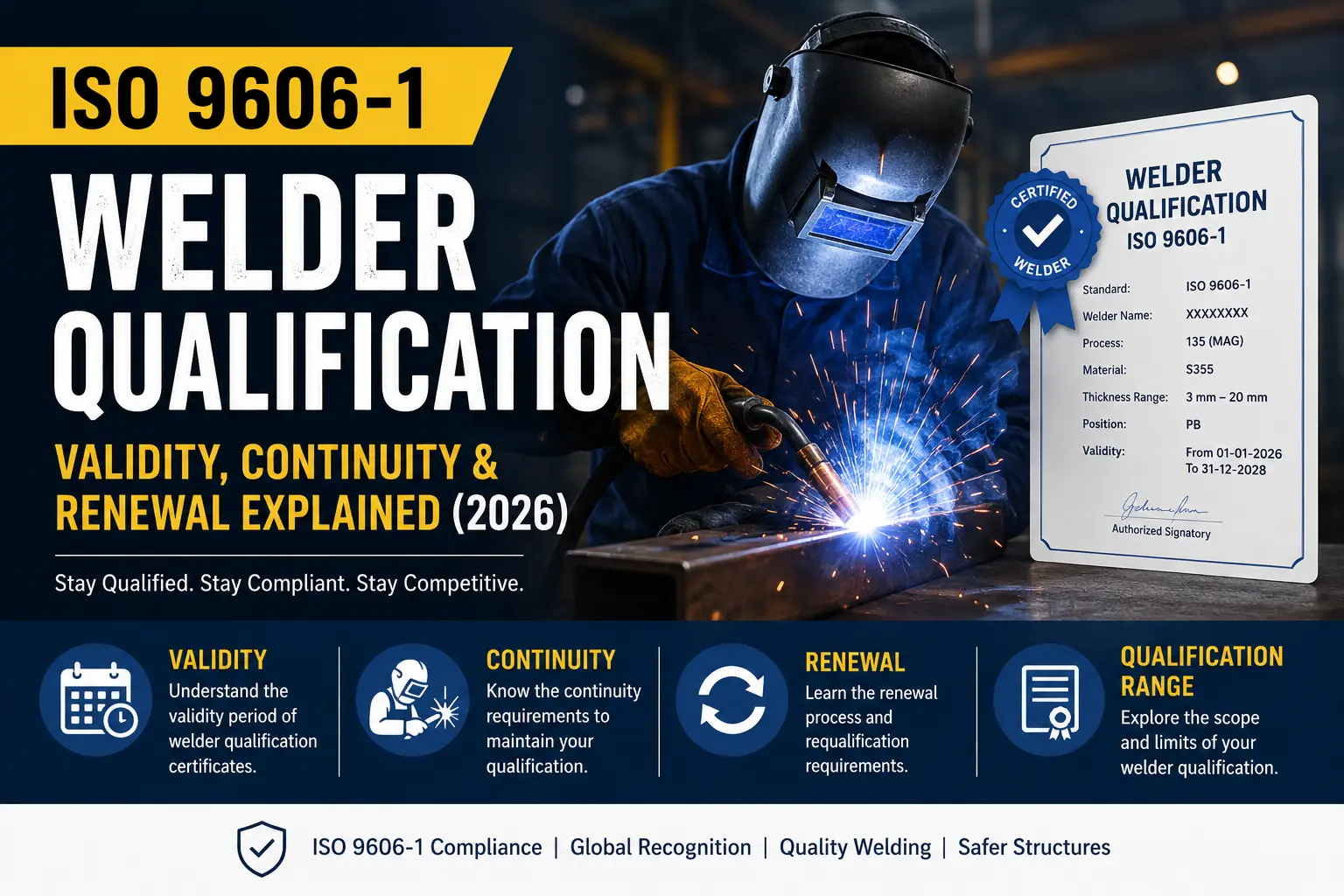
ISO 9606-1
WELDER QUALIFICATION
EXPLANINATION
21 Aug 2026
ISO 9606-1 Welder Qualification: Validity, Continuity & Renewal Explained (2026)
By Editorial Team
Related Blogs
AUG
22
ISO 9606-1 Welder Qualification Test: What Happens During the Certification Process?
AUG
22
How to Read an ISO 9606-1 Welder Qualification Certificate: A Field-by-Field Guide
AUG
22
ISO 9606‑1 vs ISO 14732: Welder vs Welding Operator Qualification
AUG
22
7 Common Reasons an ISO 9606-1 Welder Qualification Can Become Invalid
See Also.....
ISO 9606-1 is an international standard that helps qualify welders for fusion welding steel.It focuses on the welder’s skill, whether they are working manually or with some machine help, not on the specific process or tools used.To keep their certificate valid, a welder must stay active in their approved welding tasks.Their certificate is usually good for 2 to 3 years, but only as long as they meet the 6-month activity requirement.Every six months, the employer or welding supervisor must check that the welder has been working within their approved range.If they don’t get this confirmation or take a break longer than six months, their certificate stops being valid right away.
ISO 9606-1 Scope and Purpose
ISO 9606-1 sets the rules for testing welders who do fusion welding on steel.It explains how to check if a welder has the right skill to do the job.A welder is tested by making one or more welds on a test piece that uses a pre-approved welding procedure.Then, the test piece is checked using various methods like visual inspection and nondestructive or destructive testing, such as X-ray or ultrasonic testing, bend tests, or dye penetrant testing.If the test piece passes strict standards—like no cracks bigger than 3 mm, or flaws that meet ISO 5817 Level B limits—the welder gets a Welder Qualification Certificate (WQC).It’s important to know that this certificate isn’t a general permission to weld anywhere or anything.It only shows the welder is qualified for certain conditions, which are determined by the test they went through.
ISO 9606-1 is used for welding that is done manually or with some help from machines, but not fully automated systems.
Fully automatic welding is covered by a different standard, ISO 14732.This standard is widely used around the world in places where European or ISO standards apply, like pressure equipment, structures, or railways.In the U.S., other standards like ASME Section IX and AWS D1.1 are used for welder qualifications, though they share some similar ideas.For companies that export to different countries, like Indian steel makers, it’s common to keep records for each standard.If a customer asks for ASME IX or AWS D1.1, welders are tested under those rules.If the order requires ISO 9606-1, like for the EU, pressure vessels under PED, or EN 15085, that standard is used instead.
Qualification Validity and the 6 Month Continuity Rule
ISO 9606-1 certificates aren’t like a set date that just expires.Instead, they are kept up to date through regular checks.A certificate might say it’s valid for three years, but to keep the qualification active, the welder must be officially checked every six months.The employer or welding supervisor has to write a formal statement confirming that the welder has been working in the right way and there are no worries about their skills.This process is known as the six-month continuity rule.If this check isn’t done or there’s no record, the certificate becomes invalid right away, even if the three-year period hasn’t finished.So, ISO 9606-1 isn’t just a two-or-three-year pass; it’s a system that keeps track of a welder’s skills to make sure they don’t get worse over time.
For example, if a welder gets certified in June 2024 with a three-year certificate, they aren’t automatically qualified until June 2027.
The employer has to sign off on the welder’s work every six months, like in December 2024, June 2025, and December 2025.If there’s no sign-off by December 2025, or if the welder takes a break longer than six months, the certificate stops being valid from that point.This rule also means that there can’t be long breaks in work.As one guide says, if a welder works without being checked for two years, their qualification must stop under ISO 9606-1.Similar rules apply in ASME IX and AWS D1.1, where a break longer than six months usually means requalification is needed.AWS D1.1 also allows a certificate to stay valid forever only if there’s proof of continuous work.
Important thing to remember: ISO 9606-1 certificates need to be checked every six months.
Missing the six-month check is the most common mistake found during audits.
Requalification (Renewal) Routes – Clause 9.3
When it’s time to renew a certificate, ISO 9606-1 provides three ways to revalidate it under Clause 9.3.The original certificate must show which of these methods will be used for future renewals.A certified organization can’t change the method suddenly or let the worker choose; each method has fixed requirements that are set when the certificate is first issued.The three options are:
- Route 9.3(a): Full Re-test Every 3 Years.
The welder has to take a complete new qualification test using a new sample (coupon), with the same welding process and materials as before.If they pass, a new certificate is given for another three years.This is the most straightforward method (like a fixed three-year retest).If the welder doesn’t pass the test, their certification stops. - Route 9.3(b): Production Weld Testing Every 2 Years.
Instead of a full retest, the welder’s skill is checked by testing two real production welds they have made.These welds must be done within the last six months of the certificate’s current validity and use the same process and materials.These welds are then inspected using non-destructive testing methods like radiography, ultrasonic testing, or bend tests.If both welds meet the original test standards, the certificate is renewed.If either weld doesn’t meet the standards or can’t be properly traced, the certificate stops.This method avoids the cost of a full retest but requires strict record-keeping and testing. - Route 9.3(c): Continuous Validity with Quality System.
If the manufacturer has a welding quality management system certified to ISO 3834-2 or ISO 3834-3, the welder’s qualification may stay valid forever as long as the system remains in place.In practice, this route requires regular checks every six months to ensure the welder continues to meet standards.No full test or sample weld is needed.However, if the company’s ISO 3834 certificate ends or the welder moves jobs, this method stops.It’s important to note that not all certification bodies allow Route (c); some require Route (a) or Route (b) instead.
In short, a welder’s certificate is renewed by passing one of these routes.
Route (a) requires a new test every three years; Route (b) uses production welds every two years; Route (c) keeps the certificate valid without a set expiry.In all cases, an independent examiner must witness and sign off on the revalidation process.Employers can’t renew the certificate on their own.
Qualification Range (Essential Variables)
A common mistake is thinking that one welding certificate covers all types of welding.In reality, ISO 9606-1 sets clear limits on what a welder is qualified for, based on the specific conditions they were tested under.The range of what a welder can do depends on essential variables.Here are the key variables:
- Welding process: For example, SMAW with electrode 111, GMAW with metal-cored 138, or TIG 141.
If the process changes, a new test is needed. - Product type and weld type: This includes things like plate butt vs.
fillet, pipe vs.plate.Often, separate certificates are needed for different types, like pipe versus plate or butt versus fillet. - Material group: As defined by ISO/TR 15608, such as Group 1.1 for low-carbon steel, Group 1.2 for higher-strength steel, and Groups 3-5 for Cr-Mo steels.
Filler metals also have groups.A test on one group may cover nearby groups according to ISO rules, but not all groups automatically. - Plate thickness (or tube OD): The certificate defines a thickness range.
For instance, a 12 mm plate test could cover thicknesses from 3 mm to 24 mm.If the work is outside this range, like 30 mm, a new test on a thicker sample is needed.For pipe welds, the outside diameter (OD) of the test piece sets the range.A 150 mm pipe test could cover from 75 mm to unlimited.A DN15 (21.3 mm) test only covers from 21.3 mm to 42.6 mm.Plate tests don’t automatically cover small-bore pipes unless certain conditions (Annex B) are met. - Welding position: ISO 6947 uses position codes such as PA flat, PB horizontal/vertical, PC horizontal butt, PD vertical-down, PE overhead, PF vertical-up, and pipe inclines like H-L045.
Each test position usually covers specific other positions (for example, PF covers PA, PB, PC, and PF).For the broadest coverage, overhead (PE) on plate or H-L045 on pipe are good options.If production requires a position not tested, a requalification is needed. - Filler metal type: The certificate lists the electrode or wire specification used.
ISO 9606-1 groups similar fillers like FM1 for mild steel, FM2 for high-strength steel, etc.Using a filler outside the tested group requires a new test.
Each essential variable acts like a limit, not a flexible range.
For example, a welder qualified on a 10 mm flat fillet using SMAW on S235 steel is not automatically qualified for a 20 mm vertical pipe butt weld on Cr-Mo steel—despite all being steel.If any variable is outside the approved range, a new or supplementary test is needed.The industry generally uses a Qualification Matrix: before assigning a welder, compare all variables (process, thickness, material, position, etc.) with the certificate.The figure below (Mermaid flowchart) shows the decision logic for renewal or continuity.