
WPQR
WPQR TO WPS
QUALIFICATION
01 Oct 2026
Can One WPQR Cover Multiple WPS? Understanding WPQR-to-WPS Qualification Scope
By Editorial Team
Table Of Contents
- What Is the Relationship Between a WPQR and a WPS?
- Can One WPQR Support Multiple WPS Documents?
- The key principle is:
- How Does One WPQR Support Multiple WPS?
- What Determines Whether Multiple WPS Are Covered?
- One WPQR Does Not Mean Unlimited WPS
- When Might a New WPQR Be Required?
- WPQR-to-WPS Traceability
- Practical Checklist: Can One WPQR Support Your WPS?
- WPQR and WPS: The Bottom Line
- Frequently Asked Questions
Related Blogs
SEP
22
WPS and WPQR Qualification Tests: Complete Testing Requirements Guide
AUG
28
From WPS to Digital Weld Records: Building a Connected Welding Quality System
AUG
11
How Long Is WPQR Valid? WPQR Validity Explained
AUG
10
How to Prepare a WPQR: Step-by-Step Welding Procedure Qualification Guide
AUG
04
WPS & WPQR Explained: The Complete Manufacturer's Guide to Welding Procedure Qualification, Requirements, Standards and Industrial Applications (2026)
See Also.....
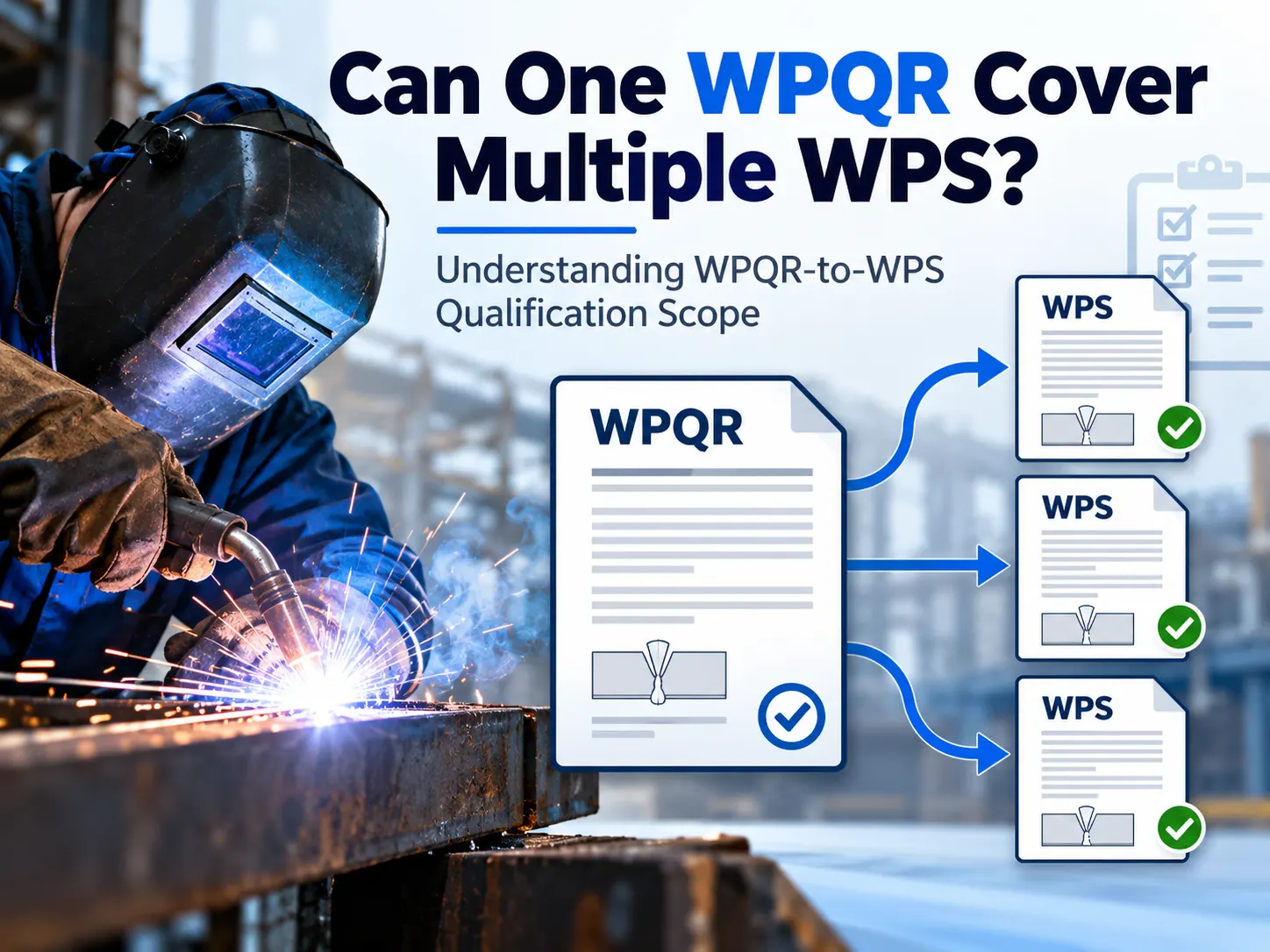
A WPQR can be used for several WPSs as long as they are within the allowed limits and follow the welding rules. Knowing how these are connected helps manufacturers save time by not doing extra tests, and makes sure that the welding done in production is properly tested and can be tracked back.
What Is the Relationship Between a WPQR and a WPS?
A WPS explains how welding is done, including the welding technique, the type of metal being welded, the filler metal used, how the pieces are joined, the position of welding, the temperatures needed before and between welds, the electrical settings, and important factors. A WPQR records the real welding conditions and test results to show that the welding method works well.
| Document | Main Purpose |
|---|---|
| WPQR | Provides evidence that the welding procedure has been successfully qualified |
| WPS | Provides controlled instructions for production welding |
| Qualification range | Defines the conditions under which the qualified procedure may be applied |
Can One WPQR Support Multiple WPS Documents?
A single WPQR can handle several WPS documents as long as they are within the allowed limits. Different WPS documents can come from the same welding process, but each one needs to be checked against the relevant WPQR and the required qualification standards.
The key principle is:
A single WPQR can cover several WPS documents as long as the key welding variables are qualified, based on applicable standards, product needs, welding techniques, and the scope of qualification.
How Does One WPQR Support Multiple WPS?
A manufacturer who has a qualified WPQR for a certain welding process and material can make several WPS documents for production, as long as they follow the limits set by the WPQR.
| Parameter | WPQR Qualified Condition | WPS A | WPS B | Covered? |
|---|---|---|---|---|
| Welding process | Qualified process | Same | Same | Yes |
| Base material | Qualified group | Same group | Same group | Yes |
| Thickness | Within qualified range | Within range | Within range | Yes |
| Welding position | Qualified position | Covered | Covered | Yes |
| Filler material | Qualified classification | Covered | Covered | Yes |
| Other essential variables | Within applicable limits | Covered | Covered | Yes |
One WPQR can cover several WPS documents, as long as each WPS meets the requirements set by the WPQR.
What Determines Whether Multiple WPS Are Covered?
– Check the welding process to see if any changes might affect what is needed for qualification.
– Make sure the WPQR covers the right material group or range.
– Confirm that the material thickness is within the approved range in the WPQR.
– Check the approved welding position and the allowed positions listed in the production WPS documents.
– Ensure the type of filler material and its limits match what is approved in the procedure.
– Review any changes to the joint setup, backing, or preparation that could affect the qualification.
– Keep heat input, preheat, inter-pass temperature, shielding gas, and other factors within the limits set during qualification.
One WPQR Does Not Mean Unlimited WPS
Manufacturers should know that a WPQR isn’t a general approval for every welding situation.It applies only to specific WPSs—A, B, and C—and covers only the approved ranges. If a new WPS goes beyond these ranges, more testing or approval might be needed.
When Might a New WPQR Be Required?
A new qualification might be needed for production WPS changes that are outside the approved limits; common areas to check are:
| Change | Qualification Review Needed? |
|---|---|
| Different welding process | Yes |
| Different material/group | Yes |
| Thickness outside qualified range | Yes |
| Different filler classification | Yes |
| Different welding position | Potentially |
| Major joint configuration change | Potentially |
| Heat input outside permitted range | Potentially |
| Other essential variable change | Depends on applicable standard |
Requirement must align with welding procedure standards and project specifications.
WPQR-to-WPS Traceability
A manufacturer needs to keep track of how WPQR connects with different WPS documents, showing the WPQR, qualification range, WPS, and the actual production weld. This helps welding coordinators, quality team members, and auditors to clearly understand which WPS documents have been approved.
Practical Checklist: Can One WPQR Support Your WPS?
Before using a single WPQR for several WPS documents, make sure: the qualification standard is known; the welding process, base material, thickness, joint type, welding position, and filler material are all included; welding parameters are within allowed limits; heat input requirements are satisfied; the WPQR documents are connected to the WPS; and project or customer needs are checked. If any important factor goes beyond qualification limits, don’t use the existing WPQR for a new WPS.
WPQR and WPS: The Bottom Line
A WPQR can include several WPS documents, but each WPS must meet the standards set by the WPQR. Manufacturers should check each WPS against the WPQR before welding to prevent unnecessary qualification steps and to make sure the work is of high quality and follows the rules. First Welding Certification Pvt.Ltd. offers services to help manufacturers get approval for their welding procedures through WPS and WPQR qualification.
Frequently Asked Questions
Can one WPQR support more than one WPS?
Yes.
A single WPQR can support several WPS documents as long as the WPS parameters stay within the qualification range and meet the requirements of the relevant standard.
Does each WPS need its own WPQR?
Not always.
The same WPQR can cover multiple WPS documents if their qualification variables are included.
Can a WPS modify the welding parameters from the WPQR?
Only within the approved qualification range.
Any changes beyond the qualified limits might need extra qualification.
Does the thickness of the material impact whether a WPQR can support a WPS?
Yes.
The actual thickness must be within the qualified thickness range stated in the WPQR.
Can one WPQR cover different welding positions?
It depends on the qualified positions and the relevant standard.
The welding position used in production must be covered by the qualification.
When is another WPQR needed?
Another WPQR may be required if the proposed WPS has changes that go beyond the qualified range, or if the standard, product specification, or customer requirements call for additional qualification.
Before using a WPQR for a production WPS, make sure to check the right edition of the welding procedure qualification standard and the project requirements.