
WPS
Welding Procedure Qualification Record (WPQR)
Approved requirements
When Should a WPS Be Revised, and When Is a New WPQR Required? A Practical Guide for Manufacturers
By First Welding Certification Technical Editorial Team
6 Min Read Time
22 Oct 2026
Table of Contents
- Introduction
- What is a WPS?
- What is a WPQR?
- WPS revision vs WPQR requalification
- When should a WPS be revised?
- When is a new WPQR required?
- Important welding variables to review
- Practical manufacturing examples
- Common mistakes manufacturers should avoid
- A checklist for reviewing WPS changes
- Frequently Asked Question
- Related Searches
- Conclusion
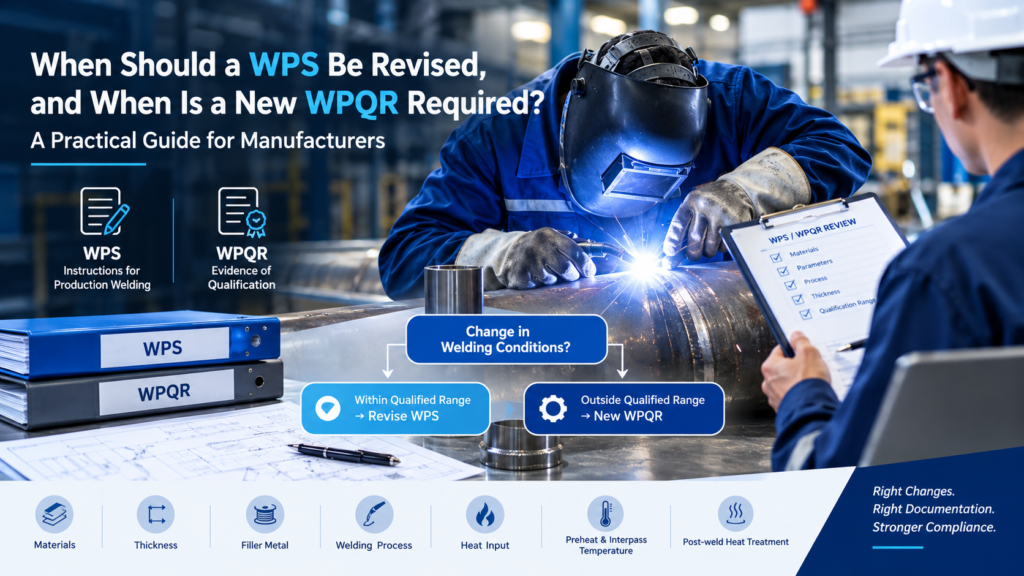
Introduction
In welding fabrication, even a small change in production conditions can raise an important technical question: can the existing Welding Procedure Specification (WPS) still be used, or is a new Welding Procedure Qualification Record (WPQR) required?
This question is particularly important for manufacturers working in railway, structural steel, pressure equipment, industrial fabrication and other sectors where welding quality, traceability and compliance with applicable standards are essential.
A WPS provides the instructions needed to perform a welding operation. A WPQR records the results and essential details of the qualification test that demonstrates the procedure’s capability within a defined range.
When discussing the welding procedure qualification, it is essential to distinguish between two similar terms: WPS and WPQR. A WPS is a document that describes the welding procedure in detail, while a WPQR is a record of qualification tests performed on a procedure. In other words, a WPS is the set of instructions for making welds, while a WPQR is the evidence that a given procedure actually works.
What Is a Welding Procedure Specification (WPS)?
A Welding Procedure Specification is a controlled technical document that describes how a welding operation should be performed.
Depending on the welding process, application and governing standard, a WPS may specify:
- Welding process and process sequence
- Base material specification and applicable material group
- Joint design and welding position
- Filler metal classification and size
- Welding current, voltage and travel speed, as applicable
- Preheat and interpass temperature requirements
- Shielding gas and flow rate, where applicable
- Heat input or other relevant welding parameters
- Post-weld heat treatment requirements, where applicable
The purpose of a WPS is to provide clear, repeatable instructions for production welding. A WPS should be suitable for the intended application and supported by an appropriate qualification route where required by the governing standard, contract or application code.
What Is a Welding Procedure Qualification Record (WPQR)?
A Welding Procedure Qualification Record is a document that describes the welding procedure qualification test and provides information about the weldment. Under the applicable qualification standard, it generally records the actual conditions used during the test, relevant material and consumable details, examination results, mechanical test results where required, and other information necessary to establish the qualification range.
For example, under the ISO 15614 series, a welding procedure test is used to demonstrate that the proposed welding process can produce a joint with the required properties for the intended application.
The resulting WPQR supports the preparation of a WPS within the permitted qualification range. It is essential to distinguish between a WPS and a WPQR since they serve fundamentally different purposes:
WPS: Specifies how production welding is to be performed.
WPQR: Records the procedure qualification test and the evidence supporting the qualified range.The WPQR is not simply another version of the WPS.
It provides the technical basis for determining which welding conditions the procedure is qualified to cover.
WPS Revision vs WPQR Requalification
The key difference is whether the proposed change remains within the permitted qualification range.
A WPS revision may be appropriate when production instructions need to be updated or clarified and the changes remain permitted by the governing standard and supporting qualification.
Requalification may be necessary when a change falls outside the permitted range or affects a variable for which the applicable standard requires renewed qualification.
| Situation | Typical action |
|---|---|
| Correcting a document reference or improving instructions | Review and revise the WPS under document control |
| Adjusting a parameter within its permitted qualified range | Verify compliance, then update the WPS if necessary |
| Changing a material beyond the qualified material range | Assess whether additional qualification is required |
| Changing the welding process | Check whether the new process is covered; requalification may be required |
| Changing a required heat-treatment condition | Review the applicable qualification rules before approval |
| Changing thickness beyond the permitted range | Establish whether the existing qualification covers it |
When Should a WPS Be Revised?
A WPS should be reviewed whenever production requirements or controlled welding instructions change. However, not every revision requires a new qualification test.
4.1 Changes to production instructions
A manufacturer may need to clarify joint preparation, welding sequence, parameter ranges, consumable handling or other instructions to improve consistency on the shop floor.
If the revision remains within the existing qualification and applicable requirements, an administrative or technical WPS revision may be sufficient.
4.2 Changes within an approved parameter range
Suppose a qualified WPS permits a specified range of welding current and voltage, and the production team proposes a change that remains within those limits.
The manufacturer should confirm that the proposed settings also satisfy all other relevant requirements, including heat input limits where applicable. If the change remains within the permitted range, a new WPQR is not automatically required.
4.3 Corrections to documentation
A document may require correction because of an incorrect reference, an unclear instruction or an administrative error.
Such corrections should follow the manufacturer’s document-control procedure. If the correction reveals that actual production conditions differ from the qualified procedure, a technical review is necessary before the WPS is approved for continued use.
4.4 Changes to production requirements
A new customer specification, application standard or project requirement may impose different conditions from those considered in the original qualification.
The manufacturer should review the existing WPS and WPQR against the new requirements before accepting the procedure for the project.
When Is a New WPQR Required?
A new welding procedure qualification test may be necessary when a proposed change exceeds the permitted range of the existing qualification or when the governing standard specifically requires requalification.
The following areas deserve particular attention.
5.1 Change in welding process
A change in the welding process always requires a new qualification test, since a procedure qualified for one welding process is not necessarily applicable to another. For example, a procedure qualified for gas metal arc welding (GMAW) cannot be used for gas tungsten arc welding (GTAW) without additional qualification testing.
5.2 Change in base material
Material substitutions are common in fabrication, but they must not be treated as interchangeable without technical review. The review should consider the material specification, material group, applicable qualification range, mechanical properties and any additional project or service requirements.
A change to a material outside the range supported by the WPQR may require additional qualification testing.
5.3 Change in material thickness
Thickness affects heat flow, cooling behaviour and the mechanical properties that may be required of the welded joint. Welding procedure qualifications establish thickness ranges according to the applicable standard and the details of the qualification test.
If the proposed production thickness falls outside that range, the manufacturer must determine whether another existing qualification covers it or whether further testing is required.
5.4 Change in filler metal
Filler metal classification, composition and other consumable characteristics can influence weld-metal strength, toughness, chemical composition and cracking resistance. The manufacturer should check the applicable qualification rules before changing the consumable classification or using a filler metal outside the qualified range.
A new WPQR may be required depending on the standard and the nature of the change.
5.5 Change in heat input or welding parameters
Welding current, voltage, travel speed and other process conditions can affect heat input and the resulting weld properties.
For applications with impact toughness or other specified mechanical-property requirements, the permitted ranges may be particularly important. A proposed change should be checked against the recorded qualification conditions and the limits established by the applicable standard.
5.6 Change in preheat or interpass temperature
Preheat and interpass temperature influence cooling behaviour, hardness and the risk of hydrogen-assisted cracking. The qualification standard may define specific limits or conditions for these variables.
If a proposed change exceeds the permitted limits, requalification or another form of technical approval may be necessary.
5.7 Change in post-weld heat treatment
Post-weld heat treatment can significantly influence the final properties of a welded component.
Adding, removing or changing a required heat-treatment condition must therefore be assessed carefully. The existing WPQR may not support the proposed condition, depending on the applicable qualification rules and material requirements.
5.8 Change in welding position or transfer mode
Welding position, metal transfer mode and other process-specific variables may affect the qualification range.
For example, a change involving pulsed transfer or a waveform-controlled welding process should be checked against the relevant requirements rather than assumed to be covered by an existing qualification.
The manufacturer must identify the variables that are essential under the applicable standard before deciding whether requalification is needed.
Important Welding Variables to Review
When a change is proposed, the review should be based on the governing standard rather than on a general checklist alone.
| Variable | Why it matters |
|---|---|
| Welding process | Different processes have different qualification requirements |
| Base material | Material groups and properties affect qualification coverage |
| Material thickness | Qualification establishes permitted thickness ranges |
| Filler metal | Classification and composition may influence weld properties |
| Welding position | Permitted positions depend on the qualification standard |
| Heat input | May affect toughness, hardness and other mechanical properties |
| Preheat and interpass temperature | Influence cooling and cracking risk |
| Shielding gas | Gas composition and process-specific rules can affect qualification |
| Joint configuration | Qualification coverage depends on the test and applicable rules |
| Post-weld heat treatment | Can change the mechanical properties of the joint |
Practical Manufacturing Examples
The following scenarios illustrate how manufacturers can approach common WPS change requests.
Example 1: Adjusting welding current
A welding engineer proposes changing the welding current to improve production efficiency.
Recommended action: Compare the proposed setting with the WPS range and applicable heat input requirements. If the change remains within the permitted limits and all other conditions are satisfied, a new WPQR may not be required.
Example 2: Using a different base material
A manufacturer wants to replace the specified material with another grade available from a supplier.
Recommended action: Verify the material specification and qualification range. If the replacement falls outside the existing qualification, additional testing or another approved qualification route may be required.
Example 3: Increasing production thickness
A fabrication order requires a thicker component than the one covered by the manufacturer’s current procedure.
Recommended action: Check the qualified thickness range under the applicable standard. Do not assume that a successful test on one thickness covers all production thicknesses.
Common Mistakes Manufacturers Should Avoid
Mistake 1: Assuming every WPS revision requires a new WPQR
This can result in unneeded qualification tests and costs. First make sure that the change is not within your existing qualified range.
Mistake 2: Assuming every change is covered by the existing WPQR
This is equally risky. A small change can affect a variable that requires requalification under the applicable standard.
Mistake 3: Using a WPS without checking its supporting WPQR
The WPS must be supported by a valid qualification route and must remain within its permitted scope.
Mistake 4: Ignoring the project specification
A procedure that meets one standard may not satisfy a different contract, application code or customer requirement.
Mistake 5: Failing to control document revisions
Uncontrolled copies can lead to welders using outdated instructions or production teams applying parameters that have not been reviewed.
WPS Change Review Checklist for Manufacturers
- Before approving a revised WPS, manufacturers should complete the following checks.
- Identify the governing welding procedure qualification standard and its applicable edition.
- Review the current WPS and its supporting WPQR or other permitted qualification record.
- Clearly document the proposed change and its technical reason.
- Identify all affected qualification variables.
- Confirm that the material, thickness, welding process and other relevant conditions remain within the permitted range.
- Check any applicable heat input, preheat, interpass temperature and heat-treatment requirements.
- Review project specifications, application codes and third-party approval requirements.
- Determine whether an existing qualification covers the revised procedure or whether further testing is required.
- Obtain the required technical review and approval before releasing the revised WPS.
- Distribute the approved revision and withdraw obsolete copies from production use.
- This process helps manufacturers maintain control over welding instructions while avoiding unnecessary testing or unsupported changes.
Frequently Asked Questions
Is a new WPQR required for every revision to the WPS?
No. A revision does not automatically require requalification. If the changes remain within the permitted qualification range and satisfy the governing requirements, a new WPQR may not be necessary.
Can a manufacturer change welding parameters without repeating the qualification test?
Potentially, yes. The proposed parameters must remain within the applicable qualified limits, and all other relevant requirements must be satisfied. The decision should be documented.
What happens if the base material changes?
The manufacturer must check the material specification, applicable material group and qualified range. If the replacement is not covered, additional qualification may be necessary.
Related Searches
- WPS & WPQR Explained: The Complete Manufacturer's Guide to Welding Procedure Qualification, Requirements, Standards and Industrial Applications (2026)
- How to Prepare a WPQR: Step-by-Step Welding Procedure Qualification Guide
- EN 1090 WPS & WPQR Requirements: Ensuring Welding Quality and Compliance
- How Long Is WPQR Valid? WPQR Validity Explained
- From WPS to Digital Weld Records: Building a Connected Welding Quality System
Conclusion
A WPS revision and a new WPQR serve different purposes. Revising a WPS keeps production instructions aligned with approved requirements, while requalification establishes that a welding procedure meets the applicable qualification requirements when the existing evidence is insufficient.
For manufacturers, the most reliable approach is to assess every proposed change against the supporting qualification record, the applicable standard and the requirements of the project. This helps maintain welding quality, improve traceability, avoid unnecessary qualification costs and reduce the risk of nonconformities during inspection or conformity assessment.
Need guidance on WPS revision or WPQR requalification?
First Welding Certification Pvt Ltd (PRVÁ ZVÁRAČSKÁ, a.s.) can help you explore the relevant welding quality and certification requirements for your application.