
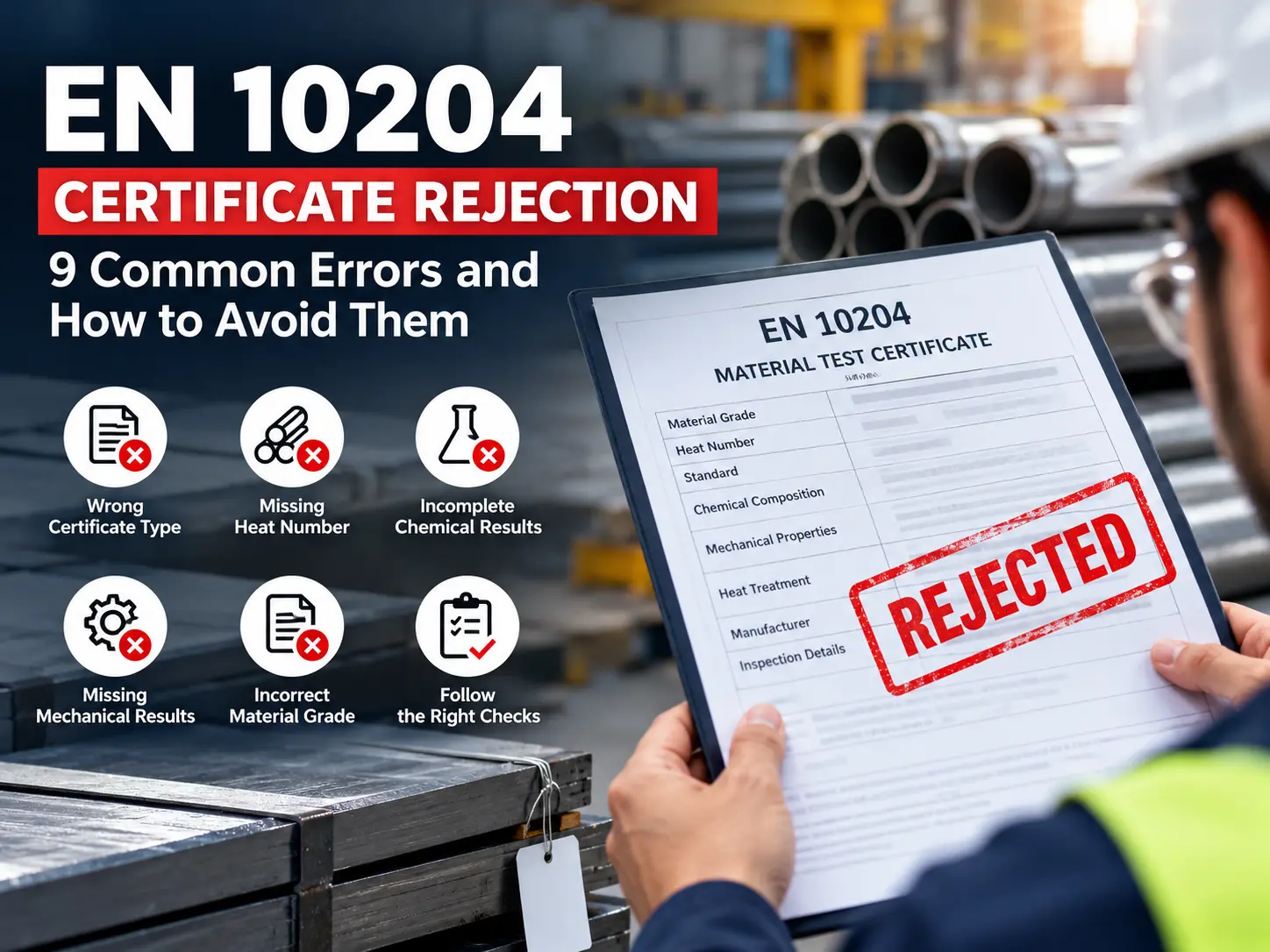
EN 10204
MISTAKES
CHECKLIST
29 Oct 2026
EN 10204 Certificate Rejection: 9 Common Errors and How to Avoid Them
By Editorial Team
Related Blogs
OCT
07
What Should Buyers Verify in an EN 10204 Type 3.2 Certificate for Steel Plates, Pipes and Structural Steel in India?
SEP
29
EN 10204 Type 3.2 RFQ Checklist for Indian & Global Buyers: What Should You Ask Manufacturers? Top 10 Questions Before Placing an Order
SEP
23
What Does an EN 10204 Type 3.2 Certificate Contain? Requirements, Third-Party Inspection and International Recognition in India
AUG
20
Steel Traceability for EU Exports: EN 10204, Heat Numbers & Digital Product Passport
AUG
11
EN 10204 Type 3.2 Inspection Certificate: Complete Guide for Manufacturers and Buyers
A material test certificate might look okay at first glance, but if it’s missing heat numbers or has the wrong grade, it can slow down deliveries. Problems can happen when the certificate doesn’t match the purchase order, test results are missing, or it’s hard to track the materials back to the manufacturer’s documents. These issues can stop production, make inspections take longer, and make it harder to accept materials. Knowing why a certificate might be rejected under EN 10204 helps buyers, suppliers, and quality checkers spot problems early on.
What Is an EN 10204 Certificate?
EN 10204 is a European standard that explains the different types of inspection documents used for metal products. It includes information about the material and makes sure the product meets the requirements stated in the purchase order, based on the technical specifications provided.
| Certificate Type | What It Means |
|---|---|
| EN 10204 Type 2.1 | A declaration that the supplied products comply with the order, without test results. |
| EN 10204 Type 2.2 | A test report containing results from non-specific inspection. |
| EN 10204 Type 3.1 | An inspection certificate containing specific inspection results, validated by the manufacturer's authorized inspection representative who is independent of the manufacturing department. |
| EN 10204 Type 3.2 | An inspection certificate containing specific inspection results, with additional validation by the purchaser's authorized representative or an inspector designated by official regulations. |
Assuming any test certificate will work is wrong; certain types, like Type 3.1, need to be decided on before placing an order, because Type 2.2 might not meet the requirements.
9 Common EN 10204 Certificate Errors
1 The certificate type does not match the purchase order
Picture this: you order steel that needs an EN 10204 Type 3.1 certificate, but instead you get a Type 2.2 test report. Even if the steel looks okay, the paperwork might not meet what was agreed upon.
To stop this from happening: make sure to write down exactly which certificate you need in your purchase order. Then, before you accept the steel, check if the document you get matches what you asked for.
2 Heat number traceability is missing
Heat numbers link the material to its production and inspection records. If the heat number on the certificate doesn’t match the markings on the delivered material, it becomes hard to confirm its true identity. This is especially important when dealing with steel plates, pipes, forgings, and materials used in pressure equipment.
To avoid this issue, check that the heat number on the certificate matches the markings on the material and the receiving records. Look into any differences before the material is used in production.
3 Chemical test results are incomplete
A certificate might show chemical composition results but might leave out an element or value that is needed according to the material specification. If the necessary information is missing, the buyer might not be able to check if the material meets the required standards.
To prevent this, compare the chemical composition listed in the certificate with the material grade and product specification. Make sure all required elements and their acceptable limits are included.
4 Mechanical test results are missing
The documentation of mechanical properties, such as tensile strength, yield strength, elongation, or impact performance, varies depending on the material and intended application. If the results are not documented, questions may arise about whether the material meets specified specifications. How can one avoid this confusion: Review the certificate against the purchase order and applicable standard. Ensure that all required tests and results are included.
5 The material grade or standard is incorrect
A certificate may show a material grade that is different from what was ordered. At times, the grade is right, but the standard or specification it refers to might not match. These differences shouldn’t be ignored just because they look like small mistakes without checking.
To prevent this, compare the material grade, product standard, size, and description on the certificate with the order. Let the supplier explain any differences before you accept the documents.
6 Required heat treatment information is missing
Some materials need certain heat treatments as part of how they are made or delivered. If an order needs extra information and the certificate or related documents don’t have it, you might need to do more checks.
To prevent this, figure out the heat treatment needs when you buy the material and make sure the required records are there when the material arrives.
7 Supplier or manufacturer details are inconsistent
If the manufacturer details, order numbers, or batch information are wrong, it can be hard to check the certificate. If the details don’t match, it might make people wonder if the certificate matches the material you provided.
To prevent this, make sure the manufacturer, supplier, order reference, product description, and batch information are all correct. If you can’t match the information, reach out to the organization that issued the certificate.
8 Required inspection validation is missing
For inspection certificates like Types 3.1 and 3.2, it’s important to check the validation requirements. If there’s no signature, if the authorization isn’t clear, or if the inspection details are missing, these issues should be fixed before the document is accepted.
To avoid problems: Make sure the certificate follows the validation rules for its specific type. For Type 3.2, be extra careful with the extra validation steps.
9 The certificate contains conflicting or questionable information
Different heat numbers in the same record, inconsistent test results, unexplained changes, or incomplete tables can cause issues when reviewing documents. A certificate that seems questionable doesn’t always mean the material isn’t suitable, but any differences should be looked into, not just ignored. To avoid problems, check the document for consistency and reach out to the manufacturer or the organization that issued the certificate through a trusted method if something looks wrong. Do not change the original certificate on your own.
How to Verify an EN 10204 Material Test Certificate
Checking a certificate can be easy if you follow a step-by-step process to find problems before approval.
Begin with the purchase order and check these things:
- Make sure the certificate type matches what was ordered.
- Check the material details to confirm the grade, size, product description, and heat number are correct.
- Look at the test results to see if they show the needed chemical and mechanical properties.
- Ensure the certificate is connected to the actual material you received.
- Check that the manufacturer details and inspection information are correct.
- Record any differences found and what steps were taken before accepting or releasing the material.
- Make sure the certificate truly meets the real requirements, not just that it exists.
EN 10204 Certificate Verification Flowchart
The following flowchart shows a practical way to review incoming material documentation.
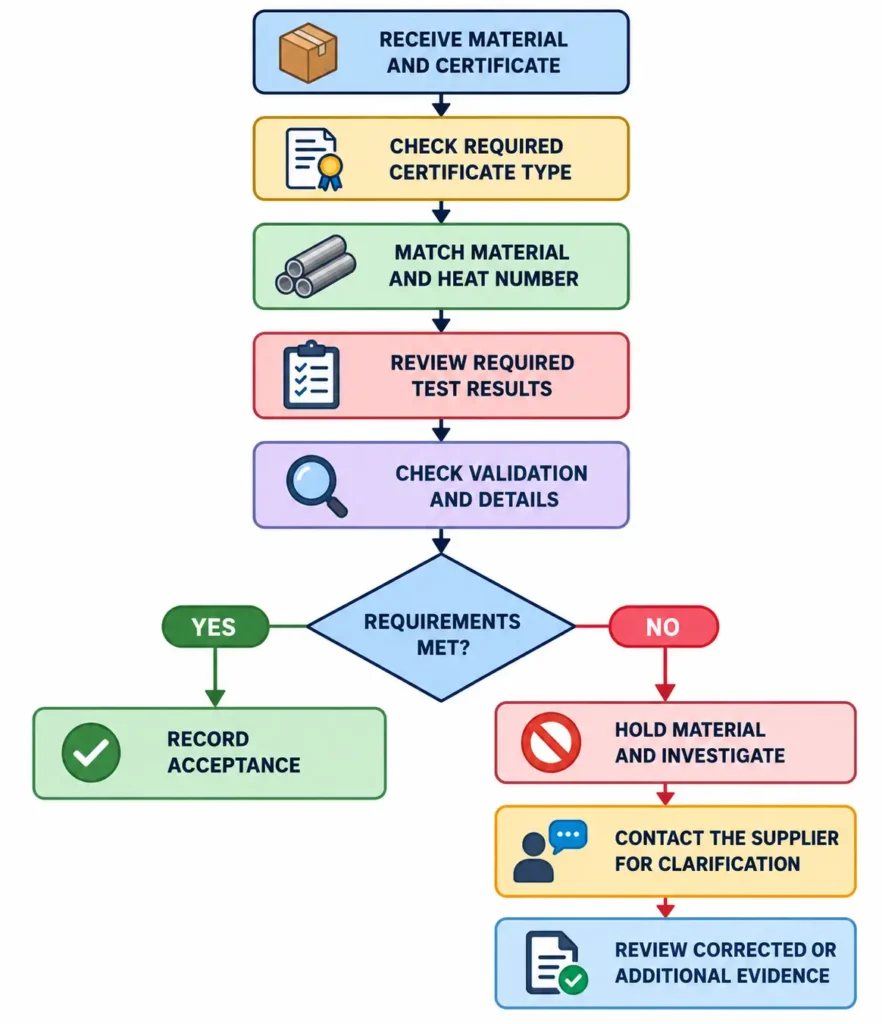
This is a standard check process. You should follow the inspection and approval steps mentioned in the purchase order and any relevant requirements.
How to Prevent EN 10204 Certificate Rejection
- Having clear requirements helps make it easier to solve problems with certificates.
- Make sure purchase orders are detailed, including the material grade, standards, type of certificate needed, and any extra tests required.
- Choose suppliers who understand and can provide the necessary documentation.
- Check traceability when you receive the materials to prevent mismatches or missing heat numbers.
- Review all documents before starting production so you have time to fix any differences or issues.
- Keep inspection records organized by keeping certificates with the related purchase orders, material details, and inspection papers.
- These steps won’t stop all material issues, but they can help avoid documentation problems that might slow down production.
FAQ's
Why are EN 10204 certificates rejected?
Certificates might be denied or delayed if the document type doesn’t match the order, if the tracking information is not complete, if necessary test results are not provided, or if the details don’t agree with what was requested.
How can I verify an EN 10204 3.1 certificate?
Check the material grade, heat number, applicable standard, required test results, manufacturer information, and confirmation from the manufacturer’s authorized inspection representative, separate from the manufacturing department.
What is the difference between EN 10204 3.1 and 3.2?
Both are based on specific inspection outcomes. Type 3.1 is checked by an inspector approved by the manufacturer, and this inspector works separately from the production team. Type 3.2 needs to be confirmed by an inspector chosen by the buyer or by someone appointed according to official rules.
What should I do if a material test certificate contains an error?
Keep the material in place if needed, note the difference, and reach out to the supplier or the company that made it. Ask for more information or the right documents, then check the material again against the correct standards.
Does an EN 10204 certificate guarantee that material is suitable for use?
It cannot be done on its own. The document needs to be checked against the purchase order, the relevant product standards, the material identification, and the intended use. More checks might be needed.
Final Thoughts
A missing heat number or wrong certificate type may look like a small paperwork problem, but it can slow down the approval of materials and cause problems in production. The best way is to include certificate checking as part of the process when materials arrive. Look at the purchase order, check the product’s history, review the needed test results, and fix any issues before the material is allowed to be used.
For companies that work with steel, pressure equipment, pipes, and other important products, checking documents regularly is key to making sure quality is maintained.