
EN 1090 Certification
Andhra Pradesh Steel Fabrication
Drawing Revision Control
EN 1090 Drawing Revision Control in Andhra Pradesh: Preventing Steel Fabrication Errors
By First Welding Certification Technical Editorial Team
6 Min Read Time
23 Nov 2026
Table of Contents
- Introduction
- Why Drawing Revision Control Matters in Steel Fabrication
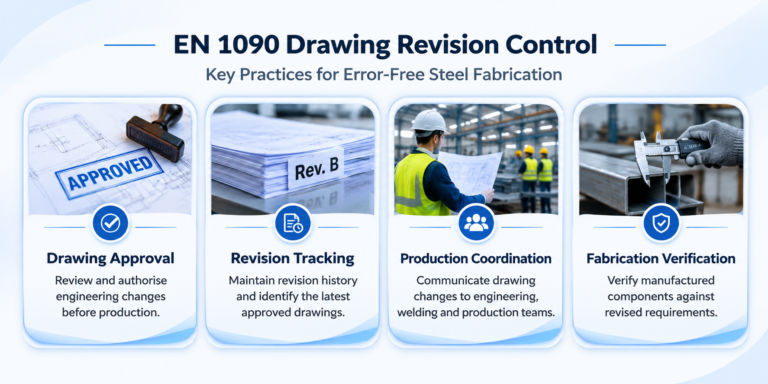
- Reviewing and Approving Drawing Changes Before Production
- Communicating Revised Drawings to Fabrication Teams
- Checking the Impact of Drawing Changes on Welding and Inspection
- Maintaining Drawing Revision Records for EN 1090 Assessment
- Frequently Asked Questions
- Related Searches
- Conclusion
Introduction
Steel fabrication involves several connected activities, including engineering design, material preparation, cutting, welding, assembly and inspection. Each activity depends on accurate technical drawings and manufacturing instructions. Even a small change in a dimension, connection detail or material specification can affect the way a structural component is manufactured. For steel fabricators in Andhra Pradesh, particularly companies operating in Visakhapatnam, Vijayawada, Guntur, Tirupati and other industrial areas, managing drawing revisions is an important part of production control.
A project may begin with an approved fabrication drawing, but changes can arise during production due to design corrections, customer requirements, site conditions or engineering reviews. If an outdated drawing remains in use, the result may be incorrect cutting, unsuitable connections, welding rework or dimensional nonconformities. Under EN 1090, manufacturers need to control the technical information used during the execution of structural steelwork. Drawing revision control helps ensure that fabrication teams work with the correct approved information and that changes are properly reviewed and communicated.
This blog explains five important areas of drawing revision control that steel manufacturers in Andhra Pradesh should consider when managing EN 1090 production requirements.
Why Drawing Revision Control Matters in Steel Fabrication
A fabrication drawing provides essential information about how a structural component must be manufactured. It may include dimensions, material grades, connection details, weld symbols, hole positions, tolerances and assembly requirements. When a project drawing is revised, the manufacturing team must understand exactly what has changed and which components are affected. For example, a steel fabrication company in Andhra Pradesh may receive an updated drawing for an industrial platform. The revised version may change the position of a connection plate or modify the dimensions of a supporting member.
If production continues using the earlier drawing, the fabricated components may not match the approved design.
Common problems caused by uncontrolled drawing revisions include:
- Incorrect cutting dimensions.
- Incorrect hole positions and connection details.
- Use of outdated material specifications.
- Welding performed according to superseded details.
- Assembly mismatches during fabrication or installation.
- Additional rework, delays and material wastage.
- Inspection failures due to differences from approved drawings.
A controlled drawing system helps manufacturers prevent these issues and maintain consistency throughout production.
Reviewing and Approving Drawing Changes Before Production
Not every drawing change has the same technical impact. A minor clarification may not affect manufacturing, while a change in member size, connection design or material specification may require a detailed technical review. Before implementing a revised drawing, manufacturers should establish a review process.
The review should identify:
Nature of the change: Determine whether the revision affects dimensions, material grades, connection details, welding information, tolerances or other technical requirements.
Affected components: Identify which parts, assemblies or production orders are connected to the revised drawing.
Production status: Check whether the affected components are still awaiting production, already cut, under welding or completed.
Technical impact: Review whether the change affects the approved execution specification, manufacturing instructions, inspection requirements or other project requirements.
Approval responsibility: Confirm that the revision has been reviewed and authorised by the appropriate design or project authority before it is implemented.
For example, if a connection detail changes after cutting has started, the manufacturer should identify the affected components and determine the appropriate action before continuing fabrication. This approach helps prevent informal instructions from replacing approved technical information.
Communicating Revised Drawings to Fabrication Teams
An approved drawing revision is useful only when the correct information reaches the people responsible for manufacturing. Engineering, production, welding, inspection and quality personnel should have access to the current applicable documents. Manufacturers should establish a clear method for distributing revised drawings and withdrawing superseded versions.
Important practices include:
- Maintaining a drawing register with document numbers and revision details.
- Identifying the latest approved revision.
- Recording the date on which revised documents are received and issued.
- Communicating changes to relevant departments.
- Removing outdated printed drawings from production workstations.
- Informing subcontractors when revised information affects their activities.
- Retaining previous revisions for reference and traceability.
For example, when a revised structural assembly drawing is issued, the production supervisor should confirm that the cutting and welding teams are using the correct version. A document register can help the manufacturer identify which revision was applicable to each production activity. This is especially important for companies handling multiple fabrication projects at the same time.
Checking the Impact of Drawing Changes on Welding and Inspection
Drawing revisions can affect more than component dimensions. They may also influence welding operations, inspection arrangements and manufacturing records. A change in joint configuration, plate thickness or connection design may require a review of the applicable welding arrangements.
Manufacturers should consider the following areas when reviewing a revised drawing:
Welding requirements: Check whether changes to joint details or material thickness affect the applicable WPS, welding parameters or qualification arrangements.
Welder competence: Confirm that personnel assigned to the revised welding activity have qualifications appropriate to the work.
Material requirements: Review whether the revision changes material grades, dimensions or other specified properties.
Dimensional inspection: Identify whether new or modified measurements need to be checked during fabrication.
Non-destructive testing: Review whether the revised technical requirements or project specifications affect the applicable inspection and testing arrangements.
Production records: Update relevant manufacturing and inspection documents so that they correspond to the approved revision.
For instance, a revised connection detail may change the weld location or joint preparation. The manufacturer should review the relevant welding instructions and inspection arrangements before proceeding.
This helps maintain consistency between engineering information and actual manufacturing activities.
Maintaining Drawing Revision Records for EN 1090 Assessment
Document control should continue throughout the manufacturing process, not stop after a revised drawing has been issued. Manufacturers should maintain records showing how changes were received, reviewed, approved, distributed and implemented.
A practical drawing revision record may contain:
- Project name and identification number.
- Component or assembly reference.
- Drawing number and original revision.
- Revised drawing number or revision level.
- Date of receipt.
- Description of the change.
- Technical review and approval details.
- Departments or subcontractors informed.
- Production status at the time of revision.
- Final implementation and verification status.
These records help demonstrate that manufacturing activities were performed using controlled technical information.
For EXC2, EXC3 and EXC4, EN 1090-2 includes quality-documentation requirements covering procedures for handling changes and modifications. Its quality-plan guidance also addresses document revision status and prevention of obsolete documents being used. The exact applicable requirements should be checked against the relevant standard edition and project specification. Manufacturers should also retain the final applicable drawings and production records as part of the execution documentation.
This makes it easier to connect the approved engineering information with the finished structural components during assessment and project handover.
Frequently Asked Questions
Why is drawing revision control important under EN 1090?
Drawing revision control helps manufacturers ensure that fabrication activities follow the current applicable technical information. It reduces the risk of incorrect dimensions, outdated manufacturing instructions and production nonconformities.
What should a manufacturer do when a drawing changes during fabrication?
The manufacturer should identify the affected components, review the technical impact, obtain the required approval, communicate the revision to relevant personnel and determine how work already completed should be handled.
Does EN 1090-2 address changes and modifications in production documentation?
Yes. EN 1090-2 includes provisions for handling alterations to the execution specification and requires change-handling procedures within quality documentation for EXC2, EXC3 and EXC4.
What records should be maintained for drawing revision control?
Manufacturers should maintain drawing registers, revision histories, approval records, distribution details and relevant production or inspection records demonstrating that approved changes were implemented.
Related Searches
- EN 1090 for Steel Staircases, Handrails and Platforms: When Is CE Marking Required Globally In 2026?
- ISO 9606-1 Welder Qualification in Singapore: How Fabrication Supervisors Plan Qualification Coverage for Stainless Steel Process Piping
- EN 1090 Scope Extension: How to Add New Products, Materials and Manufacturing Processes
- EN 1090-3 for Aluminium Roof Structures in Singapore: Fabrication, Assembly and Inspection
Conclusion
Drawing revision control is an important part of managing steel fabrication activities. When engineering changes are not properly reviewed or communicated, manufacturers may face incorrect fabrication, welding rework, inspection problems and delays in project completion. For steel manufacturers in Andhra Pradesh, a structured approach to drawing approval, revision identification, production communication and technical record maintenance can help improve manufacturing consistency.
Under EN 1090, the applicable execution requirements and project specifications should guide how manufacturers control changes and maintain execution documentation.
Are You a Steel Fabricator in Andhra Pradesh Planning EN 1090 Certification?
Do you have a proper system to review drawing changes, track approved revisions and ensure that fabrication teams use the latest technical documents? Contact PZVAR to discuss your EN 1090 certification and Factory Production Control requirements.