
Related Blogs
SEP
08
EN 1090 Standard: Which Companies Need It in India & International Markets in 2026?
AUG
14
EN 1090 CE Marking Audit: Complete Checklist, Common Non-Conformities & Preparation Guide
AUG
12
EN 1090 Execution Classes: Complete Guide to EXC1, EXC2, EXC3 & EXC4
AUG
10
Mastering EN 1090 Factory Production Control (FPC): Comprehensive Audit Checklist & Compliance Guide
JLY
31
EN 1090 Certification Requirements: 15-Point Checklist for Structural Steel & Aluminium Manufacturers
JLY
20
CE Marking vs EN 1090: Key Differences Every Manufacturer and Exporter Should Know (2026 Guide)
EN 1090
CHECKLIST
PROCESS
06 Nov 2026
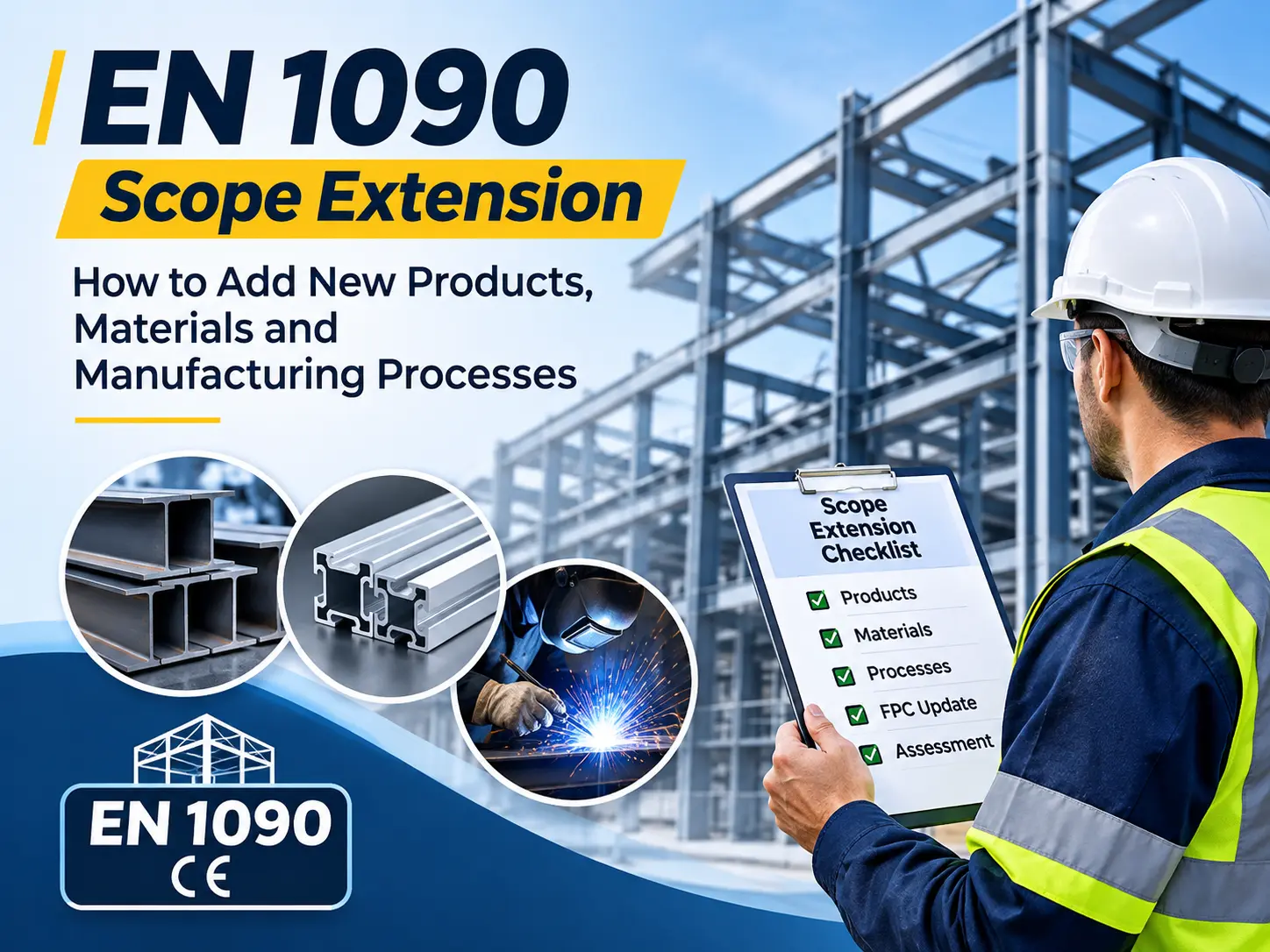
EN 1090 Scope Extension: How to Add New Products, Materials and Manufacturing Processes
By Editorial Team
Table Of Contents
- When Does a Manufacturer Need EN 1090 Scope Extension?
- 7 Areas to Review Before Extending EN 1090 Certification
- EN 1090 Scope Extension: Documentation Checklist
- EN 1090 Scope Extension Process: Step-by-Step Workflow
- Common Mistakes to Avoid During EN 1090 Scope Extension
- What Happens After Scope Extension?
- Frequently Asked Questions
- Conclusion
As structural steel manufacturers progress, their production requirements undergo transformation, often necessitating the integration of aluminum fabrication or complex component manufacturing. Such an expansion under EN 1090 certification extends beyond the mere acquisition of new machinery; it fundamentally influences both the scope of certification and the protocols of Factory Production Control. Consequently, an EN 1090 Scope Extension serves as a critical mechanism, allowing manufacturers to rigorously assess the incorporation of novel products or activities, thereby guaranteeing regulatory compliance and averting operational delays.
When Does a Manufacturer Need EN 1090 Scope Extension?
When manufacturers intend to broaden their certification scope, a formal scope extension becomes imperative. This procedure is frequently triggered by specific operational shifts, such as the incorporation of aluminium fabrication, the introduction of novel structural components, or the adoption of supplementary welding methodologies. Furthermore, expanding operations into new facilities, altering subcontracting arrangements, or assuming heightened design and production responsibilities often mandate such an extension. However, it is crucial to recognize that not every operational modification requires a scope extension; consequently, the certification body must rigorously evaluate each change to determine whether it satisfies the requisite assessment criteria.
7 Areas to Review Before Extending EN 1090 Certification
1. Review the Existing Certification Scope
Examine your current EN 1090 certification to verify the precise scope of coverage, encompassing authorized products, designated manufacturing sites, required execution standards, and specific production activities; refrain from presuming that certification granted for steelwork automatically extends to aluminum components or newly introduced products.
2. Update the Factory Production Control System
The imperative of Factory Production Control lies in its capacity to sustain uniform manufacturing excellence. Prior to the introduction of novel products or operational methodologies, it is essential to verify that the EN 1090 manual comprehensively encompasses the proposed scope of activities. To facilitate the effective execution of EN 1090 FPC, one must systematically revise manufacturing protocols, inspection frameworks, material traceability mechanisms, production surveillance strategies, equipment upkeep schedules, and document control systems.
3. Review Material and Supplier Requirements
The introduction of new product lines inherently demands a diversified array of materials, suppliers, and inspection protocols. Manufacturers are therefore compelled to rigorously evaluate material certificates, conduct comprehensive inspections, secure supplier approvals, and meticulously manage storage, identification, and traceability. These critical operational facets must be harmonized within a robust EN 1090 Material Inspection framework to guarantee full regulatory compliance.
4. Verify Welding and Subcontractor Controls
Fluctuations in manufacturing methodologies can precipitate the adoption of novel welding protocols, shifting personnel requirements, or the delegation of tasks to external contractors. Prior to authorizing any expansion of certification, it is imperative to verify that robust welding procedures, competent welders, seamless coordination mechanisms, rigorous inspection methodologies, and comprehensive oversight of subcontractors are fully established. Adherence to the stipulations of EN 1090 regarding subcontractor qualifications is essential to ensure the effective governance and control of outsourced operational processes.
5. Clarify Design Responsibility
For novel structural products or emerging manufacturing operations, it is imperative to delineate design accountability, explicitly determining whether the manufacturer assumes full design responsibility, utilizes pre-approved designs, or executes designated tasks. This clarification directly governs the integrity of technical documentation, specification adherence, and the management of design modifications, thereby mitigating ambiguity among all stakeholders involved.
6. Review Technical Documentation and CE Requirements
The introduction of new products often necessitates supplementary technical documentation and rigorous conformity assessments. Manufacturers are obligated to scrutinize product specifications, manufacturing records, material certificates, welding procedures, CE documentation, and Declaration of Performance (DoP) documents where applicable. Crucially, an EN 1090 DoP must align precisely with the specific requirements of the product in question; the existence of a prior DoP does not guarantee its validity for newly manufactured items. Furthermore, accurate EN 1090 CE documentation serves as a cornerstone for export compliance and empowers customers to effectively evaluate the conformity of the supplied goods.
7. Prepare for Assessment and Corrective Actions
Engage the certification body to evaluate the extent of the necessary scope expansion following the implementation of updated controls. Ascertain whether supplementary factory inspections or assessments are warranted in light of these modifications. Furthermore, rectify any EN 1090 audit nonconformities by instituting documented corrective actions to guarantee adherence to all manufacturing specifications.
EN 1090 Scope Extension: Documentation Checklist
| Document / Record | Purpose |
|---|---|
| Existing EN 1090 certificate | Review current approved scope |
| Updated FPC manual | Cover additional production activities |
| Product specifications | Define new structural components |
| Material certificates | Verify material conformity |
| Supplier approval records | Demonstrate supplier control |
| WPS and WPQR | Support applicable welding processes |
| Welder qualifications | Verify personnel competence |
| Inspection reports | Demonstrate quality control |
| Production records | Maintain manufacturing evidence |
| Traceability records | Connect materials with finished products |
| CE documentation and DoP | Support applicable conformity requirements |
| Corrective action records | Resolve identified compliance gaps |
The exact documentation depends on the proposed extension, applicable requirements and certification body’s assessment.
EN 1090 Scope Extension Process: Step-by-Step Workflow
Adopting a structured methodology enables manufacturers to ascertain the requisite preparations necessary prior to the launch of novel products or operational initiatives.
Illustrative process:
- Please examine the current EN 1090 certification.
- Discern novel product innovations or emerging manufacturing methodologies.
- Assess the FPC alongside the associated technical specifications.
- Review materials, welding and suppliers.
- Update documentation and production controls.
- Initiate communication with the relevant certification authority.
- Execute the mandatory scope extension evaluation.
- Address any nonconformities.
- Secure the relevant certification scope authorization.
Common Mistakes to Avoid During EN 1090 Scope Extension
Expanding production without reviewing the existing quality system can create compliance problems.
| Common Mistake | Potential Impact |
|---|---|
| Starting new production without scope review | Activities may fall outside the approved scope |
| Outdated FPC manual | Inadequate production controls |
| Missing material certificates | Weak material verification |
| Uncontrolled subcontracting | Gaps in production responsibility |
| Unqualified welding procedures | Welding compliance issues |
| Incomplete production records | Insufficient conformity evidence |
| Unclear design responsibility | Technical and contractual confusion |
Manufacturers must likewise take these factors into account throughout the preparation for an EN 1090 audit as well as during the ensuing surveillance audit activities.
What Happens After Scope Extension?
Upon the successful evaluation and authorization of the extension via the relevant certification framework, manufacturers are obligated to sustain their revised production controls.
This includes:
- Pursuant to the sanctioned scope delineating pertinent manufacturing operations.
- Maintaining updated FPC documentation.
- Monitoring suppliers and subcontractors.
- Maintaining material and production traceability.
- Reviewing welding and inspection arrangements.
- Ensuring the preservation of technical documentation to facilitate subsequent evaluations.
The renewal of certification and ongoing surveillance initiatives must likewise align with the updated certification frameworks.
Frequently Asked Questions
What is EN 1090 Scope Extension?
This entails the systematic evaluation and inclusion of qualified products, materials, or manufacturing operations within an established certification framework, contingent upon adherence to all pertinent regulatory mandates.
Can a steel fabricator extend EN 1090 certification to aluminium fabrication?
Admittedly, the production of aluminium components entails stringent technical and operational control mandates. The manufacturer is obligated to substantiate that its fabrication methodologies and facility process control frameworks are fully aligned with the requisite regulatory standards.
Does adding a new product require a new EN 1090 certificate?
Not invariably so. The certification body is tasked with evaluating the proposed product against the current approved scope to ascertain whether a scope extension or an alternative conformity assessment measure is necessary.
Is a new factory inspection required?
The necessity for further factory inspections hinges upon the specific nature of the proposed modifications, the framework of current certification protocols, and the relevant assessment mandates.
Does scope extension affect the Declaration of Performance?
It is feasible. In instances where a novel product is subject to the stipulations of the applicable Declaration of Performance, the manufacturer is obligated to guarantee the accuracy of both the pertinent product documentation and the declared performance metrics.
How can manufacturers prepare for EN 1090 scope extension?
Examine the current certificate to discern the proposed modifications, amend the FPC manual accordingly, validate welding and material control protocols, compile the requisite technical documentation, and initiate communication with the certification body.
Conclusion
While expanding manufacturing capabilities unlocks novel business avenues, it necessitates the implementation of rigorous production controls and comprehensive certification protocols. Manufacturers must critically evaluate their current EN 1090 scope and recalibrate their Factory Production Control (FPC) systems prior to integrating new components or processes. Ensuring production excellence and facilitating organizational growth relies fundamentally on robust supplier management, meticulous welding inspection, unbroken material traceability, and precise technical documentation.