
WPS & WPQR
PREQUALIFICATION
CHECKLIST
01 Oct 2026
Welding Supplier Prequalification Checklist: 20 Documents Buyers Check Before Approval
By Editorial Team
Table Of Contents
- What Is Welding Supplier Prequalification?
- 20 Documents Buyers May Check Before Approving a Welding Supplier
- 1. Company and Certification Documents
- 2. WPS and WPQR Documentation
- 3. Welder and Welding Operator Qualifications
- 4. Material Certificates and Traceability
- 5. Welding Consumable Documentation
- 6. Inspection and NDT Records
- 7. Calibration and Equipment Records
- 8. Nonconformity, Repair and Corrective Action Records
- 9. The Traceability Chain Buyers Want to See
- Quick Supplier Prequalification Checklist
- What Can Delay Supplier Approval?
- How Suppliers Can Prepare for Customer Prequalification
- Final Takeaway
Related Blogs
SEP
22
WPS and WPQR Qualification Tests: Complete Testing Requirements Guide
AUG
28
From WPS to Digital Weld Records: Building a Connected Welding Quality System
AUG
11
How Long Is WPQR Valid? WPQR Validity Explained
AUG
10
How to Prepare a WPQR: Step-by-Step Welding Procedure Qualification Guide
AUG
04
WPS & WPQR Explained: The Complete Manufacturer's Guide to Welding Procedure Qualification, Requirements, Standards and Industrial Applications (2026)
See Also.....
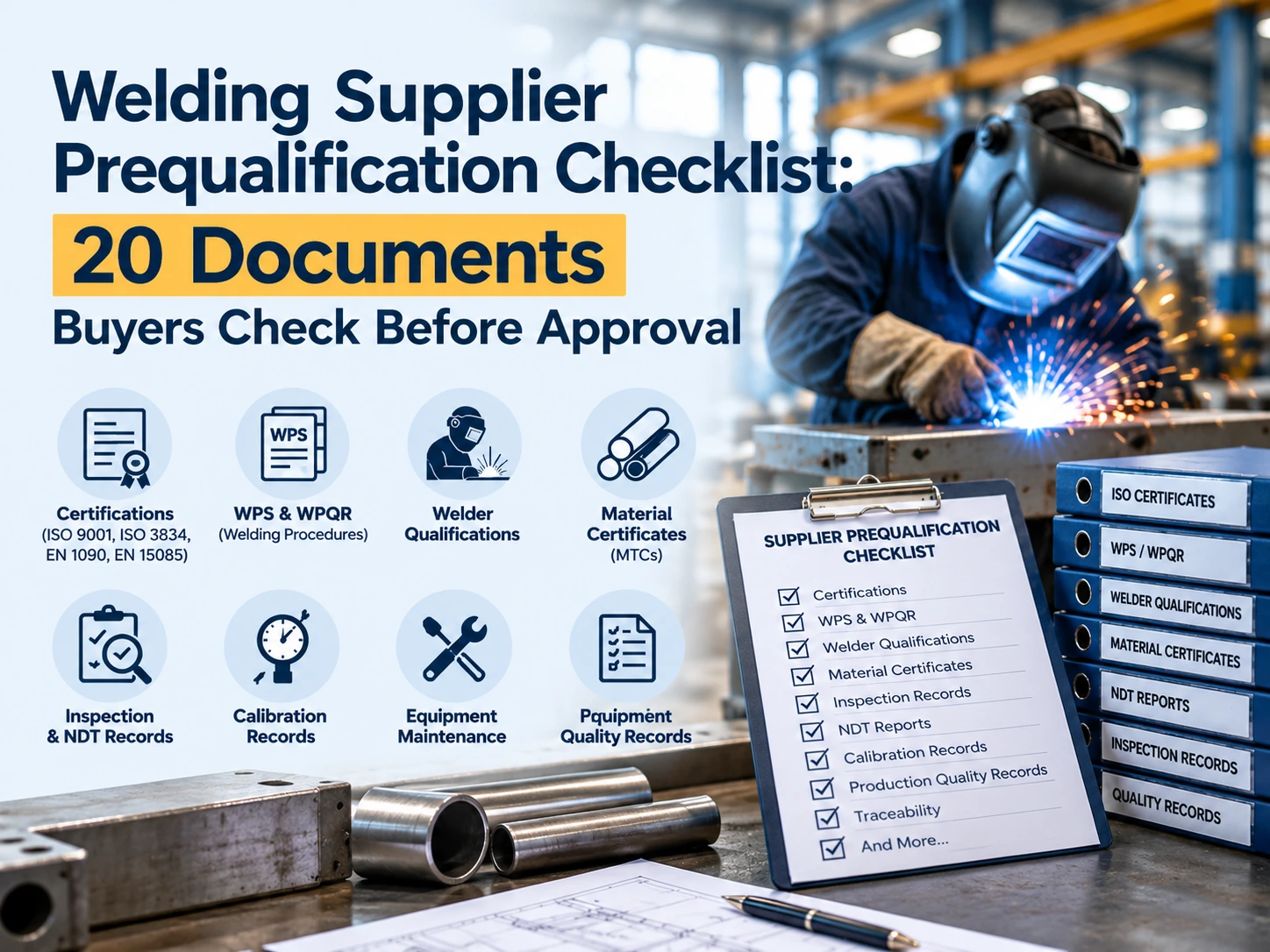
Choosing a welding supplier is not just about cost and how much they can produce. Buyers look at things like welding certifications, the methods they use, their past performance, the qualifications of their welders, where they get their materials, reports from inspections and tests that don’t damage the product, and their quality control records.Using a checklist for prequalification helps make sure everything meets standards, which helps suppliers get approved faster for projects overseas.
What Is Welding Supplier Prequalification?
Welding supplier prequalification checks if a manufacturer has the right skills and follows standards like ISO 3834. It looks at the people, tools, and methods they use. Buyers review certifications, how they control their welding processes, and the records they keep to make sure their qualifications match what is needed in the contract and specifications.
20 Documents Buyers May Check Before Approving a Welding Supplier
| No. | Document / Record | What the Buyer May Verify |
|---|---|---|
| 1 | Company Quality Certification | Applicable ISO or industry certifications and their scope |
| 2 | Welding Quality Certification | ISO 3834 or other applicable welding-quality certification |
| 3 | WPS – Welding Procedure Specification | Whether production welding procedures are documented and applicable |
| 4 | WPQR – Welding Procedure Qualification Record | Whether welding procedures are properly qualified |
| 5 | Welder Qualification Certificates | Welder competence, process, material, position and qualification range |
| 6 | Welding Operator Qualifications | Qualifications for applicable mechanized or automated welding operations |
| 7 | Welding Coordination Records | Competence and responsibilities of welding coordination personnel |
| 8 | Material Certificates / MTCs | Material grade, heat number, mechanical properties and traceability |
| 9 | Welding Consumable Records | Consumable specification, batch identification and storage controls |
| 10 | Material Traceability Records | Link between incoming material and finished components |
| 11 | NDT Reports | Applicable testing methods results and qualified personnel |
| 12 | Inspection & Test Records | Dimensional, visual and other required inspection results |
| 13 | Calibration Records | Calibration status of relevant measuring and inspection equipment |
| 14 | Equipment Maintenance Records | Maintenance and suitability of production equipment |
| 15 | Weld Maps / Weld Identification Records | Traceability between welds procedures and welders |
| 16 | Repair Records | Identification and control of repaired welds or components |
| 17 | Nonconformity Records | How quality problems are documented and controlled |
| 18 | Corrective Action Records | Evidence that recurring quality issues are addressed |
| 19 | Production / Quality Records | Evidence that manufacturing activities are controlled |
| 20 | Previous Project / Technical References | Relevant manufacturing experience and technical capability |
The checklist used to review suppliers depends on what the customer needs, the standards they follow, and the terms in their contract, so it’s not a one-size-fits-all list of documents.
1. Company and Certification Documents
2. WPS and WPQR Documentation
A buyer should check that the supplier has the right Welding Procedure Specifications (WPS) and Welding Procedure Qualification Records (WPQR). This includes things like the welding process used, the type of base material, the range of thickness, the type of joint, the welding position, the filler material, the shielding gas, preheat needs, essential variables, and the qualification range.
3. Welder and Welding Operator Qualifications
Supplier approval needs proof that welders are qualified. Buyers should check several things: the welder’s ID, the standards they were tested against, the welding method used, the type of material being welded, the welding position, the range of thickness or diameter they can handle, how long their qualification is valid, and whether it applies to the actual work being done. For example, the ISO 9606-1 records should match the production records to show which qualified welders did which work.
4. Material Certificates and Traceability
Material traceability helps make sure that important and controlled products are made properly. Buyers usually ask for things like test results, what kind of material was used, numbers from heat or casting, strength details, what elements are in the material, records that identify the material, checks before using it, and proof that the material can be traced back, including certificates from EN 10204 inspections.
5. Welding Consumable Documentation
The buyer checks how welding materials are managed by looking at details like the type of materials, who made them, batch numbers, certificates, how they are stored, records of drying or baking, and logs of when they were used, to make sure they work well with the right welding techniques.
6. Inspection and NDT Records
A trustworthy supplier shows that their welded products are of good quality by keeping records of inspections, test results like ultrasonic, radiographic, magnetic particle, and penetrant tests, measurements, inspection plans, acceptance standards, and having trained and qualified staff who follow the right rules and guidelines.
7. Calibration and Equipment Records
Production quality is affected by how well the equipment is controlled. Buyers need to check the equipment’s identification, calibration, certificates, maintenance history, and preventive measures to make sure the tools are right for making products and doing inspections.
8. Nonconformity, Repair and Corrective Action Records
Supplier prequalification is the process of checking documents and evaluating whether a manufacturer can handle problems. Important records that are looked at include those related to nonconformity, finding the root cause, taking corrective actions, verifying solutions, closing issues, and making repairs.
9. The Traceability Chain Buyers Want to See
To check welding papers, make sure they are all connected: Material, Material Certificate, WPS/WPQR, Certified Welder, Welding Job, Testing/NDT, Final Quality Report. First Welding Certification Pvt.Ltd.’s EN 15085 guidelines stress the importance of this connection when assessing suppliers.
Quick Supplier Prequalification Checklist
Before approving a welding supplier, buyers can ask:
| Check | Yes / No |
|---|---|
| Relevant company certifications are available | |
| Certification scopes match the required work | |
| Applicable ISO 3834 certification is available | |
| WPS documents are available | |
| Supporting WPQR records are available | |
| Welder qualifications are current/applicable | |
| Welding coordination competence is documented | |
| Material certificates are controlled | |
| Material traceability is maintained | |
| Welding consumables are controlled | |
| NDT personnel and reports are documented | |
| Inspection records are available | |
| Calibration records are current | |
| Equipment maintenance is controlled | |
| Weld identification/traceability is maintained | |
| Repair records are controlled | |
| Nonconformities are documented | |
| Corrective actions are recorded | |
| Production quality records are retained | |
| Relevant technical/project experience is demonstrated |
What Can Delay Supplier Approval?
Common problems are things like old certifications, using WPS without proper proof, welders not having the right qualifications, missing material records, incomplete MTC paperwork, no NDT records, changes in documents not being controlled, no calibration records, unresolved issues, and poor connection between production welds and quality records.
How Suppliers Can Prepare for Customer Prequalification
Keep your folder neatly organized with all the important papers from your suppliers. Include things like company certifications, what coverage they offer, records of quality welding, lists of WPS and WPQRs, a chart showing which welders are qualified, information about welding management, tracking of materials, steps for inspection and non-destructive testing, records of equipment calibration, details about the equipment used, any issues that came up, and references to projects. Make sure everything is current and easy to find so you can quickly get the documents you need.
Final Takeaway
Welding supplier prequalification looks at real proof instead of just having a certificate. Buyers want to make sure there are trained workers, proper ways of doing things, materials that can be traced back, and strong checks to ensure quality. Having clear welding records is very important for companies that work with customers from other countries. First Welding Certification Pvt.Ltd. offers necessary certification and inspection services to meet the standards of EN 1090, EN 15085, ISO 3834, ISO 9606, WPS/WPQR, and welding inspections.