
PED Design
Calculations
EU Market
PED Design Review Checklist: How to Verify Pressure Equipment Calculations, Applicable Standards & Safety Requirements for EU Market from India
By First Welding Certification Technical Editorial Team
8 Min Read Time
06 Oct 2026
Table Of Content
- Introduction
- What Is a PED Design Review?
- Why Is Pressure Equipment Design Review Important?
- PED Design Review Checklist
- How to Verify Pressure Equipment Calculations
- How to Check Applicable Standards
- How to Review Materials and Material Properties
- How to Verify Safety Requirements
- Technical Documentation Review
- Common PED Design Review Mistakes
- Frequently Asked Questions
- Related Searches
- Conclusion
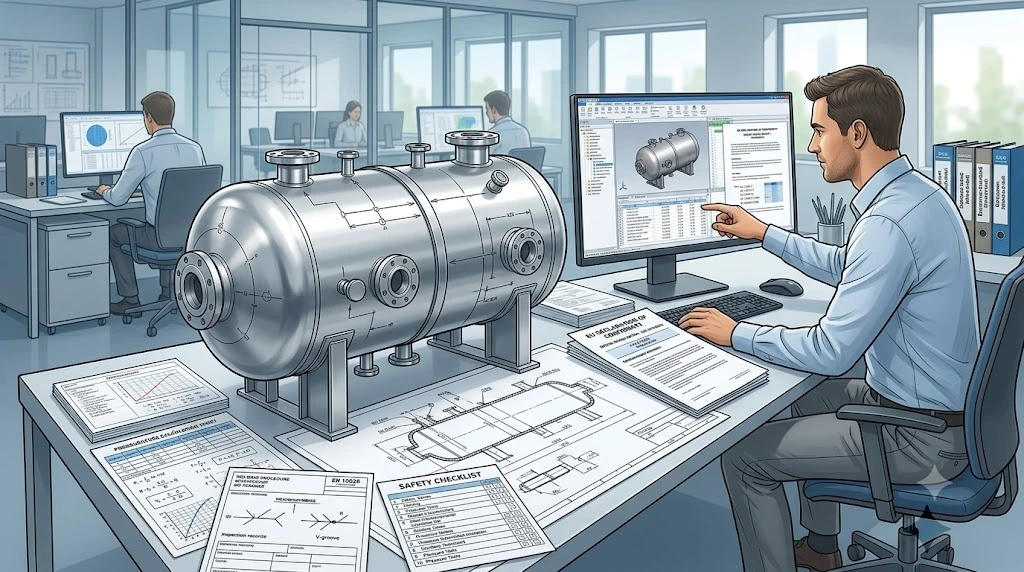
PED DESIGN REVIEW | PRESSURE EQUIPMENT
DESIGN BASIS
Pressure Temperature Service
CALCULATIONS
Thickness Stress Stability
STANDARDS
Applicable Standards
MATERIALS
Grade Properties Traceability
SAFETY
Loads Fatigue Corrosion Testing
Introduction
Designing pressure equipment for the European market requires more than checking whether a vessel can withstand its design pressure. Manufacturers must demonstrate that the equipment meets the applicable requirements of the Pressure Equipment Directive (PED) 2014/68/EU, relevant technical standards, material requirements, manufacturing controls and conformity assessment requirements.
A properly conducted PED design review verifies whether the design basis, pressure calculations, materials, loads, safety factors, welding considerations, inspection requirements and technical documentation are consistent with the intended application.
The PED requires manufacturers to analyse applicable hazards and risks and design equipment accordingly. Its essential safety requirements also address pressure, temperature, external loads, corrosion, erosion, fatigue, material properties and other foreseeable degradation mechanisms.
For manufacturers in India supplying pressure equipment to Europe, a structured PED design review checklist can identify technical gaps before manufacturing and conformity assessment begin.
What Is a PED Design Review?
A PED design review is a systematic examination of pressure equipment design documentation to determine whether the proposed design addresses the applicable PED requirements and selected technical standards.
The review can cover:
- Design pressure
- Design temperature
- Operating conditions
- Pressure-containing components
- Material selection
- Wall thickness calculations
- Nozzle and opening calculations
- External pressure and stability
- Loads and stresses
- Fatigue considerations
- Corrosion allowance
- Welding and joint efficiency
- Non-destructive examination
- Pressure testing
- Safety devices
- Technical documentation
The objective is to establish a traceable connection between the design basis, calculations, standards, materials, manufacturing requirements and final conformity assessment.
Why Is Pressure Equipment Design Review Important?
Pressure equipment can experience several different loading conditions during operation, testing, transportation and installation.
The PED specifically requires appropriate consideration of factors including internal and external pressure, operating and ambient temperatures, static pressure, wind, earthquake loading, support reactions, piping loads, corrosion, erosion and fatigue.
Therefore, a pressure equipment design review should not focus only on the basic pressure-vessel thickness equation.
A comprehensive review should ask:
Does the design demonstrate adequate safety for all reasonably foreseeable operating and failure conditions?
PED Design Review Checklist
Use the following checklist when reviewing pressure equipment calculations and technical documentation.
1. Confirm the Design Basis
Check whether the design documentation clearly identifies:
- Maximum allowable pressure
- Design pressure
- Operating pressure
- Design temperature
- Operating temperature
- Test pressure
- Equipment volume
- Fluid/service
- Fluid group
- Intended service life
- Corrosion allowance
- Applicable environmental conditions
The calculation inputs should be consistent throughout the design package.
2. Verify Applicable PED Classification
Determine whether the equipment falls within the scope of PED 2014/68/EU and establish its applicable category.
PED conformity assessment procedures depend on the equipment category. Categories I, II, III and IV have different conformity assessment routes.
This makes PED classification an important early-stage design review activity.
3. Check Design Loads
Review whether the calculations consider relevant loads, such as:
- Internal pressure
- External pressure
- Thermal loads
- Weight
- Wind
- Seismic loads
- Piping reactions
- Nozzle loads
- Support reactions
- Transportation loads
- Test conditions
The PED requires design calculations to consider relevant loading conditions and foreseeable operating conditions.
How to Verify Pressure Equipment Calculations
A strong pressure equipment calculation review should verify both the calculation method and the input data.
Check 1: Design Pressure
Confirm that the pressure used in the calculation is appropriate for the maximum allowable pressure and actual operating conditions.
Check 2: Design Temperature
Verify that the selected design temperature reflects the most demanding foreseeable operating condition.
Check 3: Material Strength
Check whether the calculation uses documented material properties at the applicable calculation temperature.
Depending on the material and application, relevant properties can include yield strength, tensile strength, creep strength, fatigue data, elastic modulus and fracture toughness.
Check 4: Wall Thickness
Verify the calculated minimum required thickness against:
- Nominal thickness
- Manufacturing tolerance
- Corrosion allowance
- Forming allowance
- Required design margin
Check 5: Stress Analysis
Where applicable, verify:
- Primary stresses
- Secondary stresses
- Local stresses
- Stress concentrations
- Support loads
- Nozzle loads
Check 6: External Pressure
Do not review only internal-pressure calculations.
Vacuum conditions or external pressure can create buckling or instability risks. The design should demonstrate adequate structural stability where applicable.
Check 7: Fatigue
For equipment exposed to repeated pressure or temperature cycles, evaluate whether fatigue is a relevant failure mechanism.
Check 8: Corrosion and Degradation
The PED requires foreseeable degradation mechanisms such as corrosion, creep and fatigue to be appropriately considered in design.
How to Check Applicable Standards
The next step in a PED design review is to establish which standards and technical specifications apply to the equipment.
Depending on the equipment, relevant standards may include:
- EN 13445 — Unfired pressure vessels
- EN 13480 — Metallic industrial piping
- EN 10204 — Metallic products inspection documents
- EN ISO 3834 — Quality requirements for fusion welding
- Applicable material standards
- Applicable welding and NDT standards
However, the correct standard depends on the equipment type, design methodology and scope.
Do not simply add multiple standards to a calculation report. Each selected standard should have a defined role.
For example:
Equipment → PED requirements → Product standard → Design calculation method → Material standard → Welding/NDT requirements → Inspection and testing
Where harmonised standards published for the PED are applied, they can provide a presumption of conformity for the requirements they cover.
How to Review Materials and Material Properties
Material selection directly affects the validity of PED design calculations.
Review:
- Material grade
- Material specification
- Material certificate
- Mechanical properties
- Design-temperature properties
- Impact requirements
- Corrosion resistance
- Weldability
- Heat treatment requirements
- Material traceability
PED requirements also address suitable material selection and require manufacturers to obtain documentation demonstrating material conformity. For certain pressure-bearing parts in Categories II, III and IV, specific product-control certification requirements apply.
A calculation should therefore use material data that can be traced back to the applicable material specification and technical documentation.
How to Verify Safety Requirements
A PED safety review should extend beyond calculations.
Check whether the design addresses:
Pressure Protection
Review pressure relief and safety devices where applicable.
Safe Operating Limits
Confirm that maximum and minimum allowable operating conditions are clearly established.
Manufacturing Risks
Review whether manufacturing processes could affect material properties or structural integrity.
Welding
Check welding procedures, welder qualifications, joint efficiency and applicable inspection requirements.
NDT
Verify whether the selected NDT methods and extent are consistent with the design and applicable requirements.
Pressure Testing
PED final assessment includes pressure-containment testing, normally through a hydrostatic pressure test unless another recognised approach is justified.
Technical Documentation Review
A complete PED technical documentation review should establish whether another competent reviewer can understand how the equipment demonstrates compliance.
Documentation can include:
- General equipment description
- Design drawings
- Manufacturing drawings
- P&ID or relevant diagrams
- Design calculations
- Material specifications
- Material certificates
- Welding documentation
- NDT procedures and reports
- Heat-treatment records
- Pressure-test documentation
- Risk assessment
- Applicable standards
- Inspection records
- Technical justification where standards are not fully applied
PED conformity assessment documentation is expected to contain sufficient information to assess conformity, including applicable requirements, design/manufacturing information, standards used, design calculations and examination/test results.
Common PED Design Review Mistakes
Mistake 1: Checking Only Wall Thickness
A vessel may pass a basic thickness calculation while still requiring review for external pressure, fatigue, nozzle loads or other conditions.
Mistake 2: Using Incorrect Material Data
Using room-temperature properties where temperature-dependent properties are required can affect calculation validity.
Mistake 3: Missing Load Combinations
Individual load checks may not represent the most demanding combined operating condition.
Mistake 4: Ignoring Traceability
Material and manufacturing records must connect the design documentation with the manufactured equipment.
Mistake 5: Selecting Standards Without a Defined Scope
Every selected standard should have a clear relationship with the design, manufacturing, inspection or conformity assessment process.
Mistake 6: Treating PED as Only a Certification Exercise
PED compliance starts with the design and risk assessment and continues through manufacturing, inspection, testing and conformity assessment.
Frequently Asked Questions
What is a PED design review?
A PED design review evaluates pressure equipment calculations, materials, loads, standards, safety requirements and technical documentation against the applicable requirements of the Pressure Equipment Directive.
Is EN 13445 the same as PED?
No. PED 2014/68/EU is European legislation, while EN 13445 is a technical standard for unfired pressure vessels. A product may use applicable standards to demonstrate conformity with relevant PED requirements.
Does PED apply to equipment manufactured in India?
PED requirements become relevant when pressure equipment falls within the Directive’s scope and is placed on the EU market. The conformity assessment route depends on the applicable classification and requirements.
Is a notified body always required?
Not necessarily for every item. The required conformity assessment procedure depends on the PED category and applicable module. Categories II, III and IV involve notified-body participation under the relevant procedures.
What documents are important for PED design review?
Important documents can include design drawings, design calculations, material documentation, applicable standards, risk assessment, welding and NDT documentation, inspection records and test reports.
Related Searches
- PED 2014/68/EU Material Requirements: Material Traceability, PMA & European Approval Explained
- Top 10 PED Documentation & Welding Compliance Gaps That Can Delay Pressure Equipment Conformity Assessment: WPS, WPQR, Welder & NDT Records Explained
- PED Certification Cost in India 2026: Fees, Factors, Process & Documents
- What Are the Latest PED 2014/68/EU Pressure Vessel Regulations, Design Standards, Safety Factors and Certification Requirements in 2026 for Indian and Global Manufacturers?
Conclusion
A reliable PED design review should evaluate much more than a pressure-vessel thickness calculation. The reviewer should connect the design basis, pressure calculations, material properties, load conditions, applicable standards, manufacturing controls, inspection requirements, testing and technical documentation into one traceable compliance process.
The PED requires manufacturers to analyse relevant hazards and design pressure equipment with appropriate safety margins and consideration of foreseeable operating conditions and degradation mechanisms.
For Indian manufacturers targeting the European market, conducting a structured design review before manufacturing can identify technical gaps early and improve the readiness of the equipment for the applicable conformity assessment route.
Planning PED compliance for pressure equipment manufactured in India?
First Welding Certification Pvt Ltd (PRVÁ ZVÁRAČSKÁ, a.s.) can review the applicable certification and technical requirements for your pressure equipment project.
Contact the certification team to discuss your PED design review and compliance requirements.