
WPS QUALIFICATION
WPQR REQUIREMENTS
GUIDE
02 Nov 2026
WPS for Aluminium Welding: WPQR Qualification Requirements, Essential Variables and Common Mistakes
By Editorial Team
Table Of Contents
- Why Is WPS Important for Aluminium Welding?
- What Is the Difference Between WPS and WPQR for Aluminium?
- Which Standards Apply to Aluminium Welding Procedure Qualification?
- Essential Welding Parameters for Aluminium WPS
- Heat Input and Temperature Control
- WPQR Qualification Requirements for Aluminium
- WPQR Qualification Flowchart
- WPQR Essential Variables and Qualification Range
- Aluminium WPQR Qualification Checklist
- Seven Common Mistakes in Aluminium WPS Preparation
- What Tests Are Required for Aluminium WPQR Qualification?s
- Aluminium WPS Compliance Checklist Before Production
- How Can Manufacturers Obtain WPS and WPQR Certification Support?
- Frequently Asked Questions
- Conclusion
Related Blogs
AUG
28
From WPS to Digital Weld Records: Building a Connected Welding Quality System
AUG
11
How Long Is WPQR Valid? WPQR Validity Explained
AUG
10
How to Prepare a WPQR: Step-by-Step Welding Procedure Qualification Guide
AUG
04
WPS & WPQR Explained: The Complete Manufacturer's Guide to Welding Procedure Qualification, Requirements, Standards and Industrial Applications (2026)
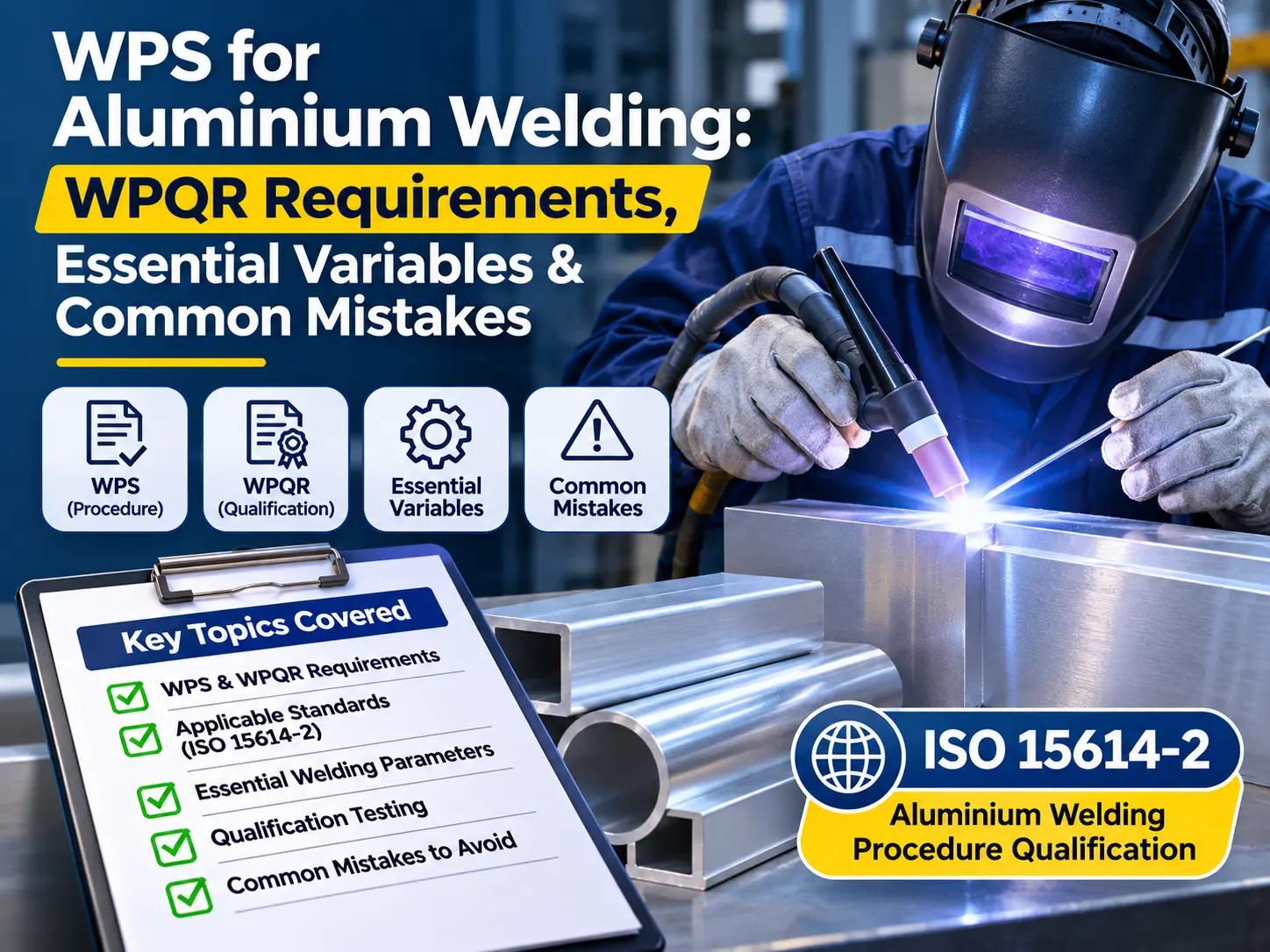
The successful execution of aluminium welding demands rigorous parameter control, meticulous material selection, and thorough joint preparation, given that even marginal deviations can compromise structural integrity and operational performance. A Welding Procedure Specification (WPS) delineates the specific methodologies employed, whereas the Welding Procedure Qualification Record (WPQR) documents the results of subsequent qualification testing. For manufacturers of aluminium structures and equipment, a comprehensive understanding of WPS mandates is paramount to guarantee consistent weld quality and adherence to project specifications. This guide provides an in-depth examination of WPS formulation, WPQR stipulations, critical variables, testing protocols, and prevalent pitfalls.
Why Is WPS Important for Aluminium Welding?
The distinctive characteristics of aluminium, when contrasted with carbon steel, mandate rigorous process control during welding operations. A comprehensive Welding Procedure Specification (WPS) delineates critical parameters, encompassing the specific alloy composition, material thickness, welding process, joint configuration, filler metal selection, shielding gas composition, electrical current and voltage, travel speed, preheat and interpass temperature limits, welding position, pass sequence, and heat input regulations. Strict adherence to a qualified procedure is instrumental in mitigating defects, ensuring operational consistency, and maintaining traceable documentation of the welding record.
What Is the Difference Between WPS and WPQR for Aluminium?
WPS and WPQR serve different but complementary purposes.
| Aspect | WPS | WPQR |
|---|---|---|
| Full form | Welding Procedure Specification | Welding Procedure Qualification Record |
| Main purpose | Defines how welding should be performed | Records the welding qualification test and its results |
| Key information | Welding parameters, materials and joint details | Actual test conditions, examinations and test results |
| Production use | Guides welders during fabrication | Establishes the qualified range supported by testing |
| Revision control | Updated, when necessary, under the applicable requirements | Retained as evidence of the qualification achieved |
In accordance with applicable standards or specifications, a Welding Procedure Specification (WPS) mandates a defined qualification methodology, wherein the Welding Procedure Qualification Record (WPQR) delineates the specific qualified range. It is imperative for manufacturers to guarantee that the production WPS remains strictly within these established parameters.
Which Standards Apply to Aluminium Welding Procedure Qualification?
Choosing the appropriate welding standard constitutes a fundamental initial requirement.
Applicable standards are contingent upon the specific welding methodology, the nature of the product, industry-specific mandates, and the stipulations outlined in contractual agreements.
| Standard | Purpose |
|---|---|
| ISO 15607 | General rules for welding procedure specification and qualification |
| ISO 15609-1 | Requirements for the content of arc welding procedure specifications |
| ISO 15614-2 | Welding procedure qualification by testing for arc welding of aluminium and its alloys |
| ISO 9606-2 | Qualification testing of welders for aluminium and aluminium alloys |
ISO 15614-2:2025 delineates the arc welding protocols and qualification testing requirements for wrought and cast aluminium, alongside their respective alloys; practitioners must cross-reference these specifications against pertinent product standards and certifications. The finishing processes applicable to aluminium castings fall under the scope of ISO 15614-4. Consequently, it is imperative to verify all governing standards and qualification pathways prior to the formulation of a Welding Procedure Specification (WPS).
Essential Welding Parameters for Aluminium WPS
Establishing repeatable welding conditions relies on the precise calibration of WPS parameters, which must be rigorously aligned with the specific alloy composition, joint configuration, material thickness, and welding process employed.
| Parameter | What Manufacturers Should Verify | Why It Matters |
|---|---|---|
| Welding process | MIG, TIG or another permitted process | Determines the applicable procedure and operating conditions |
| Base material | Alloy designation and material condition | Influences weldability and mechanical performance |
| Filler material | Compatible filler classification | Supports suitable weld-metal properties |
| Current and voltage | Qualified operating ranges | Influences arc stability and penetration |
| Travel speed | Approved speed range, where specified | Affects heat input and weld formation |
| Shielding gas | Correct gas composition and delivery | Helps protect the molten weld pool |
| Heat input | Applicable limits and calculation method | Influences thermal effects and weld properties |
| Preheat | Requirements established by the procedure | Helps control welding conditions where necessary |
| Interpass temperature | Maximum or specified temperature limits | Controls heat accumulation during multipass welding |
Such parameters cannot be derived solely from generic guidelines; they must be rigorously established and validated to suit the specific intended application.
Heat Input and Temperature Control
Given aluminium’s exceptional thermal conductivity, welders must rigorously maintain precise operational parameters to ensure joint integrity. Deviations in heat input can precipitate significant distortions, incomplete fusion, or detrimental modifications to the heat-affected zone. Consequently, preheat and interpass temperatures must be empirically established for each specific aluminium alloy
WPQR Qualification Requirements for Aluminium
The WPQR qualification serves to validate that a welding procedure adheres to stipulated requirements, initiating with the formulation of a preliminary WPS. Subsequently, a test coupon is fabricated under meticulously controlled conditions, during which critical process variables are systematically documented. The resulting specimen then undergoes rigorous examinations, where satisfactory outcomes culminate in the generation of qualification documentation that explicitly defines the permissible scope of application.
WPQR Qualification Flowchart
Use the following flowchart to understand the qualification process.
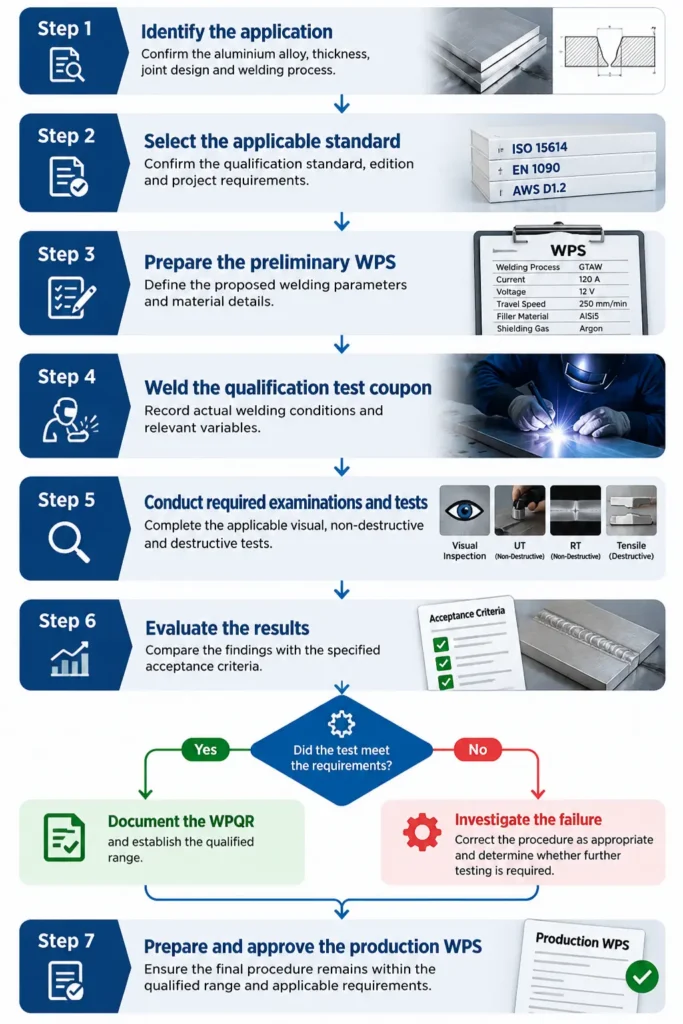
Note: This is a simplified workflow. The actual qualification sequence and approval requirements depend on the governing standard and application.
WPQR Essential Variables and Qualification Range
The core parameters governing aluminium welding encompass the specific welding process, the composition of the base metal, the classification of the filler material, sheet or plate thickness, joint design, welding position, shielding gas characteristics, and the magnitude of heat input. Deviations exceeding predefined thresholds can compromise the validity of a welder’s or procedure’s qualification. Consequently, manufacturers are obligated to evaluate these critical variables and delineate the permissible Welding Procedure Qualification Record (WPQR) range in strict adherence to relevant standards, ensuring all qualifications are meticulously documented. It is imperative to recognize that a single WPQR lacks universal applicability across all aluminium alloys, material thicknesses, positional requirements, or welding processes; therefore, any significant alteration may mandate supplementary qualification testing.
Aluminium WPQR Qualification Checklist
| Verification Point | What to Check |
|---|---|
| Material identification | Confirm the alloy designation and material condition |
| Thickness | Verify the proposed thickness falls within the qualified range |
| Welding process | Match the process to the qualified procedure |
| Filler material | Check the permitted classification and applicable requirements |
| Joint configuration | Confirm the proposed joint is covered |
| Welding position | Verify the applicable qualification limits |
| Test evidence | Ensure required examination and test results are documented |
| Production WPS | Confirm that all specified parameters remain within the qualified range |
Serving merely as a preliminary review instrument, this checklist does not supplant the comprehensive mandates of the governing standard.
Seven Common Mistakes in Aluminium WPS Preparation
Inadequate management of WPS documentation may precipitate production irregularities and postpone qualification timelines. Prominent concerns encompass:
- The improper identification of aluminium alloys presents significant challenges, as each variant possesses unique welding characteristics. Consequently, to mitigate this risk, it is imperative to validate material certificates and confirm alloy designations before initiating any procedural preparations.
- Deviating from certified welding parameters by altering variables such as current or voltage without verifying their validity against approved limits jeopardizes regulatory compliance. It is imperative to define and adhere to established operating ranges while ensuring that all production settings strictly conform to the Welding Procedure Specification.
- The selection of incompatible filler materials poses a significant threat to weld integrity; consequently, the appropriate choice must be meticulously determined in accordance with the specific alloy composition, operational service conditions, and overarching engineering mandates.
- The failure to adhere to prescribed heat input specifications significantly compromises weld integrity; consequently, it is imperative to delineate the mechanisms governing heat input regulation and meticulously record all critical process parameters.
- Neglecting joint preparation can precipitate significant defects; therefore, it is imperative to explicitly stipulate the requisite protocols for surface preparation and cleaning prior to commencement.
- The absence of comprehensive qualification documentation impedes verification efforts; therefore, it is imperative to maintain the integrity and completeness of the WPS, test records, and approved production documents.
- When deploying WPQR outside its certified operational parameters, it is imperative to verify that the application remains within the stipulated qualification limits, undertaking supplementary testing whenever deviations are detected to ensure continued reliability and compliance.
What Tests Are Required for Aluminium WPQR Qualification?
The specifications governing WPQR testing are contingent upon the relevant standard, the specific welding procedure employed, the base material, the joint design, and the designated service conditions.
Possible examinations and tests include:
| Test or Examination | Purpose |
|---|---|
| Visual testing | Identifies visible surface imperfections and weld profile issues |
| Radiographic or ultrasonic testing | Examines internal discontinuities where applicable |
| Tensile testing | Evaluates tensile properties of the test specimen |
| Bend testing | Assesses weld and joint integrity under bending |
| Macro examination | Examines weld penetration, fusion and cross-sectional characteristics |
| Additional specified tests | Evaluates other required properties, where applicable |
The mandate for specific examinations and tests varies across each aluminium Welding Procedure Qualification Record (WPQR)
rather than being universally obligatory, the requisite protocols, specimen locations, and acceptance criteria are strictly dictated by the governing standard.
In the event of a test failure, the manufacturer must scrutinize the malfunction, ascertain its root cause, and subsequently adhere to the pertinent regulatory frameworks governing corrective measures, retesting, or requalification.
Aluminium WPS Compliance Checklist Before Production
Prior to authorizing an aluminium welding procedure for production, manufacturers must validate the following criteria:
- The relevant welding standard and its specific edition have been duly identified.
- The aluminium alloy and its material condition have been confirmed.
- The WPS is supported by the required qualification evidence.
- The welding procedure and the selected filler material are suitable.
- The criteria governing joint preparation and fit-up specifications have been established.
- Welding parameters and the corresponding controls for heat input have been explicitly defined.
- The specifications for preheat and interpass temperatures are incorporated wherever relevant.
- The necessary qualification assessments and corresponding reports are currently accessible.
- The production application is situated within the scope of the WPQR qualification.
- Document revisions and approval status are controlled.
- Welders hold the required qualifications for the intended work.
Finalizing this checklist serves to uncover deficiencies in documentation and process control prior to the commencement of production, while the comprehensive applicable standard and project specifications retain their status as the governing authorities.
How Can Manufacturers Obtain WPS and WPQR Certification Support?
Manufacturers are required to delineate product specifications, welding standards, and the extent of production operations. This entails a rigorous examination of material specifications, the formulation of a preliminary Welding Procedure Specification (WPS), the execution of requisite tests, the critical evaluation of outcomes, and the comprehensive documentation of qualified procedures. The specific methodology adopted fluctuates according to the application context and certification mandates.
Frequently Asked Questions
What is WPS aluminium welding?
WPS aluminium welding entails the utilization of a Welding Procedure Specification that delineates the requisite materials, welding processes, operational parameters, and pertinent conditions for the fusion of aluminium and its respective alloys.
Which standard is used for aluminium WPQR qualification?
ISO 15614-2 delineates the qualification protocols for arc welding processes involving aluminium and its alloys, mandating that the specific edition and requisite criteria be validated in strict accordance with the governing product standard and project specifications
What are the essential variables in aluminium welding?
Designated by the relevant qualification standards, these variables define the boundaries of a procedure’s scope and may encompass the welding process, parent material, filler material, thickness, and other stipulated conditions.
Does every aluminium WPS require a new WPQR?
Not invariably so; an extant Water Quality Report (WPQR) can sustain a Water Supply Plan (WPS) provided the proposed application resides within its qualified scope and fulfills all requisite conditions. However, supplementary qualification becomes necessary should modifications surpass the established thresholds.
What tests are required for aluminium WPQR qualification?
The specific suite of examinations—ranging from visual inspection and non-destructive evaluation to tensile and bend testing, alongside other mandated assessments—is contingent upon the relevant standard and the intended application.
How can manufacturers avoid aluminium WPS documentation errors?
Confirm the verification of material identification, filler selection, welding parameters, qualification scope, and test reports alongside their revision status, ensuring that the approved production Welding Procedure Specification (WPS) is substantiated by the requisite qualification documentation.
Conclusion
The efficacy of aluminium welding extends far beyond the mere selection of an appropriate process; it necessitates that manufacturers rigorously define optimal welding parameters, secure procedure qualification where mandated, meticulously document the resulting test data, and maintain continuous adherence to the approved qualification envelope throughout production.
The formulation of a robust Welding Procedure Specification (WPS), underpinned by a comprehensive Welding Procedure Qualification Record (WPQR), enables manufacturers to ensure consistent process execution, substantiate regulatory compliance, and mitigate preventable defects in welding quality.