WPS
MATERIALS
QUALITY
12 Oct 2026
The most common WPS mistakes and the technical checks required before using a WPS for production welding
By Editorial Team
Table Of Contents
- Incorrect Parent Material or Material Group
- Incorrect Material Thickness Range
- Incorrect Welding Process Number
- Incorrect Welding Consumable Classification
- Incorrect Joint Design
- Incorrect Welding Position
- Incorrect Preheat and Interpass Temperature
- Incorrect Welding Current, Voltage, or Travel Speed
- Incorrect Shielding Gas Information
- WPS and WPQR Mismatch
- Poor Document Control
- How to Check a WPS Before Production?
- FAQ
- Conclusion
Related Blogs
OCT
1
Can One WPQR Cover Multiple WPS? Understanding WPQR-to-WPS Qualification Scope
SEP
15
WPS Qualification Range: Key Variables Explained
SEP
4
When Do You Need a New WPQR? 10 Welding Changes That Can Trigger Requalification
AUG
6
WPS vs WPQR: Understanding the Key Differences Every Manufacturer Should Know (2026 Guide)
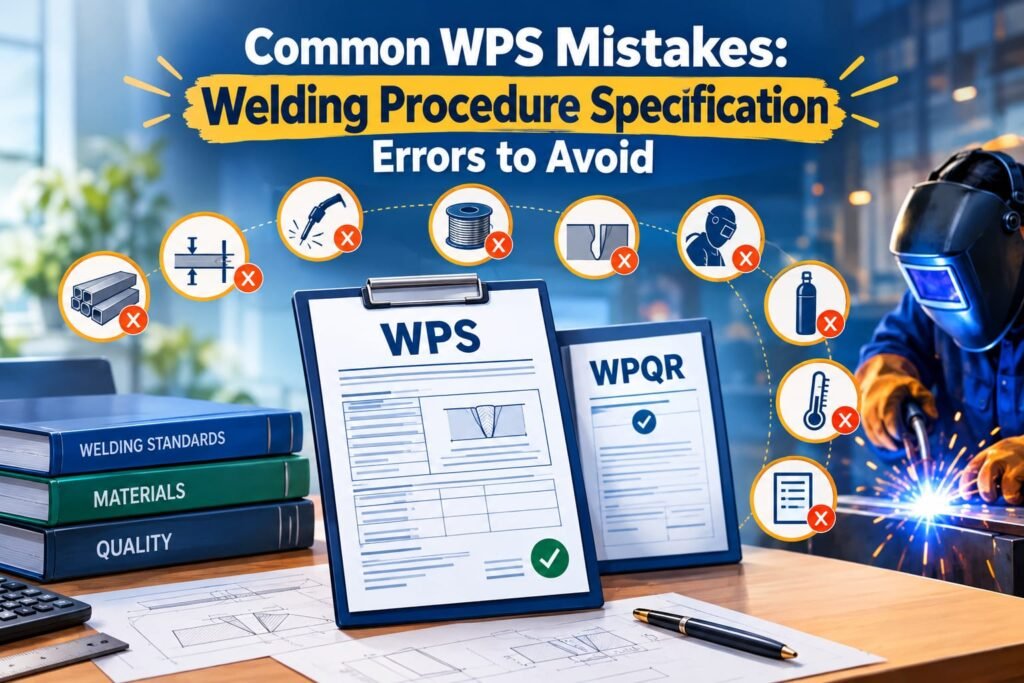
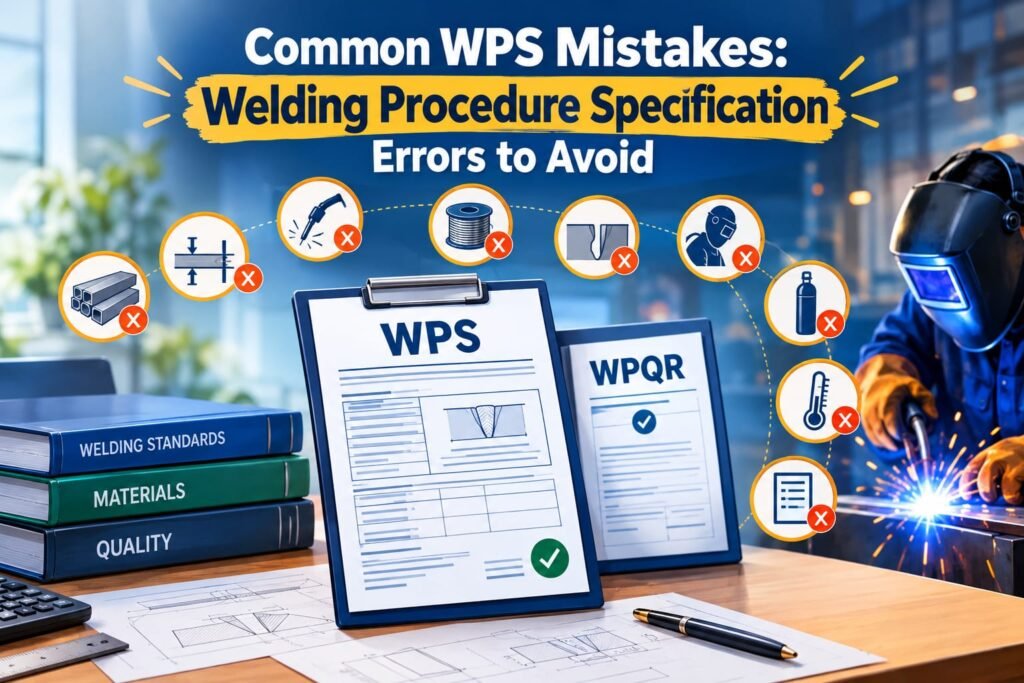
A Welding Procedure Specification (WPS) is a controlled technical document that defines the welding variables and conditions to be followed during production welding. A properly prepared WPS should be supported by an applicable Welding Procedure Qualification Record (WPQR) and comply with the relevant welding standard. Errors in WPS preparation can create inconsistencies between the qualified welding procedure and production welding. Common mistakes involve material identification, welding parameters, consumables, joint configuration, qualification ranges, and document control.
This article explains the most common WPS mistakes and the technical checks required before using a WPS for production welding.
Incorrect Parent Material or Material Group:
The material specified on the WPS should correspond with the applicable material standard, grade, and qualification recorded in the supporting WPQR.
Key Technical Checks:
1.Material grade
2.Material specification
3.Material group
4.Thickness range
5.Product form
6.Material certificate
An incorrect material group can result in a WPS being outside the qualification range of the supporting WPQR.
Incorrect Material Thickness Range:
The material thickness range stated on the WPS must be supported by the applicable WPQR.A common mistake is entering a production thickness range without checking whether the qualified test coupon supports that range.
Key Technical Checks:
1.Confirm the actual thickness of the production component.
2.Check the thickness of the test coupon recorded in the WPQR.
3.Verify the permitted thickness range under the applicable qualification standard.
4.Confirm that the WPS covers the intended production thickness.
The permitted range depends on the applicable welding qualification standard and the relevant qualification conditions. Do not assume that a single test coupon automatically qualifies every thickness.
Incorrect Welding Process Number:
Welding processes are identified by standardized process numbers. The process specified in the WPS should match the process qualified by the supporting WPQR.
Common Welding Process Numbers:
111 – Manual Metal Arc Welding (MMA)
135 – MAG welding with solid wire
136 – MAG welding with flux-cored wire
141 – TIG welding
121 – Submerged Arc Welding (SAW)
Key Technical Checks:
1.Verify the welding process number on the WPS.
2.Compare it with the process recorded in the WPQR.
3.Confirm that the process is suitable for the intended production operation.
4.Check whether the qualification permits the proposed combination of welding processes.
5.Using the wrong process number can create a direct inconsistency between the WPS and WPQR.
Incorrect Welding Consumable Classification:
The welding consumable specified on the WPS should be compatible with the qualified consumable and applicable requirements recorded in the WPQR.
Incorrect consumable selection can affect weld metal properties, mechanical performance, and compliance with the qualified procedure.
Key Technical Checks:
1.Consumable classification
2.Trade designation, where applicable
3.Electrode or wire diameter
4.Manufacturer requirements, where specified
5.Consumable group, where applicable
6.Welding position capability
The consumable classification and applicable qualification requirements should be verified before finalizing the WPS.
Incorrect Joint Design:
The joint configuration specified in the WPS should be suitable for the production joint and consistent with the qualification limits established by the applicable WPQR.
Differences in joint preparation can affect weld quality, penetration, and the applicability of the qualified procedure.
Important Joint Details to Verify:
1.Joint type
2.Groove angle
3.Root gap
4.Root face
5.Bevel angle
6.Fillet weld size
7.Backing
8.Back-gouging
9.Single-sided or double-sided welding
Technical Verification:
Compare the proposed production joint with the joint configuration and qualification conditions recorded in the WPQR. Confirm that the WPS adequately defines the joint preparation and welding sequence.
A difference between the WPS joint design and the qualification test coupon should be evaluated against the applicable qualification standard before production welding begins.
Incorrect Welding Position:
Welding position is an important variable to verify when reviewing a qualified welding procedure. The WPS should specify the applicable position using the relevant designation.
Common Welding Position Designations:
PA – Flat position
PB – Horizontal-vertical fillet position
PC – Horizontal position
PD – Overhead fillet position
PE – Overhead position
PF – Vertical-up position
PG – Vertical-down position
Key Technical Checks:
1.Verify the welding position required for production.
2.Check the test position recorded in the WPQR.
3.Confirm the qualified position range under the applicable standard.
4.Verify that the WPS covers the intended welding operation.
The production welding position must remain within the qualification range established by the applicable WPQR.
Incorrect Preheat and Inter pass Temperature:
Incorrect preheat temperature and inter pass temperature values are common issues in WPS documentation. Preheat and interpass temperature controls help maintain suitable welding conditions and can influence the risk of cracking and other weld defects.
Key Technical Checks:
1.Minimum preheat temperature
2.Maximum interpass temperature, where applicable
3.Measurement location
4.Measurement method, where required
5.Applicable material and project requirements
Incorrect Welding Current, Voltage, or Travel Speed:
Welding parameters such as current, voltage, and travel speed directly influence welding conditions and can affect heat input and weld quality. A common mistake is copying generic parameter values into the WPS without checking the qualified procedure and production requirements.
Key Technical Checks:
1.Welding current range
2.Arc voltage range
3.Travel speed range, where specified
4.Wire feed speed, where applicable
5.Polarity
6.Heat input, where relevant
7.Welding technique and progression
Incorrect Shielding Gas Information:
For gas-shielded welding processes, the WPS should correctly identify the shielding gas and define the applicable operating conditions. Incorrect shielding gas information can affect arc stability, weld metal properties, and weld quality.
Key Technical Checks:
1.Gas type
2.Gas composition
3.Gas flow rate
4.Gas purity, where applicable
5.Applicable gas classification
6.Requirements for gas mixtures, where relevant
WPS and WPQR Mismatch:
One of the most important WPS errors is a mismatch between the WPS and its supporting WPQR. The WPQR records the welding procedure test conditions and results, while the WPS specifies the conditions permitted for production welding.
WPS vs. WPQR: Comparison Checklist
Check the following details:
1.Parent material
2.Material group
3.Material thickness
4.Welding process
5.Consumable classification
6.Joint type
7.Welding position
8.Preheat temperature
9.Interpass temperature
10.Shielding gas
11.Heat input, where relevant
12.Welding technique
Poor Document Control:
A WPS must be prepared within the limits established by the applicable WPQR and welding qualification standard.
Incorrect qualification ranges can result in a procedure being used for production work that is not covered by the qualification.
Common Qualification Range Errors:
Excessive material thickness range
Incorrect pipe diameter range
Incorrect material group
Unqualified welding position
Unqualified welding process
Incorrect consumable range
Key Technical Checks:
1.Confirm the applicable qualification standard and its edition.
2.Review the essential variables and other relevant qualification conditions.
3.Verify the permitted material thickness and diameter ranges, where applicable.
4.Check the qualification coverage for welding process, material, consumables, and position.
5.Confirm that the intended production application falls within the qualified range.
The qualification range should always be verified against the actual WPQR and applicable welding qualification standard. Do not extend the range based on assumptions or generic values.
Technical accuracy alone is not sufficient. Proper document control is also essential for ensuring that the correct WPS is available at the production location. Using an obsolete, unapproved, or incorrectly referenced WPS can create inconsistencies in production welding.
Key Document Control Requirements:
1.Document number
2.Revision number
3.Issue date
4.Approval status
5.Supporting WPQR reference
6.Prepared-by information
7.Reviewed-by information
8.Approved-by information
Technical Verification:
Before releasing a WPS for production:
Confirm that the document is approved for use.
Verify that the revision is current.
Check that the supporting WPQR reference is correct.
Ensure that superseded revisions are controlled.
Make the approved WPS available to the relevant welding personnel.
Effective document control helps maintain consistency, traceability, and compliance throughout production welding.
How to Check a WPS Before Production?
A systematic technical review helps identify inconsistencies before production welding begins.
Step-by-Step WPS Verification Checklist:
1.Applicable Standard: Confirm the relevant welding qualification standard and project requirements.
2.WPQR: Verify the supporting qualification record and its validity for the intended application.
3.Material: Check the material grade, specification, and group.
4.Joint Design: Verify the joint preparation and configuration.
5.Welding Process: Confirm the process number and qualified process combination.
6.Consumable: Check the consumable classification and applicable requirements.
7.Welding Position: Verify that the production position is covered.
8.Welding Parameters: Review current, voltage, travel speed, and other relevant variables.
9.Preheat and Interpass: Confirm the required temperature limits and controls.
10.Shielding Gas: Verify the gas specification and operating conditions, where applicable.
11.Qualification Range: Ensure that the production application is covered by the WPQR.
12.Document Control: Confirm approval status, revision, and document traceability.
Final WPS Release Check:
Before using the WPS, confirm that:
The WPS is approved and current.
The supporting WPQR is available and applicable.
The production welding conditions are covered by the qualification.
The specified welding variables are clearly defined.
Applicable project, inspection, and quality requirements are addressed.
This systematic review helps reduce errors and supports consistent welding quality.
Frequently Asked Questions
What is a Welding Procedure Specification (WPS)?
A Welding Procedure Specification (WPS) is a controlled technical document that defines the welding variables and conditions required to produce a weld. It typically includes the welding process, parent material, consumables, joint design, welding position, parameters, and preheat requirements.
What are the most common WPS mistakes?
Common WPS mistakes include incorrect parent material identification, incorrect thickness ranges, wrong welding process numbers, incorrect consumable classifications, unsuitable joint configurations, incorrect welding parameters, and mismatches between the WPS and supporting WPQR.
What is the difference between WPS and WPQR?
A WPS specifies the welding conditions to be followed during production welding. A Welding Procedure Qualification Record (WPQR) records the welding procedure test details, test results, and qualification information used to establish the qualified procedure’s applicability.
Why must a WPS be checked against the WPQR?
Checking the WPS against the WPQR helps confirm that the proposed production welding conditions fall within the qualified range. This review helps identify discrepancies in materials, thickness, welding processes, consumables, positions, and other relevant variables before production begins.
Can a WPS be used for any material thickness?
No. The permitted material thickness range depends on the supporting qualification, the applicable welding qualification standard, and the relevant test conditions. The production thickness must fall within the range permitted by the applicable qualification requirements.
What welding parameters should be checked in a WPS?
Important parameters include welding current, arc voltage, travel speed, wire feed speed where applicable, polarity, heat input where relevant, and welding technique. The applicable parameters and permitted ranges should be clearly specified and technically consistent with the qualified procedure.
Why are preheat and interpass temperatures important in a WPS?
Preheat and interpass temperatures help control welding conditions and can influence cooling rate, hardness, and the risk of hydrogen cracking. The WPS should specify the required minimum preheat and applicable maximum interpass temperatures based on the qualified procedure and relevant technical requirements.
Conclusion:
A Welding Procedure Specification is an important production welding document and should accurately reflect the qualified welding procedure. Common WPS mistakes include incorrect material groups, thickness ranges, welding process numbers, consumable classifications, joint configurations, welding positions, welding parameters, and qualification ranges.
The most important technical check is to ensure that the WPS remains within the qualification range of its supporting WPQR and complies with the applicable welding standard.
Proper control of welding variables, technical review, traceability, and document revision status are essential elements of a technically consistent WPS. By following a structured WPS verification checklist, welding engineers, quality engineers, inspectors, and production teams can identify discrepancies before production welding begins.